
SS-31 Peptide Research: What Scientists Are Discovering About This Mitochondria-Targeting Compound
·

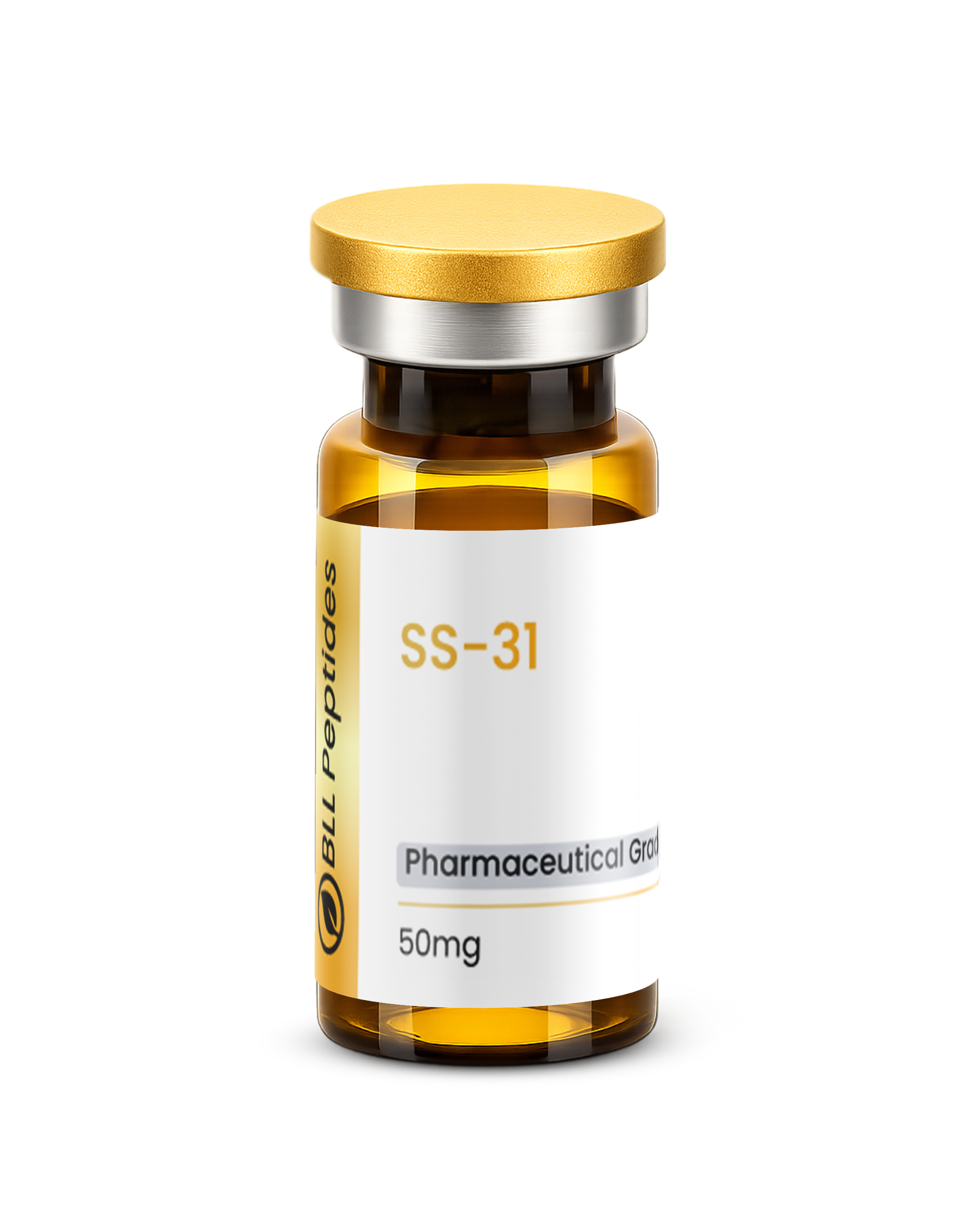
Early in my neurosurgery career, I became obsessed with a question that textbooks couldn’t fully answer: why do some patients with similar injuries recover so differently at the cellular level? The deeper I dug, the more I found myself reading about mitochondrial dysfunction — not as a side effect, but as a central player in cellular decline. That’s what put SS-31 peptide research on my radar, and I haven’t stopped following it since.
What Is SS-31 Peptide? A Direct Answer for Researchers
SS-31 (also known as Elamipretide or MTP-131) is a synthetic tetrapeptide currently under scientific investigation for its targeted interaction with cardiolipin — a phospholipid that lines the inner mitochondrial membrane and plays a critical role in energy production. The compound’s sequence, D-Arg-2′,6′-Dmt-Lys-Phe-NH₂, allows it to concentrate specifically at the inner mitochondrial membrane, unlike most antioxidants that distribute broadly throughout the cell.
Researchers are studying SS-31 for its potential to reduce oxidative stress, protect mitochondrial architecture, and restore cellular bioenergetics in models of age-related decline, cardiac dysfunction, acute kidney injury, and neurological conditions. It is strictly a research compound at this stage.
What Is Cardiolipin — and Why Does It Matter?
To understand why SS-31 peptide research is generating so much attention, you need to understand cardiolipin. This unique phospholipid is almost exclusively found in the inner mitochondrial membrane, where it anchors the protein complexes of the electron transport chain (ETC) — the machinery responsible for generating ATP, the cell’s primary energy currency.
When cardiolipin becomes oxidized — which happens with aging, injury, or metabolic stress — the ETC loses efficiency. Reactive oxygen species (ROS) accumulate, ATP output drops, and the mitochondria may trigger cell death signals. This cascade is implicated in everything from cardiac failure to neurodegenerative disease. SS-31 peptide research is built on the hypothesis that protecting cardiolipin could interrupt this destructive chain of events at its source.
How Does SS-31 Work? The Mechanism Researchers Are Studying
In preclinical studies, SS-31 has demonstrated two primary actions. First, it binds directly to cardiolipin, stabilizing the lipid and preventing peroxidation. Second, this binding appears to preserve the structural integrity of cristae — the internal folds of the inner mitochondrial membrane where the ETC complexes reside.
From a neurosurgical perspective, what’s particularly compelling is the neuroprotective research. Animal models of traumatic brain injury and ischemia-reperfusion injury have shown that SS-31 treatment was associated with reduced mitochondrial swelling and improved neuronal survival. These findings haven’t yet been translated to clinical human applications, but they’re driving serious scientific investigation.
What sets SS-31 apart in the mitochondria-targeting space is that it works structurally, not just chemically — protecting the architecture of energy production itself rather than simply scavenging free radicals after the fact.
SS-31 Peptide Research: What Studies Are Finding
The peer-reviewed literature on SS-31 has been expanding steadily. Here are some of the most notable findings:
- Cardiac Research: In a study published in JACC: Heart Failure, the EMBRACE-HF Phase II trial examined Elamipretide (SS-31) in patients with heart failure with preserved ejection fraction. Participants showed improvements in the six-minute walk distance versus placebo — a functional marker of systemic energy capacity. Read on PubMed →
- Oxidative Stress Reduction: Preclinical studies have reported up to a 40% reduction in mitochondrial ROS in cardiac cells under oxidative stress conditions following SS-31 treatment, with preserved ATP output in the same models.
- Structural Recovery: Research in aged animal models documented measurable improvements in mitochondrial cristae structure following SS-31 treatment — suggesting the compound may help reverse architectural deterioration, not just slow it.
- Renal Protection: Multiple studies in acute kidney injury models have found SS-31 treatment associated with reduced tubular cell apoptosis and better preserved renal function markers, areas where mitochondrial dysfunction plays an early and prominent role.
- Skeletal Muscle Aging: In aged mice, SS-31 was associated with improvements in muscle mitochondrial respiration and grip strength measures — findings with implications for sarcopenia research.
Across multiple tissue types and disease models, the common thread in SS-31 research is consistent: protecting the mitochondrial membrane appears to have downstream effects that extend well beyond the mitochondria themselves.
SS-31, Mitochondrial Health, and Complementary Research Pathways
As a researcher, I find it useful to situate SS-31 within the broader landscape of mitochondrial health research. One of the most studied related pathways involves NAD⁺, the coenzyme that fuels the electron transport chain and supports DNA repair. Researchers studying cellular energy often look at both mitochondria-targeting peptides like SS-31 and precursors like NAD+ (available for research purposes here) — not because they’re the same, but because they operate on overlapping bioenergetic systems.
Separately, there’s growing scientific curiosity about whether mitochondria-targeting compounds might interact with tissue repair peptide pathways. Compounds like BPC-157 (research compound) are being studied for their effects on vascular and cellular repair mechanisms — some of which intersect with mitochondrial stress signaling. These aren’t the same compound or mechanism, but the research questions increasingly overlap.
For researchers building out a peptide research library, BLL Peptides also carries TB-500 (research grade), which is being studied in parallel for cellular regeneration and cytoskeletal dynamics.
Frequently Asked Questions About SS-31 Peptide Research
What does SS-31 stand for?
SS-31 stands for Szeto-Schiller peptide 31, named after the researchers who developed the series of mitochondria-targeted peptides. It is also referred to as Elamipretide in clinical trial contexts and MTP-131 in some research literature.
What tissue types have been studied with SS-31?
Preclinical and early clinical SS-31 research has been conducted across cardiac tissue, renal tissue, skeletal muscle, neurons, and retinal cells. The common thread is mitochondrial dysfunction, which appears across all of these tissue types in disease and aging models.
How does SS-31 differ from conventional antioxidants?
Unlike vitamin C, vitamin E, or glutathione — which distribute broadly throughout the cell — SS-31 is specifically designed to concentrate at the inner mitochondrial membrane. Its mechanism involves direct interaction with cardiolipin, making it a structural protector of mitochondrial architecture rather than a generalized free radical scavenger.
Is SS-31 approved for human use?
As of current research timelines, Elamipretide (SS-31) has completed Phase II clinical trials but has not received FDA approval for any clinical indication. It remains an active area of pharmaceutical and preclinical research. All BLL Peptides SS-31 products are intended strictly for research purposes.
What makes SS-31 relevant to aging research?
Mitochondrial dysfunction is considered one of the hallmarks of cellular aging. As mitochondria lose efficiency with age — partly due to cardiolipin oxidation — cells produce less ATP, generate more ROS, and become more vulnerable to apoptotic signals. SS-31’s targeted action on cardiolipin places it directly in the scientific conversation about whether mitochondrial rescue strategies could slow aspects of cellular aging.
About the Author: Dr. James is a board-certified neurosurgeon and member of the BLL Peptides scientific advisory team. His clinical background in neurological trauma and recovery has led to a deep interest in cellular bioenergetics, mitochondrial health, and the emerging science of peptide-based research compounds. He writes about peptide science from a research-first perspective, with the aim of making complex findings accessible to the research community.
This content is intended for research purposes only. BLL Peptides products are not intended for human consumption.