
NAD+ Research: What a Neurosurgeon Found in the Cellular Energy and Brain Aging Literature
·

Halfway through a twelve-hour craniotomy a few years back, I found myself thinking about something that had nothing to do with the surgical field in front of me. I was thinking about what, exactly, was keeping this patient’s brain alive. Not the anesthesia, not the monitors — the underlying cellular machinery. The mitochondria cycling through ATP, the enzymes repairing DNA nicks in real time, the neurons holding their electrochemical gradients against everything we were throwing at them. That question has never fully left me. And it’s exactly why I’ve spent the last two years deep in NAD+ research.
What Is NAD+ Research Actually Studying?
NAD+ (nicotinamide adenine dinucleotide) is a coenzyme found in every living cell, and NAD+ research focuses on its essential roles in energy metabolism, DNA repair, and cellular signaling. It functions as an electron carrier in the mitochondrial electron transport chain and serves as a substrate for key enzymes — including sirtuins and PARPs — that regulate gene expression and genomic integrity. NAD+ levels decline significantly with age, and the research exploring what that decline means for neurological function is, frankly, remarkable.
For anyone outside medicine wondering why a neurosurgeon cares about a coenzyme: the brain is the most metabolically demanding organ in the body. At roughly 2% of body weight, it consumes approximately 20% of our total energy budget. Every watt of that energy flows through processes that are deeply dependent on NAD+. When I encounter research suggesting those processes are compromised by age-related NAD+ depletion, it commands my attention.
What Is NAD+ and Why Does It Matter for the Brain?
NAD+ exists in two interconvertible forms: the oxidized form (NAD+) and the reduced form (NADH). The ratio between them reflects the metabolic state of the cell. When NAD+ availability falls, mitochondrial efficiency falls with it. For neurons — cells that cannot easily replicate or be replaced — that efficiency loss may carry real consequences over decades.
Beyond energy production, NAD+ is the sole substrate for sirtuins (SIRT1–SIRT7), a family of deacetylases involved in epigenetic regulation, stress response, and neuronal survival. It also fuels PARP-1, the primary enzyme responsible for DNA strand-break repair. Given that neurons accumulate DNA damage over a lifetime of oxidative stress, the importance of PARP activity — and thus NAD+ availability — in neuronal maintenance is difficult to overstate.
The NAD+ biosynthesis pathway has several entry points. The rate-limiting step in the salvage pathway — the dominant route in most mammalian cells — is catalyzed by the enzyme NAMPT (nicotinamide phosphoribosyltransferase). NAMPT expression and activity both decline with age. So does NAD+ itself.
NAD+ Research: What the Peer-Reviewed Literature Actually Shows
I want to be precise here, because the popular press has a tendency to flatten complex science into breathless headlines. Here is what the peer-reviewed literature on NAD+ research actually demonstrates:
A landmark study published in Cell (Gomes et al., 2013) found that declining NAD+ levels disrupted the communication between the nucleus and mitochondria, accelerating age-related metabolic dysfunction in mice. Restoring NAD+ levels partially reversed these changes. A 2020 study in NPJ Aging and Mechanisms of Disease found that NAD+ precursor treatment improved cognitive performance and reduced neuroinflammation markers in aged mice. A separate line of research studying Wallerian degeneration — the process by which axons die following nerve injury — found that NAD+ biosynthesis is directly implicated in axonal survival signaling. You can explore a detailed mechanistic overview of NAD+ and neuronal aging via this PubMed reference.
Two statistics that stopped me mid-read:
- NAD+ levels in human tissue decline by approximately 50% between ages 40 and 60, based on metabolomic studies of blood and tissue samples.
- SIRT1, a primary NAD+-dependent sirtuin, has demonstrated reductions in amyloid-beta accumulation of up to 40% in certain preclinical Alzheimer’s models.
Key Findings in NAD+ Research: What Keeps Me Reading
After hundreds of hours in the NAD+ literature, several themes emerge consistently enough to be worth highlighting:
NAD+ depletion appears to accelerate neuroinflammation. Microglia — the brain’s resident immune cells — are highly metabolically active. When NAD+ is limited, microglial activity becomes dysregulated, potentially contributing to the chronic low-grade neuroinflammation associated with aging and neurodegenerative conditions. This is an area of active preclinical research.
The sirtuin connection to neuronal epigenetics is profound. SIRT1 and SIRT3 regulate the expression of hundreds of genes involved in stress response, mitochondrial biogenesis, and synaptic plasticity. Their activity is entirely NAD+-dependent — meaning NAD+ availability doesn’t just affect energy production, it shapes gene expression in living neurons.
PARP-1 hyperactivation during oxidative stress can paradoxically deplete NAD+. In ischemic brain injury, the burst of DNA damage that follows oxygen deprivation triggers massive PARP-1 activity, consuming NAD+ faster than it can be replenished. This “NAD+ crisis” is thought to contribute to cell death in penumbral tissue — the zone surrounding a stroke core where neurons remain salvageable with timely intervention. As a neurosurgeon, that detail hits differently.
There’s also growing interest in the relationship between NAD+ pathways and other cellular longevity mechanisms. Researchers studying compounds like BPC-157 have noted independent effects on mitochondrial resilience in preclinical models, suggesting that multiple research avenues may converge on similar cellular endpoints — though the mechanistic connections remain an open question.
NAD+ Research-Grade Access for Investigators
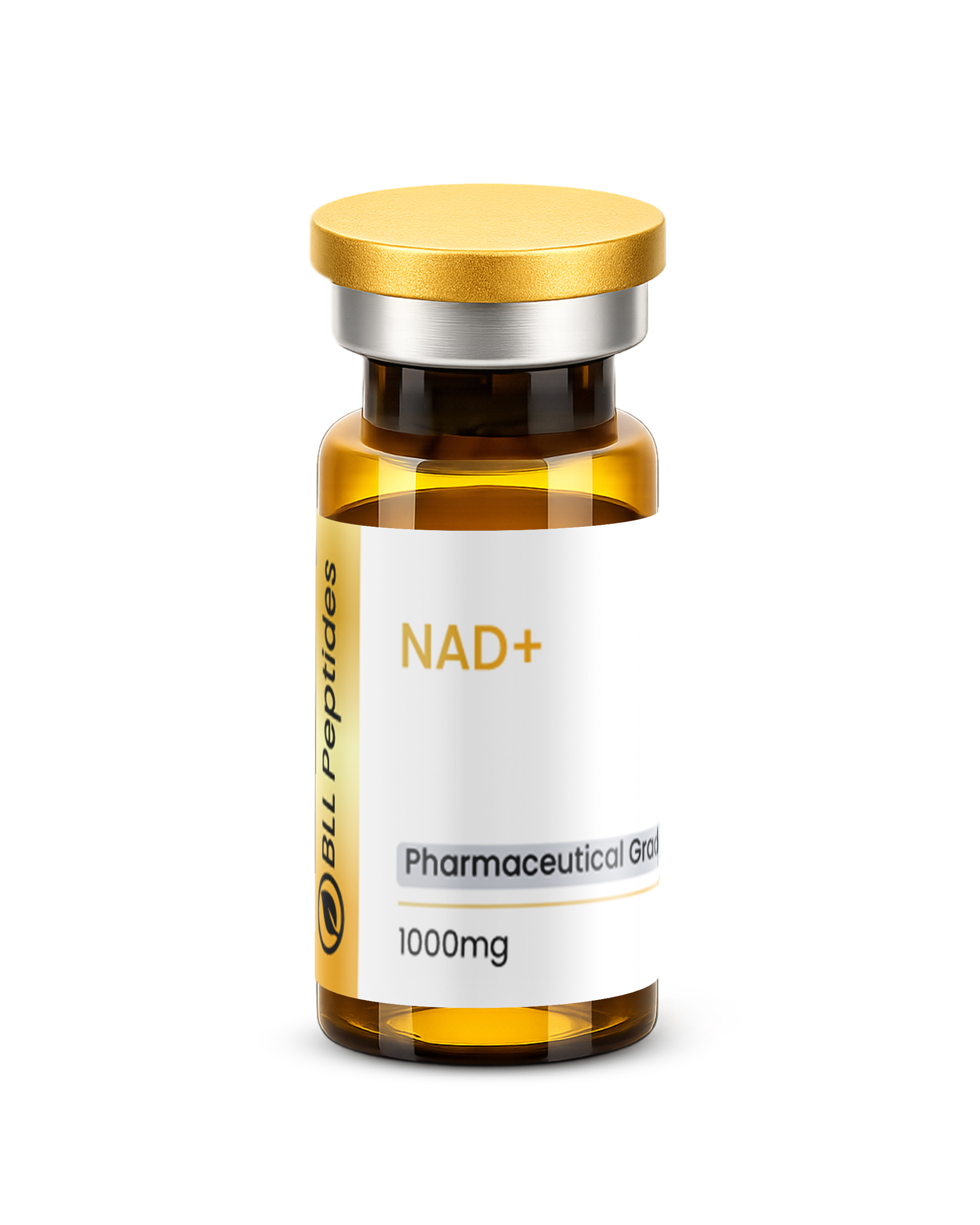
For researchers and institutions investigating NAD+ biology, access to high-purity, research-grade compounds is essential. BLL Peptides offers NAD+ (500mg/10ml) formulated to research-grade standards, intended strictly for laboratory and investigational use. Researchers exploring metabolic and cellular aging mechanisms may also be interested in the broader NAD+ research catalog alongside related longevity research compounds available through BLL Peptides.
Frequently Asked Questions About NAD+ Research
What is NAD+ used for in research?
NAD+ is studied for its roles in cellular energy metabolism (mitochondrial oxidative phosphorylation), DNA repair via PARP enzymes, sirtuin activation and epigenetic regulation, neuroinflammation modulation, and age-related metabolic decline. Preclinical research has explored NAD+ in models of neurodegeneration, metabolic disease, ischemia, and biological aging.
Does NAD+ decline with age?
Yes. Multiple studies using metabolomics in human blood and tissue samples have documented a significant decline in NAD+ levels beginning in middle age, with some studies estimating a 50% reduction between ages 40 and 60. This decline correlates with reduced NAMPT enzyme activity, the rate-limiting step in NAD+ biosynthesis.
What is the connection between NAD+ and sirtuins?
Sirtuins (SIRT1–SIRT7) are NAD+-dependent deacetylases that regulate gene expression, DNA repair, and cellular stress responses. They cannot function without NAD+ as a substrate. The age-related decline in NAD+ is therefore thought to directly impair sirtuin activity and the cellular maintenance processes they govern — including mitochondrial biogenesis and neuronal stress resistance.
What does NAD+ research show about neurodegeneration?
Preclinical research suggests that NAD+ depletion may contribute to neurodegeneration through several mechanisms: impaired mitochondrial function, reduced DNA repair capacity, dysregulated neuroinflammatory responses, and compromised axonal integrity. Animal studies have shown that restoring NAD+ levels can attenuate some of these processes, though robust human clinical evidence is still being developed.
Is NAD+ the same as NADH?
NAD+ and NADH are two forms of the same molecule. NAD+ is the oxidized form that accepts electrons during metabolic reactions; NADH is the reduced form that donates electrons to the mitochondrial electron transport chain to generate ATP. The NAD+/NADH ratio is a key indicator of cellular metabolic state and redox balance.
About the Author
Dr. James is a board-certified neurosurgeon and member of the BLL Peptides research advisory team. His clinical background in neurological surgery informs his deep interest in cellular repair mechanisms, neuroprotection, and the emerging science of metabolic aging. The views expressed in this blog reflect his personal research interests and do not constitute medical advice.
This content is intended for research purposes only. BLL Peptides products are not intended for human consumption.