NAD+ vs NMN: What Research Reveals About These Two Longevity Compounds
·

Research and educational content authored by Dr. James Nguyen, board-certified neurosurgeon and scientific advisor to BLL Peptides. For research and educational purposes only. Not for human or animal use.
As research into cellular aging and metabolic function has expanded, two compounds have attracted sustained scientific attention: NAD+ (nicotinamide adenine dinucleotide) and NMN (nicotinamide mononucleotide). Though often discussed together, they represent distinct approaches to cellular NAD+ biology — one as a direct cofactor, the other as an immediate precursor. This review examines what the current research literature reveals about each and how researchers have approached their comparison.
The NAD+ Biology Context
NAD+ is a coenzyme found in all living cells, essential for cellular energy metabolism. It serves as an electron carrier in redox reactions (converting between NAD+ and NADH), a substrate for sirtuins (NAD+-dependent deacylases involved in longevity signaling), a substrate for PARPs (poly-ADP-ribose polymerases involved in DNA repair), and a substrate for CD38 and other NAD-consuming enzymes.
Research has consistently documented that NAD+ levels decline with age — studies find NAD+ in human tissue can fall 40-60% between young adulthood and older age. This decline has been associated in research models with reduced mitochondrial function, impaired sirtuin activity, and decreased DNA repair capacity — prompting significant interest in strategies to restore cellular NAD+ levels.
NAD+ Direct Supplementation
NAD+ itself is a large molecule (molecular weight ~663 Da) with limited cell membrane permeability in its intact form. Research has examined several questions about direct NAD+ administration:
Bioavailability considerations: When NAD+ is administered intravenously or intraperitoneally in research models, tissue NAD+ levels show increases. The mechanism appears to involve extracellular degradation of NAD+ to its components (NMN, NR, nicotinamide), followed by cellular uptake of these smaller molecules and intracellular resynthesis. A specific cell-surface transporter (Slc12a8) for NMN has been identified, and some research suggests intact NAD+ may also have direct membrane transport pathways in certain tissues.
Intravenous research models: IV NAD+ administration has been studied for its effects on neurological function, addiction models, and aging-related parameters. The IV route bypasses bioavailability limitations of oral administration and achieves rapid plasma increases, making it valuable for dose-response and pharmacokinetic research.
NMN as a Precursor Approach
NMN (nicotinamide mononucleotide, molecular weight ~334 Da) is a direct precursor to NAD+ in the biosynthetic pathway. It is produced from nicotinamide riboside (NR) by NRK kinases, and from nicotinamide by the NAMPT enzyme (the rate-limiting step in the salvage pathway). NMN is then converted to NAD+ by NMNAT enzymes.
The precursor hypothesis: The rationale for NMN research is that boosting the immediate precursor to NAD+ may increase cellular NAD+ production more efficiently than supplementing NAD+ directly, particularly if the rate-limiting steps occur upstream of NMN. If NAMPT becomes the bottleneck with aging, bypassing it by supplying NMN directly could be more effective.
Oral bioavailability: NMN is smaller than NAD+ and has been shown to be absorbed intact in research models. Studies in mice demonstrated that orally administered NMN appears in blood within 2-3 minutes and in tissues including liver within 15 minutes — notably rapid absorption. A specific small intestinal transporter (Slc12a8) for NMN has been identified in mouse models.
Key research findings on NMN: Landmark studies by Yoshino et al. (2011) and subsequent work by Sinclair’s laboratory showed NMN administration increased tissue NAD+ levels and improved multiple markers of metabolic function in aged animals, including insulin sensitivity, energy metabolism, and physical activity levels.
Sirtuin Activation Research
Sirtuins (SIRT1-7 in mammals) are NAD+-dependent protein deacylases that regulate numerous cellular processes including gene expression, mitochondrial biogenesis, DNA repair, and metabolic homeostasis. Because sirtuins consume NAD+ as a substrate, their activity is directly linked to cellular NAD+ availability.
Research has shown that restoring NAD+ levels — whether through precursors like NMN or direct NAD+ administration — can reactivate sirtuin pathways that become blunted with age. Studies by Gomes et al. (2013) demonstrated that declining NAD+/SIRT1 activity with age allows HIF-1alpha to accumulate, disrupting nuclear-mitochondrial communication. NMN administration in these models restored NAD+ levels and reversed aspects of the mitochondrial dysfunction.
DNA Repair Research
PARP enzymes (particularly PARP1) are major NAD+ consumers activated in response to DNA damage. Their activation depletes local NAD+ pools, which can further impair cellular function if NAD+ synthesis cannot keep pace with consumption.
Research models examining radiation exposure, oxidative stress, and chemotherapy-induced DNA damage have found that maintaining NAD+ availability through precursors can help sustain cellular resilience during periods of high PARP activity. For NMN specifically, research has examined whether the precursor approach maintains adequate NAD+ for DNA repair enzymes under conditions of high demand — particularly in aged cells where basal NAD+ levels are already reduced.
Mitochondrial Function Research
Mitochondria require NAD+ for the TCA cycle and electron transport chain. Both SIRT3 (the major mitochondrial sirtuin) and electron transport chain complexes I and III depend on adequate mitochondrial NAD+ for optimal function.
Research in aged animal models has shown that declining mitochondrial NAD+ correlates with reduced ATP production, increased reactive oxygen species, and impaired mitochondrial morphology. Studies examining NMN’s effects have found improvements in mitochondrial respiration, ATP production, and markers of mitochondrial biogenesis (including PGC-1alpha activation) in aged tissue.
NAD+ vs. NMN: Research Comparison
For laboratory researchers, the key distinctions:
- Molecular weight: NAD+ ~663 Da vs. NMN ~334 Da
- Mechanism: NAD+ is the direct cofactor; NMN is the immediate precursor (converted to NAD+ via NMNAT enzymes)
- Oral bioavailability: NAD+ has limited intact absorption — degraded to components; NMN absorbs intact in research models via identified transporters
- IV research route: Well-established for NAD+; less commonly studied for NMN
- Research model preference: NAD+ IV for pharmacokinetic/controlled-dose studies; NMN for aging model studies, oral bioavailability research, and sustained NAD+ elevation investigations
Research Applications
- Direct NAD+ (injectable): For controlled-dose pharmacokinetic studies, IV delivery models, and research requiring precise plasma concentration control
- NMN: For studies examining the precursor pathway, NAMPT biology, oral bioavailability research, and aging models
- Comparison studies: Research directly comparing both in matched models helps resolve questions about relative efficiency of different NAD+ restoration strategies
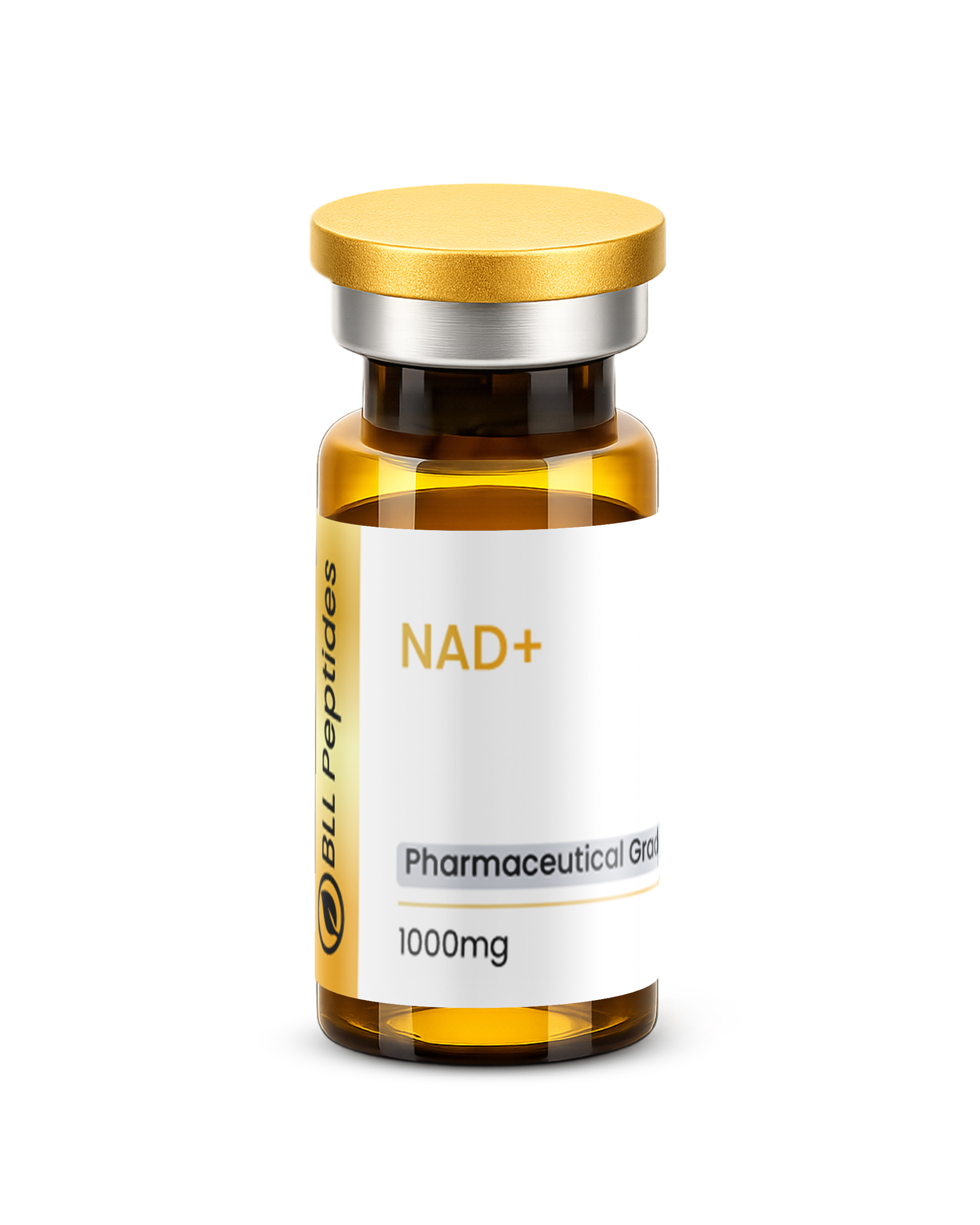
BLL Peptides supplies injectable NAD+ 500mg and NAD+ 1000mg for laboratory research use. All products are USA-manufactured to 98%+ purity, verified by HPLC and mass spectrometry, with Certificate of Analysis available.
Disclaimer: All BLL Peptides products are strictly for laboratory research and development. Not for human or animal use. Not FDA-evaluated. Not a drug, dietary supplement, or medical device. This content is authored by Dr. James Nguyen for research and educational purposes only.