

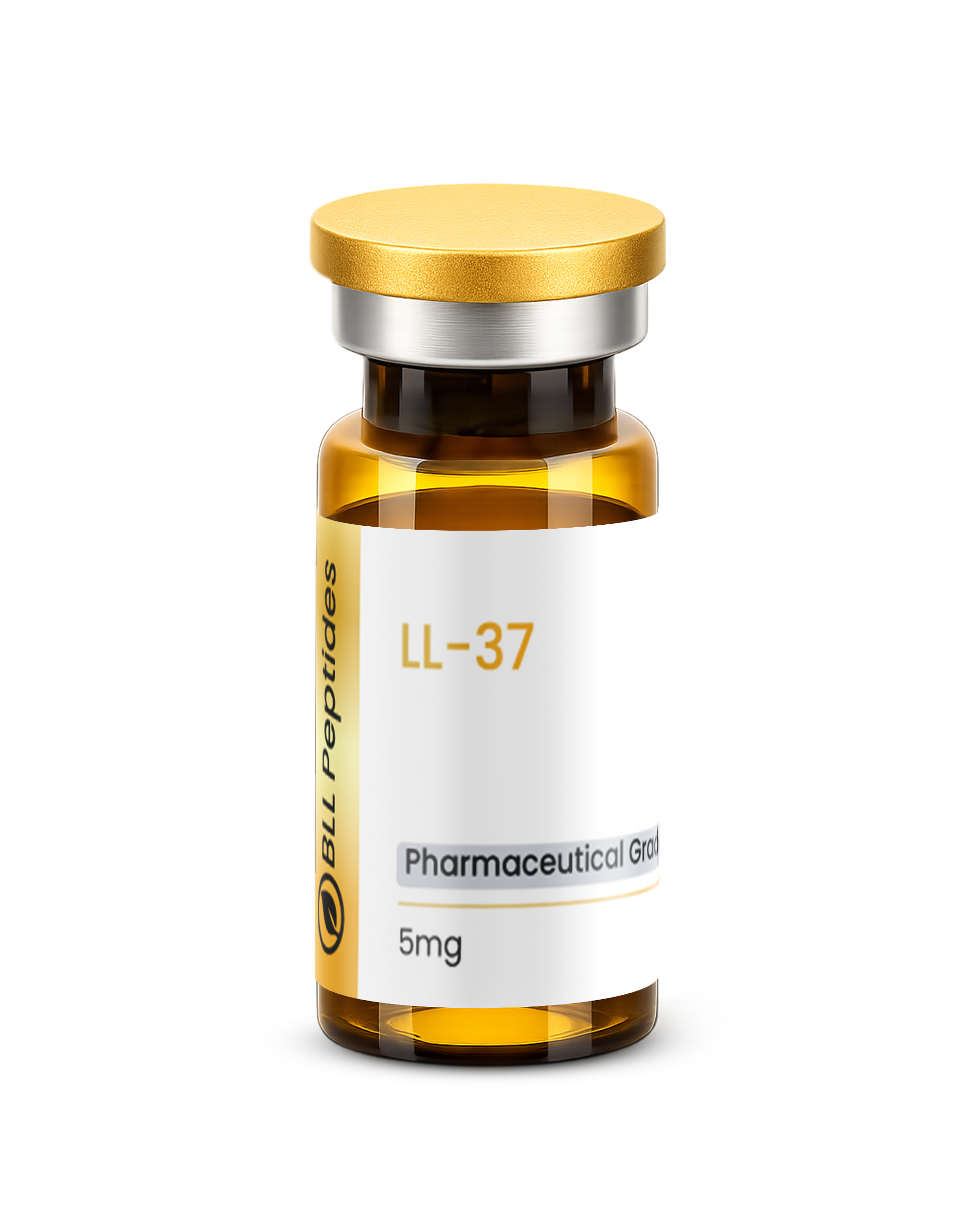
The next time you scrape your knee, something extraordinary happens in the first few seconds. Before the adaptive immune system even knows there’s an injury, your innate immune defenses are already deploying antimicrobial peptides — biological weapons that can kill bacteria, viruses, and fungi on contact, while simultaneously signaling to the tissue repair machinery to get started. LL-37 is one of those first responders, and the wound healing research around it reveals something remarkable: this peptide doesn’t just protect the wound from infection. It actively directs the repair process.
LL-37 is the only human cathelicidin — a 37-amino-acid amphipathic alpha-helical peptide derived from the precursor protein hCAP-18. It’s expressed primarily in neutrophils, epithelial cells, and macrophages, and is one of the body’s most versatile innate immune molecules. While its antimicrobial properties are well-documented (membrane disruption of bacterial cell walls through electrostatic interactions), the wound healing research on LL-37 has expanded significantly, revealing roles in angiogenesis, cell migration, re-epithelialization, and inflammatory modulation that make it a multifunctional repair peptide.
LL-37 and Wound Healing: The Repair Mechanism
Wound healing proceeds through four overlapping phases: hemostasis, inflammation, proliferation, and remodeling. LL-37 has been found to be active across multiple phases — which is unusual for an innate immune peptide and explains why the wound healing research community has paid close attention.
In the inflammatory phase, LL-37 modulates rather than simply amplifies inflammation. It can both recruit and regulate immune cell activity — attracting neutrophils and monocytes to the wound site while simultaneously limiting the duration of the inflammatory response through effects on toll-like receptor (TLR) signaling. This dual role (pro-inflammatory recruitment and anti-inflammatory modulation) helps explain why LL-37 levels at wound sites can actually determine whether healing proceeds normally or becomes chronic.
Research has found that chronic wounds — diabetic foot ulcers, venous leg ulcers, pressure injuries — consistently show markedly reduced LL-37 levels compared to acute healing wounds, suggesting that LL-37 deficiency is not just a correlate of impaired healing but a potential driver of it.
In the proliferative phase, LL-37 stimulates keratinocyte migration — the process by which skin cells at the wound edges move across the wound bed to close the defect. It activates EGFR (epidermal growth factor receptor) signaling in keratinocytes, a pathway critical for re-epithelialization. Research has also documented LL-37’s stimulation of angiogenesis (new blood vessel formation) through effects on endothelial cells — providing the vascular supply that healing tissue requires.
Key Research Findings on LL-37 and Tissue Repair
A study examining LL-37 in diabetic wound models — one of the most clinically relevant research contexts given the prevalence of impaired wound healing in diabetes — found that topical LL-37 significantly accelerated wound closure rates and improved re-epithelialization compared to controls. The researchers attributed this to LL-37’s dual actions on keratinocyte migration and angiogenesis (PMID: 14769878).
The antimicrobial-healing duality has significant clinical research relevance. Chronic wounds are invariably colonized by biofilm-forming bacteria, and conventional antibiotics struggle with biofilm infections. LL-37 has demonstrated activity against biofilm formation by multiple pathogens including Staphylococcus aureus, Pseudomonas aeruginosa, and Candida species — while simultaneously promoting the tissue repair processes that antibiotics alone cannot address.
LL-37’s ability to simultaneously address infection, inflammation dysregulation, and impaired cell migration makes it a uniquely multifunctional subject in chronic wound research — operating on the three major pathological drivers of wound healing failure at once.
The immunomodulatory dimension of LL-37 research extends beyond wound sites. LL-37 has been studied in models of autoimmune disease, where its ability to modulate TLR signaling and influence neutrophil extracellular trap (NET) formation places it in the broader context of innate immune regulation research. The psoriasis field has particular interest because LL-37 appears to play a role in the initial innate immune activation that drives psoriatic inflammation.
For tissue repair and innate immunity researchers, BLL Peptides carries LL-37 for laboratory research. Complementary wound healing research subjects include BPC-157 (with its VEGF and nitric oxide wound healing mechanisms) and TB-500 (for actin-mediated cell migration in wound closure).
Frequently Asked Questions About LL-37 and Wound Healing Research
- What is LL-37 and how is it different from other antimicrobial peptides?
- LL-37 is the only human cathelicidin — a 37-amino-acid peptide with both antimicrobial and immunomodulatory functions. Unlike simple antimicrobial peptides, LL-37 also promotes wound healing through keratinocyte migration, angiogenesis, and TLR signaling modulation.
- Why are LL-37 levels lower in chronic wounds?
- Research consistently finds reduced LL-37 in chronic wound environments (diabetic ulcers, venous ulcers). This may reflect proteolytic degradation by wound bacteria, altered neutrophil function in chronic disease states, or impaired epithelial production — and may contribute to healing failure.
- How does LL-37 promote re-epithelialization?
- LL-37 activates EGFR (epidermal growth factor receptor) signaling in keratinocytes, stimulating their migration from wound edges across the wound bed — the fundamental cellular process of wound closure. It also stimulates angiogenesis to provide vascular support for healing tissue.
- What biofilm research has been done with LL-37?
- LL-37 has demonstrated activity against biofilms formed by Staphylococcus aureus, Pseudomonas aeruginosa, and Candida species — making it of research interest for the biofilm-infected chronic wounds where conventional antibiotics show limited efficacy.
Dr. James Nguyen is a neurosurgeon and research advisor at BLL Peptides. His work focuses on peptide research, neurological recovery, and longevity science. All content is for educational and research purposes only.
This content is intended for research purposes only. BLL Peptides products are not intended for human consumption.