

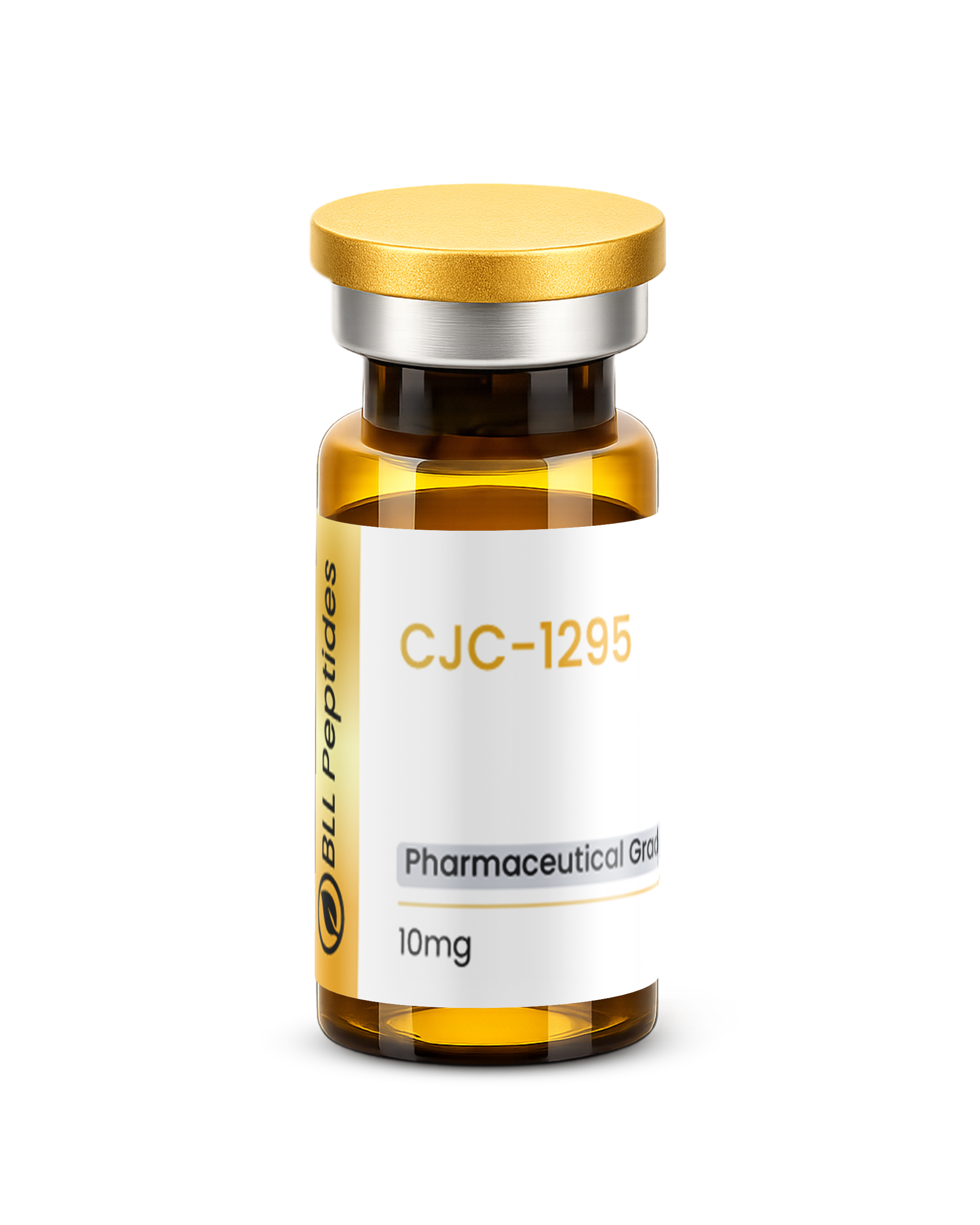
As a neurosurgeon trained at Yale, I’ve followed the research on growth hormone releasing hormone (GHRH) analogs closely — not just for their implications in metabolic medicine, but for what they reveal about how the brain and endocrine system communicate. CJC-1295 is one of the most extensively studied synthetic GHRH analogs in preclinical and early clinical literature, and the mechanisms underlying its extended activity make it a particularly interesting subject for researchers studying neuroendocrine signaling.
What Is CJC-1295?
CJC-1295 is a synthetic analog of growth hormone releasing hormone (GHRH), a 44-amino-acid peptide naturally produced in the hypothalamus. GHRH plays a central role in stimulating the pituitary gland to release growth hormone (GH) in a pulsatile pattern. In its native form, GHRH has a very short half-life in circulation — typically just a few minutes — due to rapid enzymatic degradation. CJC-1295 was engineered to address this limitation.
The peptide incorporates a drug affinity complex (DAC) technology that allows it to covalently bind to serum albumin — a major plasma protein — after administration. This binding dramatically extends the peptide’s half-life, with research suggesting it may remain active in circulation for several days. This property distinguishes CJC-1295 from shorter-acting GHRH analogs and has made it a useful tool in research settings where sustained GH axis stimulation is under study.
Mechanisms: How CJC-1295 Interacts With the GH Axis
The primary mechanism of CJC-1295 involves binding to the GHRH receptor (GHRHR) on somatotroph cells in the anterior pituitary gland. Activation of this receptor triggers a downstream signaling cascade — involving cyclic AMP (cAMP) and protein kinase A (PKA) — that stimulates both the synthesis and pulsatile secretion of growth hormone.
What makes CJC-1295 particularly notable in research models is that it appears to amplify the existing pulsatile rhythm of GH release rather than inducing a sustained, flat elevation. Studies in animal models have shown that it increases GH pulse amplitude while preserving the pulsatile architecture of secretion. This is relevant because natural GH release is rhythmic, and research has suggested that preserving this pattern may be important for downstream signaling through insulin-like growth factor 1 (IGF-1) and other anabolic mediators.
Elevated GH pulses stimulate the liver to produce IGF-1, which serves as a primary mediator of many of growth hormone’s downstream effects — including those on protein synthesis, fat metabolism, and connective tissue biology.
Research Overview: Key Studies and Findings
The most cited human clinical data on CJC-1295 comes from a phase II trial published in the Journal of Clinical Endocrinology & Metabolism (2006). In this study, healthy adult subjects received escalating doses of CJC-1295, and researchers observed sustained, dose-dependent increases in both GH and IGF-1 levels. Notably, GH levels remained elevated for several days following a single administration, and IGF-1 levels were elevated for up to two weeks in some subjects. The compound was generally well-tolerated in the study population.
Preclinical research has explored CJC-1295’s effects in animal models of aging, metabolic dysfunction, and muscle wasting. Several rodent studies have documented changes in body composition — specifically reductions in fat mass and preservation of lean tissue — in subjects with age-related GH decline. These findings have drawn interest from researchers studying sarcopenia and metabolic aging.
There is also ongoing interest in the neuroendocrine implications of GHRH analog research. The hypothalamic-pituitary axis is a central regulatory hub in the brain, and as a neurosurgeon, I find it fascinating how peptides like CJC-1295 illuminate the feedback loops that govern not just growth hormone secretion but also downstream effects on sleep architecture, cognitive function, and neural repair. GH and IGF-1 receptors are found throughout the central nervous system, and animal research has suggested potential neuroprotective roles for this signaling axis.
Key Research Themes in CJC-1295 Literature
Reviewing the body of published research, several themes emerge consistently:
- Extended half-life via albumin binding: The DAC technology incorporated into CJC-1295 is what separates it from native GHRH and shorter analogs. Research confirms albumin binding significantly prolongs activity.
- Preserved pulsatility: Unlike direct GH administration, GHRH analogs like CJC-1295 work through the pituitary’s own secretory machinery, maintaining the pulsatile pattern that appears biologically important.
- IGF-1 elevation: Multiple studies document downstream elevations in IGF-1, which researchers use as a proxy for systemic GH axis activity and anabolic signaling.
- Body composition changes in animal models: Preclinical data consistently shows effects on fat mass and lean tissue in models of GH deficiency or aging.
- CNS interest: Emerging research is examining whether GHRH signaling has direct neuroendocrine effects beyond pituitary stimulation, including potential roles in sleep regulation and brain repair.
It’s worth noting that CJC-1295 research is often conducted alongside studies on growth hormone secretagogues (GHS) like ipamorelin, which act on a distinct receptor (the ghrelin receptor / GHS-R1a). The GHRH pathway and the ghrelin pathway are synergistic in driving GH release, which is why combined protocols have been studied in research settings — though this represents a separate body of inquiry.
Research-Grade CJC-1295 at BLL Peptides
For researchers studying GHRH analog biology, CJC-1295 availability and purity are critical variables. BLL Peptides supplies rigorously tested, research-grade peptides manufactured in GMP-certified, USA-based facilities.
- CJC-1295 10mg / 3mL — BLL Peptides
- Ipamorelin 10mg / 3mL — BLL Peptides (frequently studied alongside GHRH analogs)
- Sermorelin 5mg / 3mL — BLL Peptides (another GHRH analog for comparative research)
- IGF-1 LR3 1mg / 3mL — BLL Peptides (downstream mediator in the GH/IGF-1 axis)
Related Research
- Sermorelin vs CJC-1295: Comparing Two GHRH Analogs in Research
- Ipamorelin vs GHRP-6: Two Growth Hormone Secretagogues Compared
- BPC-157 Peptide: Mechanisms of Tissue Repair in Research Models
- Research-grade CJC-1295 at BLL Peptides
This content is intended for research purposes only. BLL Peptides products are not intended for human consumption.
About the Author: Dr. James is a board-certified neurosurgeon trained at Yale University and medical advisor to BLL Peptides.