

Telomerase activation has been a target of longevity research for over three decades, but few compounds have been studied in this context as specifically as Epithalon. This tetrapeptide — Ala-Glu-Asp-Gly — was originally isolated from the bovine pineal gland by Vladimir Khavinson’s group in St. Petersburg, and the research program that followed is one of the more extensive bodies of work on any short synthetic peptide. The mechanistic hypothesis centers on Epithalon’s ability to upregulate telomerase activity in somatic cells, which normally lack it, and the downstream effects this has on chromosomal integrity and replicative lifespan. The epigenetic clock data that has emerged in parallel makes this an increasingly relevant area of study.
What Is Epithalon?
Epithalon (also written Epitalon or Epithalone) is a synthetic tetrapeptide — meaning it is composed of just four amino acids: Ala-Glu-Asp-Gly (alanine, glutamic acid, aspartic acid, and glycine). It was originally derived from the natural peptide Epithalamin, itself isolated from the pineal gland. The compound was developed and studied extensively by Russian researcher Dr. Vladimir Khavinson, whose work with the St. Petersburg Institute of Bioregulation and Gerontology spans several decades.
Unlike larger peptides, Epithalon’s compact structure allows it to interact with specific cellular machinery in ways that have made it a subject of ongoing preclinical investigation. Its primary area of research interest involves telomeres — the protective caps at the ends of chromosomes that shorten with each cell division.
The Biology of Telomeres and Telomerase
To understand why Epithalon is so compelling in research contexts, it helps to understand telomere biology. Telomeres serve as buffers during DNA replication, preventing the loss of coding sequences each time a cell divides. Over time, as cells replicate repeatedly, telomere length diminishes. When telomeres become critically short, cells enter a state called senescence — they stop dividing, accumulate, and can begin secreting inflammatory signals that affect surrounding tissue.
Telomerase is the enzyme responsible for extending telomeres. In most somatic (non-reproductive) cells, telomerase activity is low or absent. Germline cells, certain stem cells, and unfortunately some cancer cells maintain high telomerase activity. The scientific question that has captivated researchers: can telomerase activity be modulated in healthy somatic cells, and if so, what does that mean for cellular longevity?
This is where Epithalon enters the picture. Preclinical studies have explored whether Epithalon may influence telomerase expression, and the findings have been notable enough to warrant continued investigation.
Research Overview: What Preclinical Studies Have Examined
Much of the foundational research on Epithalon has been conducted in cell culture models and animal studies. A key line of inquiry has focused on whether Epithalon can upregulate telomerase activity in somatic cells. In one study published in the journal Bulletin of Experimental Biology and Medicine, researchers observed increased telomerase activity in human fetal fibroblast cells following Epithalon exposure, alongside measurable telomere elongation over successive passages.
Additional animal studies — primarily in rodent models — have examined Epithalon’s effects on lifespan parameters, tumor incidence, and circadian hormonal rhythms. Some studies noted improvements in melatonin secretion patterns in aged animal subjects, consistent with the compound’s pineal-derived origins. Melatonin regulation is of particular scientific interest given its relationship to oxidative stress, immune modulation, and circadian biology.
Research has also examined Epithalon’s interactions with gene expression. A series of studies by Khavinson and colleagues proposed that Epithalon may function as a chromatin-binding peptide, capable of influencing gene transcription patterns — particularly those associated with aging-related gene expression changes. While these findings are preliminary and largely preclinical, they have fueled continued interest in bioregulator peptide research as a distinct scientific field.
Key Findings from the Research Literature
Summarizing the current preclinical research landscape on Epithalon, several recurring findings stand out:
- Telomerase upregulation: Multiple cell culture studies have reported increased telomerase activity in Epithalon-treated somatic cells, including human fibroblasts.
- Telomere elongation: Some studies observed measurable lengthening of telomeres in treated cell lines compared to controls after extended culture periods.
- Antioxidant activity: Preclinical models have noted reductions in markers of oxidative stress in Epithalon-treated animals, including reduced lipid peroxidation levels.
- Melatonin and circadian influence: Studies in aged rodent models documented improvements in melatonin secretion patterns, suggesting a potential interaction with pineal gland function.
- Gene expression modulation: Research in chromatin biology has proposed that Epithalon’s tetrapeptide structure may allow it to interact with histone proteins and influence transcriptional regulation.
It is important to note that nearly all Epithalon research to date has been conducted in cell culture or animal models. Human clinical data is extremely limited, and many of the proposed mechanisms remain under active investigation. The findings, while intriguing, are not yet sufficient to draw conclusions about effects in human subjects.
Research-Grade Epithalon at BLL Peptides
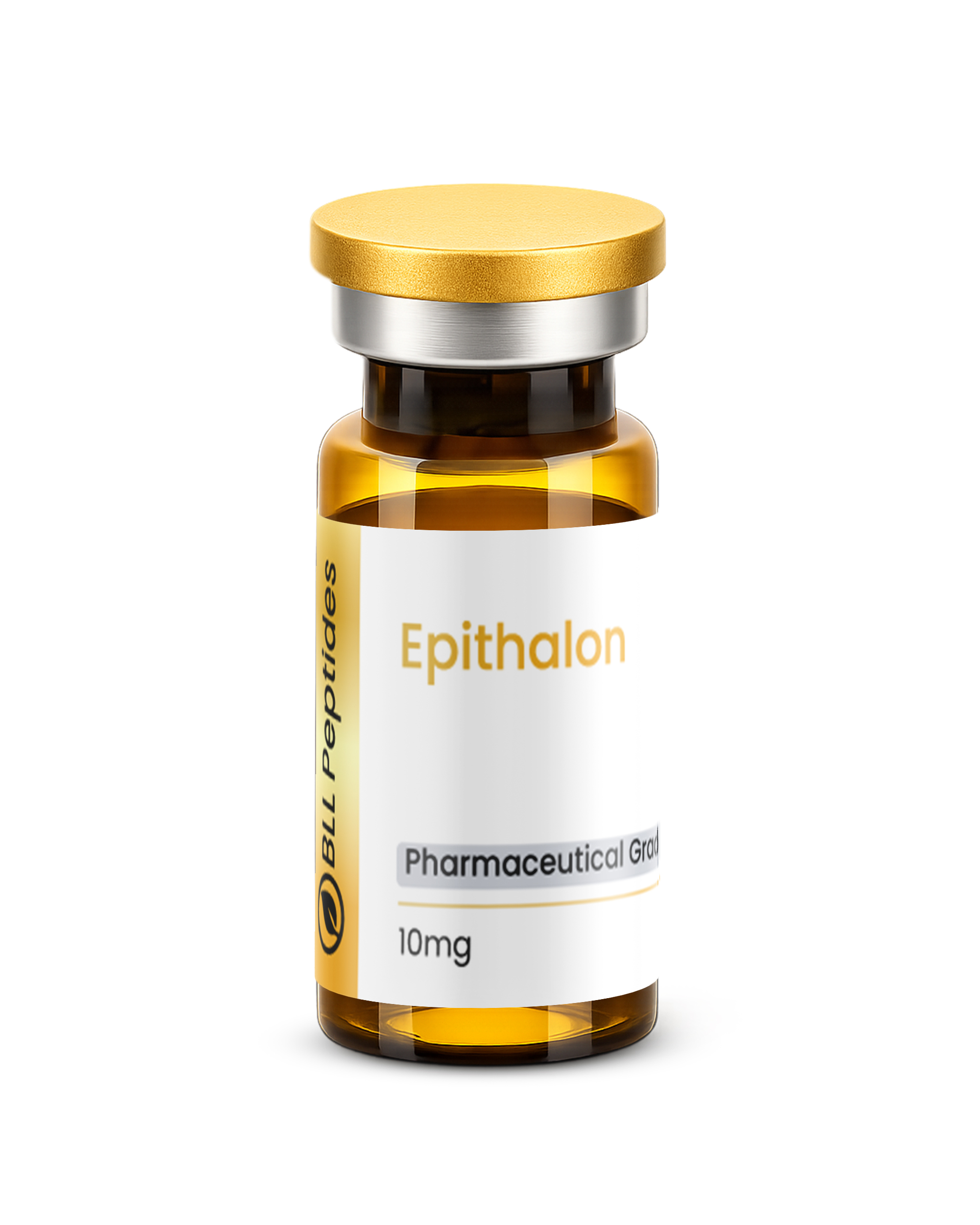
For researchers studying telomere biology, bioregulator peptides, or cellular aging mechanisms, BLL Peptides offers research-grade Epithalon for laboratory use. Our peptides are manufactured in the USA under GMP-certified conditions, ensuring purity and consistency for preclinical research applications.
- Epithalon 10mg / 3ml — Research-grade tetrapeptide for laboratory use
All BLL Peptides products are intended for research purposes only and are not for human consumption.
Conclusion
Epithalon represents one of the more scientifically intriguing peptides in the bioregulator research field. The intersection of telomere biology, telomerase activity, and aging-related gene expression makes it a meaningful subject of ongoing preclinical study. From my perspective as a neurosurgeon who follows cellular aging research, the mechanisms being explored here touch on some of the most fundamental questions in biology — how cells age, why they stop dividing, and what molecular signals govern those processes.
The research is early, and the leap from preclinical findings to clinical application is never straightforward. But the science behind Epithalon is grounded in legitimate cell biology, and the questions it raises about telomere regulation are among the most active areas of inquiry in longevity research today.
Dr. James is a board-certified neurosurgeon trained at Yale University and medical advisor to BLL Peptides.
Further Reading
- Cognitive Function & Brain Health: A Complete Guide to Peptides
- Energy & Cellular Health: A Complete Guide to NAD+ Optimization
Related Research
- Anti-Aging & Longevity: A Complete Guide to Peptides and Compounds
- GHK-Cu: What Research Reveals About Copper Peptide and Tissue Biology
- NAD+: Complete Research Guide – Cellular Energy, Longevity Science, and Anti-Aging
- Research-grade Epithalon at BLL Peptides
This content is intended for research purposes only. BLL Peptides products are not intended for human consumption.