

Something quietly remarkable happened in mitochondrial biology research in 2015: scientists discovered that mitochondria — long understood as the cell’s energy factories — also produce their own signaling peptides. One of these, MOTS-c, is a 16-amino-acid molecule encoded within mitochondrial DNA itself, and the metabolic effects researchers have observed in preclinical models are hard to ignore. The idea that a mitochondria-derived peptide could mimic aspects of aerobic exercise and caloric restriction at the cellular level genuinely surprised me when I first encountered this literature.
MOTS-c (Mitochondrial Open Reading Frame of the Twelve S rRNA-c) is a mitochondria-derived peptide that activates AMPK — the cell’s energy-sensing master switch — with preclinical research linking it to improved insulin sensitivity, exercise-like metabolic signaling, and longevity-associated pathways. It represents a new class of signaling molecules that may help explain how mitochondrial health communicates with systemic metabolism.
What Is MOTS-c?
MOTS-c is a 16-amino-acid peptide discovered in 2015 by researchers at the University of Southern California, led by Dr. Pinchas Cohen. It belongs to a newly identified class of molecules called mitochondria-derived peptides (MDPs), which are encoded within the mitochondrial genome — specifically within the 12S ribosomal RNA gene — rather than the nuclear DNA that governs most cellular proteins. This is what makes MOTS-c so biologically unusual.
Unlike typical mitochondrial proteins that remain inside the organelle, MOTS-c is released into the cytoplasm, can translocate to the nucleus, and circulates in peripheral blood. This makes it a genuine systemic signaling molecule — one that communicates the mitochondria’s functional status to the rest of the cell and, apparently, to distant tissues including skeletal muscle and the hypothalamus. The discovery that mitochondrial DNA encodes circulating peptides with hormonal-like behavior opened an entirely new line of research in aging and metabolic biology.
How MOTS-c Works: AMPK Activation and Metabolic Signaling
The primary mechanism identified for MOTS-c centers on AMPK (AMP-activated protein kinase) — often described as the cell’s metabolic master switch. When cellular energy is low, AMPK activation triggers a cascade of adaptive responses: enhanced glucose uptake, fatty acid oxidation, mitochondrial biogenesis, and autophagy. These are the same pathways activated by aerobic exercise and caloric restriction — two of the most well-validated longevity interventions in the scientific literature.
In skeletal muscle cell lines and rodent models, MOTS-c treatment activates AMPK and improves insulin-stimulated glucose uptake, reproducing key metabolic features of aerobic exercise at the cellular level — a finding that has led researchers to classify it as an “exercise mimetic.”
Additional research has identified MOTS-c’s role in regulating the folate cycle and methionine metabolism. Studies suggest it inhibits de novo purine synthesis, shifting cellular metabolism toward a state resembling the adaptations seen during caloric restriction. At the nuclear level, MOTS-c appears to translocate to the nucleus during cellular stress and interact with the antioxidant response element (ARE), potentially activating cytoprotective gene programs — a mechanistic layer that makes this peptide particularly compelling to researchers studying stress resilience and longevity pathways.
Research Shows: Specific Findings and Data
The foundational MOTS-c study, published in Cell Metabolism (2015) by Lee et al. — available on PubMed — documented several quantifiable effects:
- Insulin resistance reversal: In high-fat-diet-fed mice, MOTS-c treatment reversed insulin resistance and obesity. Treated animals showed significantly improved glucose tolerance compared to controls, with body weight reductions evident within weeks of treatment onset.
- Exercise-responsive plasma levels: Circulating MOTS-c in healthy humans increased approximately 1.5-fold following acute aerobic exercise, establishing it as a physiologically regulated, exercise-responsive signal — not merely a laboratory artifact.
- Age-associated decline: Plasma MOTS-c levels were documented to decline with age in both mice and humans, consistent with the age-related deterioration of mitochondrial function seen across species.
A 2019 study published in Nature Communications extended these findings significantly. In aged mice, MOTS-c treatment improved age-related physical decline, increased skeletal muscle function, and was associated with extended median lifespan in the treated cohort compared to controls — a finding that positioned MOTS-c among the most mechanistically grounded longevity research compounds in current literature.
As a neurosurgeon, I’m particularly drawn to the nuclear translocation data: the idea that mitochondrial stress directly programs cytoprotective gene expression via a circulating peptide is the kind of mechanistic specificity that distinguishes serious research from speculative biology.
Key Research Themes in MOTS-c Literature
Reviewing the published research, several consistent findings emerge:
- AMPK activation and glucose metabolism: Multiple independent studies confirm AMPK pathway engagement with downstream improvements in insulin-stimulated glucose uptake in metabolic disease models
- Exercise mimetic biology: Plasma elevation following exercise and recapitulation of exercise-induced metabolic benefits in sedentary animal models
- Aging and longevity: Age-associated decline in circulating MOTS-c; administration in aged models associated with improved physical performance and lifespan extension
- Nuclear translocation and gene regulation: Stress-induced movement to the nucleus with potential upregulation of cytoprotective gene programs via ARE interaction
- Mitochondrial-nuclear communication: MOTS-c as a molecular messenger linking organelle health to nuclear gene regulation — a paradigm with broad implications for aging biology
The confluence of exercise mimicry, AMPK activation, and documented age-associated decline makes MOTS-c one of the more mechanistically coherent mitochondria-derived peptides currently under investigation in longevity research.
Research-Grade MOTS-c at BLL Peptides
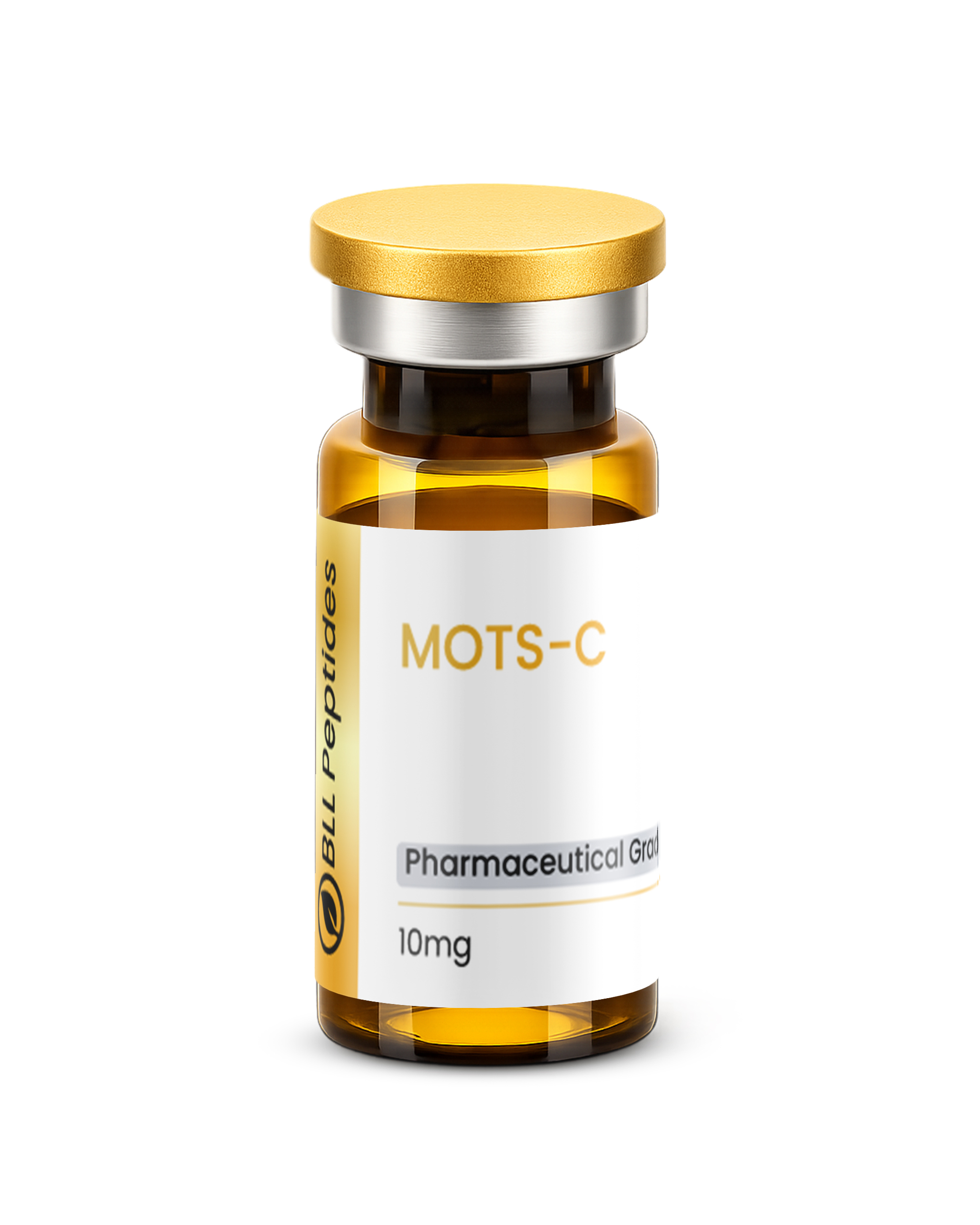
For investigators studying mitochondria-derived peptides, AMPK pathway biology, metabolic aging, or exercise mimetic compounds, BLL Peptides provides research-grade MOTS-c manufactured in GMP-certified, USA-based facilities with third-party purity verification.
- MOTS-c — BLL Peptides — Research-grade, third-party tested, USA-manufactured
- NAD+ 500mg / 10mL — BLL Peptides — Complementary mitochondrial research compound frequently studied alongside MDPs
- BPC-157 10mg / 3mL — BLL Peptides — Tissue repair and regeneration research
Frequently Asked Questions About MOTS-c
- What is MOTS-c?
- MOTS-c is a 16-amino-acid peptide encoded within mitochondrial DNA (the 12S rRNA gene), making it part of a class called mitochondria-derived peptides (MDPs). It functions as a systemic signaling molecule influencing metabolism, stress responses, and potentially longevity pathways.
- Why is MOTS-c described as an exercise mimetic?
- Preclinical research shows MOTS-c activates AMPK and improves insulin-stimulated glucose uptake in skeletal muscle — effects that parallel those of aerobic exercise. Plasma MOTS-c levels also rise approximately 1.5-fold following acute aerobic exercise in healthy humans, suggesting it is part of the body’s exercise-responsive signaling network.
- Does MOTS-c decline with age?
- Yes. Research has documented that circulating MOTS-c levels decline with age in both mice and humans, consistent with broader patterns of mitochondrial dysfunction in aging. This decline has fueled interest in MOTS-c’s potential role in age-related metabolic deterioration.
- What is the relationship between MOTS-c and AMPK?
- MOTS-c activates AMPK — the cell’s energy-sensing master switch. This activation promotes glucose uptake, fatty acid oxidation, and mitochondrial biogenesis, contributing to the metabolic improvements observed in research models and the phenotypic similarities to exercise-induced adaptations.
- Where can researchers source MOTS-c for laboratory studies?
- BLL Peptides supplies research-grade MOTS-c manufactured in GMP-certified, USA-based facilities with third-party purity testing, suitable for laboratory and preclinical research applications.
About the Author: Dr. James Nguyen is a board-certified neurosurgeon trained at Yale University and Medical Advisor to BLL Peptides. His research interests include neuroprotective mechanisms, mitochondrial biology, and the emerging science of peptide-based compounds in preclinical models.
This content is intended for research purposes only. BLL Peptides products are not intended for human consumption.