
Introduction
The relationship between NMN and NAD+ is more biochemically nuanced than most supplement discussions acknowledge. NMN (nicotinamide mononucleotide) is one step upstream of NAD+ in the salvage pathway, but whether it can enter cells directly or must first be dephosphorylated to NR (nicotinamide riboside) before uptake was genuinely contested in the literature until the identification of the Slc12a8 transporter in mouse intestinal cells by Imai’s group at Washington University in 2019. Even that finding introduced new questions rather than resolving the debate, because the transporter’s expression appears tissue-specific and the human ortholog’s function has not been fully characterized. Understanding what the current data actually shows — rather than the simplified version that circulates in popular science coverage — is what this review attempts.
| Feature | NAD+ | NMN |
|---|---|---|
| Classification | Coenzyme (direct substrate) | NAD+ biosynthetic precursor |
| Cell Membrane Permeability | Low — requires conversion or transport | Higher via Slc12a8 transporter |
| Primary Research Focus | Mitochondrial function, sirtuin activation | NAD+ repletion, aging research |
| Longevity Research | Extensive (sirtuin/PARP pathways) | Growing (lifespan extension in rodents) |
| Stability | Less stable, pH-sensitive | More stable in standard conditions |
| Route of Conversion | Immediate substrate | Converted to NAD+ via NMNAT enzymes |
NAD+ Overview
NAD+ is a fundamental coenzyme found in every living cell, serving as the central electron carrier in cellular respiration and as a substrate for key regulatory enzymes. In the context of energy metabolism, NAD+ is essential for the mitochondrial electron transport chain, where its reduction to NADH drives ATP synthesis. Beyond bioenergetics, NAD+ serves as the primary substrate for sirtuins (SIRT1–7) — a family of deacylases central to epigenetic regulation, mitochondrial biogenesis, and stress response — as well as for PARPs (poly-ADP-ribose polymerases) involved in DNA repair.
Research has demonstrated that NAD+ levels decline with age in multiple tissues, a finding that has catalyzed substantial interest in NAD+-boosting strategies. Direct IV and intraperitoneal administration of NAD+ has been studied in animal models to assess its effects on neurological function, mitochondrial efficiency, and metabolic health markers.
NMN Overview
NMN (nicotinamide mononucleotide) is a nucleotide derived from ribose and nicotinamide that serves as a direct precursor to NAD+ in the salvage biosynthesis pathway. It is converted to NAD+ through the action of NMN adenylyltransferase (NMNAT) enzymes present in the cytoplasm, mitochondria, and nucleus.
A landmark discovery by Dr. Shin-ichiro Imai’s lab at Washington University identified the Slc12a8 transporter as a specific NMN membrane transporter, helping explain how NMN may enter cells more efficiently than NAD+ itself. Research in aged rodent models has shown that NMN supplementation can restore NAD+ levels in multiple tissues, including muscle, liver, and brain, with associated improvements in energy metabolism, insulin sensitivity, and physical activity parameters.
Head-to-Head Comparison
The fundamental debate in NAD+ versus NMN research centers on cellular uptake efficiency. NAD+ is a large, charged molecule with limited membrane permeability under most physiological conditions. NMN, while also charged, benefits from specific transporter-mediated uptake mechanisms that may facilitate more efficient delivery to intracellular NAD+ pools.
From a research design perspective, this means NAD+ administration may produce different tissue distribution and kinetic profiles compared to NMN. Studies using NAD+ directly — particularly parenteral formulations — bypass the biosynthetic step entirely and may be relevant in acute models, while NMN studies may better model physiological augmentation of the salvage pathway.
Research Findings
Longevity research in this space has accelerated dramatically since 2013. A pivotal study by Gomes et al. published in Cell demonstrated that raising NAD+ levels via NMN in aged mice restored mitochondrial homeostasis and improved muscle physiology to a degree comparable to younger animals. Subsequent studies have explored NMN’s effects on cognitive function, cardiovascular markers, and insulin sensitivity in aged rodent models.
On the NAD+ side, research into its neuroprotective properties is of particular relevance to the neuroscience community. Studies examining NAD+ in models of traumatic brain injury, neurodegeneration, and ischemic injury have shown promising results in preserving neuronal function, likely through PARP modulation and sirtuin-mediated mitochondrial protection.
The complementary nature of these compounds — one a direct substrate, the other a precursor — has led some researchers to investigate combination approaches as a means of maximizing intracellular NAD+ availability across different tissue compartments.
Research-Grade NAD+ at BLL Peptides
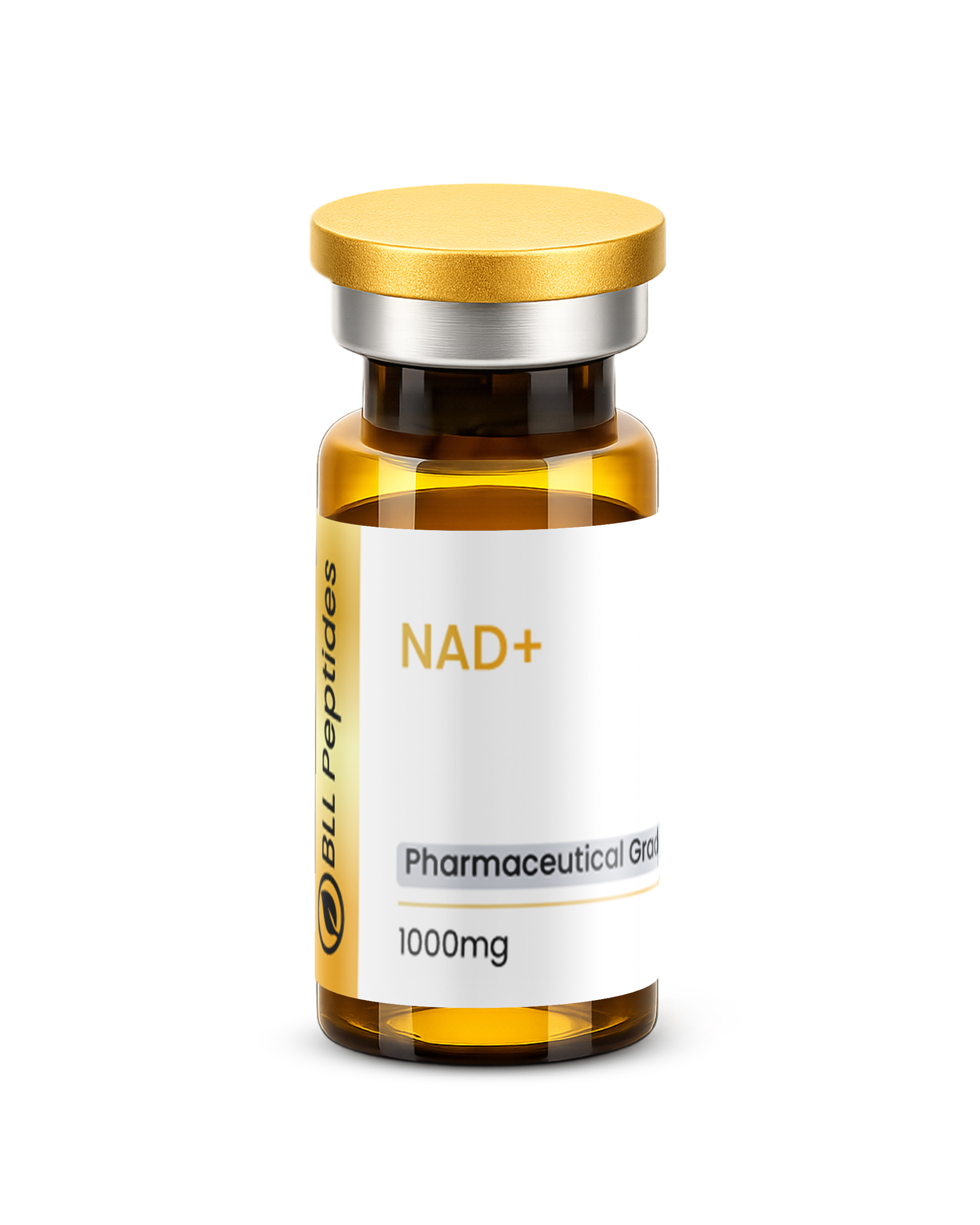
BLL Peptides offers a research-grade NAD+ formulation for qualified researchers studying nicotinamide pathway biology:
- NAD+ 1000mg/10mL — High-concentration research formulation
Conclusion
NAD+ and NMN represent two distinct but deeply interconnected research tools for studying nicotinamide pathway biology, cellular aging, and mitochondrial function. Each has a robust and growing literature base, and their complementary roles in the NAD+ biosynthesis network make them valuable for different experimental designs. Researchers should evaluate both the mechanistic and pharmacokinetic distinctions when selecting between these compounds for their studies.
Further Reading
- NAD+ and Mitochondrial Function: What the Research Reveals
- Energy & Cellular Health: A Complete Guide to NAD+ Optimization
- Cognitive Function & Brain Health: A Complete Guide to Peptides
About the Author: Dr. James is a board-certified neurosurgeon trained at Yale University and medical advisor to BLL Peptides.
Related Research
- NAD+ and Mitochondrial Function: What the Research Reveals
- NAD+: Complete Research Guide – Cellular Energy, Longevity Science, and Anti-Aging
- Energy & Cellular Health: A Complete Guide to NAD+ Optimization
- Research-grade NAD+ at BLL Peptides
Research Disclaimer: All content on this page is intended for informational and educational purposes only. NAD+ and NMN are research compounds. This article does not constitute medical advice, diagnosis, or treatment recommendations. All research use must comply with applicable institutional and regulatory guidelines.