

The ACTH(4-7) fragment that forms the structural basis of Semax has been studied for decades in Russian neurological research, but it has only recently attracted broader attention in Western peptide science. What sets it apart from other cognitive research compounds is its documented effect on BDNF — brain-derived neurotrophic factor — which plays a central role in synaptic plasticity, neuronal survival, and hippocampal neurogenesis. Having spent years studying neuroprotective mechanisms in the context of surgical brain injury, I find the preclinical BDNF data on Semax genuinely instructive. This review examines the mechanistic and experimental evidence behind Semax, with a focus on what the research actually supports versus what remains speculative.
What Is Semax?
Semax is a synthetic heptapeptide derived from a fragment of adrenocorticotropic hormone (ACTH). Specifically, it is based on the ACTH(4-7) sequence — Met-Glu-His-Phe — extended with a Pro-Gly-Pro C-terminal addition that significantly increases its stability and duration of activity compared to the native fragment. The compound was developed in Russia, initially through work at the Institute of Molecular Genetics of the Russian Academy of Sciences, and has been the subject of scientific investigation for several decades.
Unlike many peptides derived from peripheral hormones, Semax’s parent sequence, ACTH(4-7), is known to cross the blood-brain barrier. The synthetic modification preserves this property while reducing rapid enzymatic degradation — a critical consideration in neuropeptide research where CNS penetration is central to the compound’s utility as a research tool.
Semax has been evaluated in preclinical research primarily across three domains: cognition and learning, neuroprotection, and BDNF (brain-derived neurotrophic factor) modulation. Each of these areas aligns with active questions in neuroscience, which is what makes this compound consistently relevant in research contexts.
Mechanisms of Action: What Research Has Identified
The mechanistic picture that has emerged from Semax research involves several distinct but interconnected pathways:
- BDNF upregulation: One of the most replicated findings in Semax preclinical research is its ability to increase BDNF expression in the hippocampus and frontal cortex. BDNF is a neurotrophin essential for synaptic plasticity, neuronal survival, and the cellular processes underlying memory formation and learning. Rodent studies have consistently documented elevated BDNF levels following Semax administration, particularly in brain regions associated with cognition.
- Dopaminergic and serotonergic modulation: Research has examined Semax’s effects on monoamine neurotransmitter systems. Studies in animal models suggest the compound may influence dopamine and serotonin turnover in limbic structures, offering a potential neurochemical basis for observed behavioral effects in preclinical anxiety and memory paradigms.
- Opioid receptor interactions: Some research has proposed that Semax may interact with μ-opioid receptors, which could contribute to its reported effects on stress reactivity and nociception in animal models. This interaction is distinct from classical opioid agonism and has been characterized as modulatory rather than agonist in nature.
- Anti-inflammatory and neuroprotective signaling: Preclinical studies involving stroke and ischemia models have documented that Semax may reduce neuroinflammation markers and limit neuronal apoptosis in the penumbral zone following ischemic injury. These findings have generated interest in Semax as a research tool for studying neuroprotective mechanisms in CNS injury models.
- Enkephalinase inhibition: Semax has been shown in some research to inhibit enkephalinase, the enzyme responsible for degrading endogenous enkephalin peptides. This mechanism may amplify endogenous neuropeptide signaling in the brain, providing another route by which the compound influences CNS activity in experimental settings.
Research Overview: Cognitive and Neurological Studies
The breadth of Semax research is notable, spanning basic cognitive neuroscience through ischemia models and neurological function studies.
Cognitive and Learning Research: A substantial body of preclinical work has examined Semax’s effects in learning and memory paradigms. Studies in rodent models — including Morris water maze, passive avoidance, and radial arm maze tasks — have generally reported improved acquisition and retention of learned behaviors in Semax-treated animals compared to controls. Researchers attribute these effects, at least in part, to BDNF upregulation and the associated enhancement of hippocampal synaptic plasticity. It is important to note that these findings are derived from animal models and do not establish cognitive enhancement in human subjects.
Stroke and Ischemia Models: Some of the most compelling Semax research has been conducted in ischemia models. Studies in rodents subjected to middle cerebral artery occlusion found that Semax administration was associated with reduced infarct volume, decreased expression of pro-inflammatory cytokines, and improved neurological scoring in the post-ischemic period. These findings have positioned Semax as a compound of scientific interest for researchers studying neuroprotective interventions in stroke biology.
Optic Nerve Research: Russian research groups have examined Semax in models of optic nerve injury and retinal ischemia, reporting findings consistent with reduced neuronal death and improved functional outcomes in treated animals. This line of research touches on neuro-ophthalmology — an intersection that I find particularly interesting given the overlap between visual pathway neuroscience and neurosurgical practice.
Anxiety and Stress Reactivity: Behavioral pharmacology studies have examined Semax in animal models of stress and anxiety. Several studies have reported anxiolytic-like effects in open-field and elevated plus-maze paradigms, with proposed mechanisms involving both dopaminergic modulation and interaction with endogenous opioid systems. These findings have been replicated in independent laboratories, lending some degree of consistency to the behavioral profile documented in preclinical models.
Key Findings from the Research Literature
Reviewing the Semax preclinical literature, several consistent themes emerge:
- BDNF elevation: Robust, replicated findings across multiple labs and animal models showing increased BDNF expression in hippocampus and cortex.
- Improved learning metrics in rodent models: Consistent improvements in maze performance and memory retention tasks across multiple cognitive paradigms.
- Neuroprotection in ischemia models: Reduced infarct size, decreased neuroinflammation markers, and improved neurological outcomes in stroke model animals.
- Anxiolytic-like behavioral effects: Reduced anxiety-related behavior in standard rodent assays, with proposed monoaminergic and opioidergic mechanisms.
- CNS penetration: Documented ability to cross the blood-brain barrier, which distinguishes Semax from many peptides that lack CNS bioavailability and makes it a useful research tool for studying central neuropeptide signaling.
It is essential to emphasize that Semax research remains predominantly preclinical. The mechanistic insights from these studies are valuable for understanding neuropeptide biology, but they do not translate directly to conclusions about effects or safety in humans. Researchers using Semax work within controlled laboratory contexts designed to advance the scientific understanding of CNS peptide pharmacology.
Research-Grade Semax at BLL Peptides
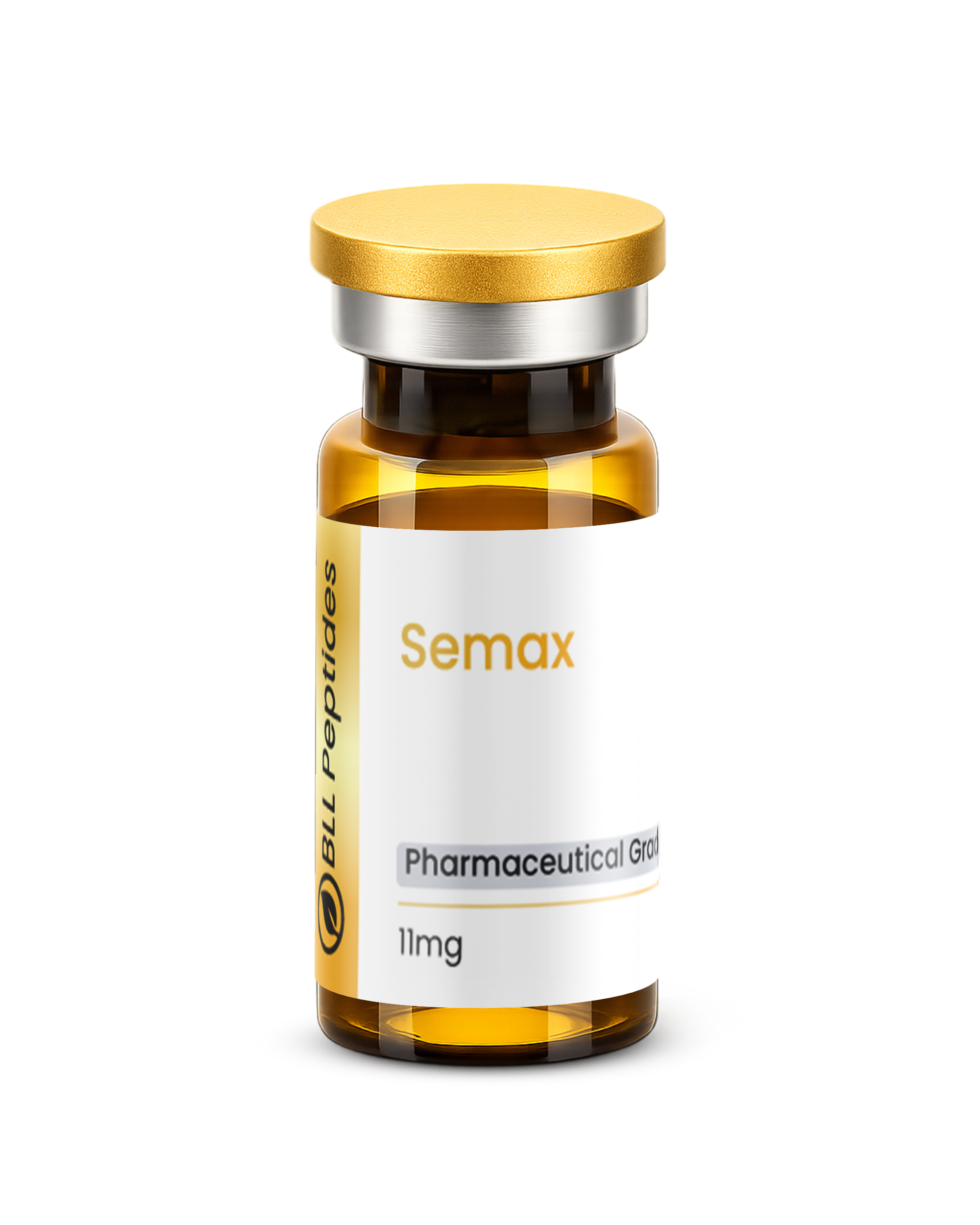
For researchers studying neuropeptide pharmacology, BDNF signaling, or CNS ischemia models, BLL Peptides offers research-grade Semax manufactured under strict GMP-certified conditions in the USA:
- Semax 11mg / 3mL — Research-grade synthetic neuropeptide for in vitro and preclinical laboratory use
All BLL Peptides compounds are USA-manufactured and third-party tested for purity and consistency, meeting the quality standards that rigorous preclinical research demands.
Conclusion
From my perspective as a neurosurgeon who follows the basic science literature, Semax occupies a genuinely interesting space in neuropeptide research. The convergence of BDNF biology, monoamine modulation, and neuroprotective mechanisms in a single synthetic peptide makes it a valuable tool for investigators studying the molecular underpinnings of cognition and CNS injury response.
The blood-brain barrier penetration issue that limits so many compounds in neuroscience is not a barrier here — which is scientifically significant. Whether studying plasticity-related transcription factors, modeling ischemic neuroprotection, or examining anxiolytic mechanisms, Semax offers a reasonably well-characterized pharmacological handle for engaging these questions in preclinical systems. The research base, while largely preclinical, is substantive and comes from multiple independent laboratories. That replication is meaningful in evaluating the reliability of the findings.
Dr. James is a board-certified neurosurgeon trained at Yale University and medical advisor to BLL Peptides.
Related Research
- Cognitive Function & Brain Health: A Complete Guide to Peptides
- Epithalon and Telomere Research: What Science Reveals About This Tetrapeptide Bioregulator
- GHK-Cu: What Research Reveals About Copper Peptide and Tissue Biology
- Research-grade Semax at BLL Peptides
This content is intended for research purposes only. BLL Peptides products are not intended for human consumption.