

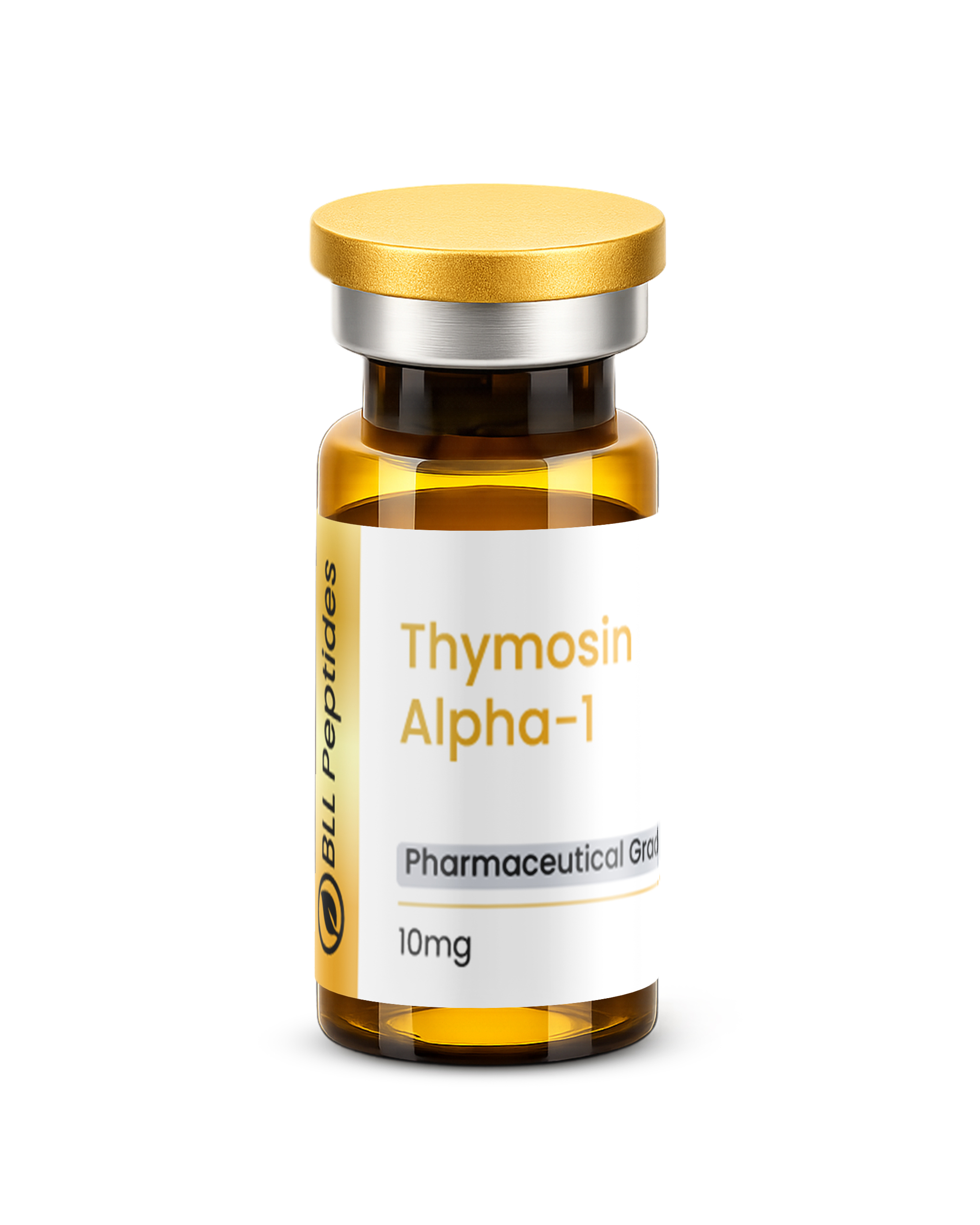
I had a patient — a 58-year-old physician himself — who described feeling immunologically “depleted” after recovering from a serious viral illness. His labs were essentially normal, but he wasn’t bouncing back the way he expected. What he was describing is something researchers are increasingly able to measure: the phenomenon of immune exhaustion, where T-cell populations lose their functional potency after sustained activation. Thymosin Alpha-1 sits at the intersection of that problem in a way that’s scientifically fascinating.
Thymosin Alpha-1 (Tα1) is a 28-amino-acid peptide originally isolated from thymic tissue in the 1970s by researcher Allan Goldstein. The thymus — the gland responsible for T-cell maturation — produces Tα1 naturally, but thymic output declines sharply with age (a process called thymic involution). This means older individuals have progressively less of a peptide that is now understood to be essential for T-cell training, activation, and the maintenance of immune surveillance against both viral threats and malignant cells.
Thymosin Alpha-1 and Viral Immune Response Research
The viral immunity research on Thymosin Alpha-1 is among the most clinically developed in the entire peptide field. Tα1 (branded as Zadaxin in some markets) has been approved in numerous countries for use in hepatitis B, hepatitis C, and as an adjunct therapy in cancer immunotherapy — making it one of the few peptides with a substantial human clinical trial dataset.
In viral infection models, Tα1 exerts its effects primarily through several mechanisms: stimulating the differentiation of naive T-cells into functionally active T-helper and T-cytotoxic cells, enhancing dendritic cell maturation and antigen presentation, increasing production of interferon-alpha and interferon-gamma, and modulating toll-like receptor (TLR) signaling — the pattern recognition system that detects viral RNA and DNA.
A meta-analysis of clinical trials found that Thymosin Alpha-1 improved outcomes in patients with hepatitis B and C, with particularly significant effects on antiviral immune response markers including IFN-γ production and T-cell proliferation rates.
The COVID-19 pandemic brought renewed attention to Tα1 research. Several studies, including an observational study in Italy and a randomized trial in China, examined Tα1 in critically ill COVID-19 patients. A study published in Clinical Infectious Diseases reported that Tα1 administration was associated with significantly reduced 28-day mortality in severe COVID-19 cases — a finding attributed to its ability to restore T-cell functionality in lymphopenic (low T-cell count) patients (PMID: 33354738).
Key Findings: Immune Restoration and T-Cell Function
One of the most consistent findings in Thymosin Alpha-1 research is its effect on T-cell “exhaustion” — a state where chronically stimulated immune cells lose their functional capacity. This occurs in chronic viral infections (hepatitis, HIV) and in cancer, where sustained antigen exposure drives T-cells toward a dysfunctional phenotype. Tα1 research suggests it may help restore or maintain T-cell functional capacity in these contexts.
In aging models, Tα1 has been shown to partially compensate for the decline in thymic T-cell output by supporting the functional activation of peripheral T-cell populations. This is particularly relevant for older individuals, where immune surveillance against both viral reactivation and early neoplastic cells is compromised.
The breadth of Thymosin Alpha-1’s immune modulation — from antiviral defense to T-cell exhaustion reversal to adjuvant effects in cancer immunotherapy — reflects the central coordinating role that thymic peptides play in adaptive immunity.
For researchers investigating immune modulation peptides, BPC-157 offers parallel research on immune-regulatory and anti-inflammatory mechanisms through a different mechanistic pathway. Researchers studying Thymosin Alpha-1 can source high-quality material at BLL Peptides for laboratory use.
Frequently Asked Questions About Thymosin Alpha-1 and Viral Immunity
- What is Thymosin Alpha-1 and where does it come from naturally?
- Thymosin Alpha-1 is a 28-amino-acid peptide naturally produced by the thymus gland. It plays a central role in T-cell maturation and immune activation. Its production declines with thymic involution, which accelerates from middle age onward.
- What is the clinical research basis for Thymosin Alpha-1?
- Tα1 (Zadaxin) is approved in multiple countries for hepatitis B, hepatitis C, and cancer immunotherapy applications. It has been studied in numerous randomized controlled trials with documented effects on antiviral T-cell responses.
- What is T-cell exhaustion and how does Tα1 research address it?
- T-cell exhaustion is a dysfunctional state caused by chronic antigen exposure, common in persistent viral infections and cancer. Research suggests Tα1 may help restore or maintain T-cell functional capacity in exhausted populations.
- What happened in COVID-19 research with Thymosin Alpha-1?
- Multiple studies examined Tα1 in severe COVID-19, with one finding in Critical Infectious Diseases reporting significantly reduced 28-day mortality in lymphopenic patients receiving Tα1 — attributed to restored T-cell functionality.
Dr. James Nguyen is a neurosurgeon and research advisor at BLL Peptides. His work focuses on peptide research, neurological recovery, and longevity science. All content is for educational and research purposes only.
This content is intended for research purposes only. BLL Peptides products are not intended for human consumption.