

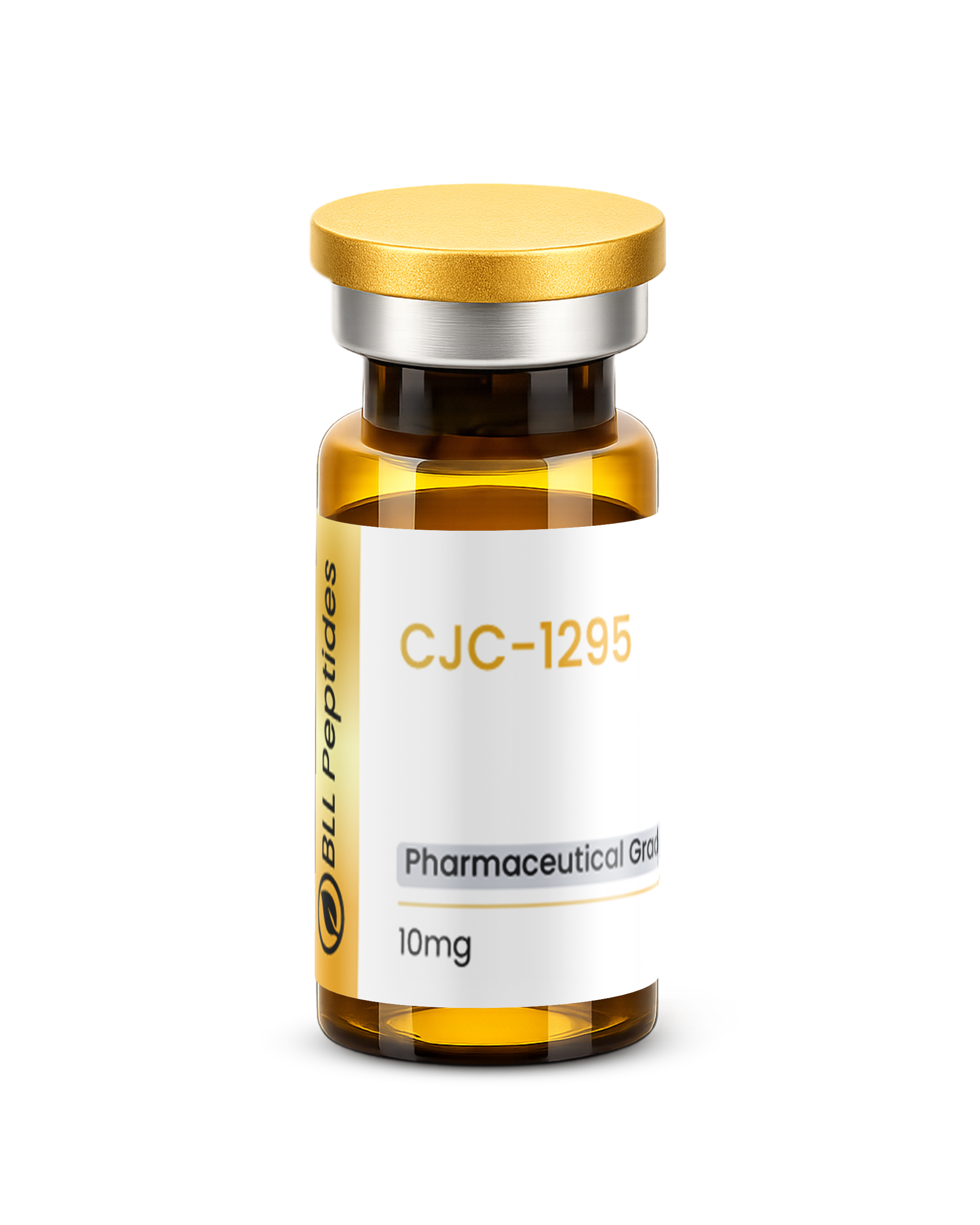
There’s a moment in the OR — maybe you’ve had a version of it too — where you step back from what you’re doing and wonder whether the body could just… do this faster. Regenerate more efficiently. Restore what time and injury have worn down. For me, that question eventually led to the research literature on growth hormone-releasing hormone analogues, and specifically to a peptide called CJC-1295.
CJC-1295 is a synthetic analogue of GHRH (growth hormone-releasing hormone) that has attracted significant scientific attention for its ability to extend the half-life of pulsatile GH secretion. Unlike the natural GHRH signal, which disappears from circulation within minutes, CJC-1295 is engineered to bind albumin and persist — creating sustained pulses of growth hormone release that more closely resemble the body’s youthful secretory patterns. For researchers studying aging, metabolic function, and tissue repair, that’s a meaningful distinction.
What Is CJC-1295?
CJC-1295 (also known as DAC:GRF when formulated with the Drug Affinity Complex) is a 30-amino-acid peptide that mimics the action of endogenous GHRH at the pituitary gland. It stimulates the release of growth hormone from somatotroph cells — but because of a chemical modification called the Drug Affinity Complex (DAC), it binds to albumin in the bloodstream, dramatically extending its active window from minutes to days.
As a neurosurgeon, I spend a lot of time thinking about the relationship between growth hormone and brain function. GH and its downstream effector IGF-1 are neuroprotective — they support synaptic plasticity, myelination, and cognitive performance. The research on GHRH analogues like CJC-1295 has opened new questions about whether restoring more youthful GH pulse patterns could influence neurological resilience as well as body composition.
How CJC-1295 Works at the Molecular Level
The mechanism is elegant. CJC-1295 binds to the GHRH receptor on pituitary somatotrophs, triggering a G-protein signaling cascade that elevates intracellular cAMP. This drives the synthesis and release of growth hormone. What makes CJC-1295 distinctive is the DAC modification — a reactive group that forms a covalent bond with lysine residues on albumin, using the plasma protein as a biological reservoir. The result is a peptide that delivers GHRH-like stimulation over an extended period.
This sustained stimulation doesn’t override the body’s own regulatory feedback loops — it works within them, amplifying the natural GH pulsatility that tends to diminish with age.
IGF-1 levels rise downstream of this GH stimulus. IGF-1 is the primary mediator of many of GH’s anabolic and regenerative effects — promoting protein synthesis, fat metabolism, tissue repair, and in the brain, neuroprotection and neurogenesis. The CJC-1295/IGF-1 axis has become a focus of aging research precisely because this entire signaling pathway declines significantly after age 30.
What the Research Shows on CJC-1295
In a landmark 2006 clinical study published by Teichman et al. in the Journal of Clinical Endocrinology and Metabolism, CJC-1295 administered at various doses to healthy adults produced dose-dependent increases in mean plasma GH concentrations by 2- to 10-fold, with effects lasting up to 6 days following a single injection (PMID: 16822960). Equally notable, IGF-1 levels increased by 1.5- to 3-fold and remained elevated for 9 to 11 days.
Those are remarkable pharmacokinetic numbers. For context, standard GHRH has a plasma half-life of less than 7 minutes. CJC-1295 extends that window to approximately 6–8 days through its albumin-binding mechanism. Researchers studying GH deficiency, body composition, and recovery from injury have found this prolonged activity window opens up experimental protocols that weren’t feasible with shorter-acting GHRH compounds.
Studies in animal models have also suggested that GHRH analogues may exert neuroprotective effects independently of IGF-1, which is a finding that I find particularly fascinating from a neurological standpoint.
The body composition data in human subjects showed decreases in body fat and increases in lean muscle mass — consistent with the known metabolic role of GH/IGF-1 signaling. These effects were most pronounced in subjects with lower baseline GH secretion, suggesting the peptide may have its greatest research relevance in populations with age-related or functional GH decline.
There’s also emerging interest in the combination of CJC-1295 with GHRP peptides like Ipamorelin. When a GHRH analogue and a growth hormone secretagogue are combined, they work on different receptor pathways but produce synergistic GH release — a research combination that has attracted interest in sports science, aging research, and tissue regeneration contexts. You can explore NAD+ research at BLL Peptides as a complementary longevity-focused compound.
For researchers exploring the GHRH-analogue class, BPC-157 offers a parallel angle on tissue regeneration through an entirely different receptor pathway — making these two compounds interesting to study alongside each other.
If you’re researching this compound, BLL Peptides offers high-quality CJC-1295 formulations for laboratory and research use. All products are for research purposes only.
Frequently Asked Questions About CJC-1295 Research
- What makes CJC-1295 different from regular GHRH?
- CJC-1295 uses a Drug Affinity Complex (DAC) to bind albumin in the bloodstream, extending its active half-life from minutes to approximately 6-8 days. This sustained action produces prolonged GH and IGF-1 elevation compared to natural GHRH.
- What research applications has CJC-1295 been studied for?
- Research has examined CJC-1295 in the context of body composition (fat reduction, lean mass), growth hormone deficiency, IGF-1 elevation, aging biology, and more recently, neuroprotection. All research is conducted in controlled laboratory or clinical settings.
- Does CJC-1295 work better when combined with other peptides?
- Preclinical and some clinical research suggests that combining GHRH analogues with GHRPs (like Ipamorelin) produces synergistic GH release because they act on different receptor pathways. This combination approach is an active area of study.
- Is CJC-1295 the same as Sermorelin?
- No. Both are GHRH analogues, but Sermorelin is a truncated 29-amino-acid fragment of GHRH without the DAC modification, giving it a much shorter half-life. CJC-1295 with DAC is specifically engineered for albumin binding and extended duration.
- What do IGF-1 increases in CJC-1295 research mean?
- IGF-1 (Insulin-like Growth Factor 1) is the primary downstream mediator of GH’s anabolic and regenerative effects. Elevations of 1.5 to 3-fold observed in human trials represent a significant shift in the GH/IGF-1 axis — which is why researchers studying aging, recovery, and metabolism have focused on this compound.
Dr. James Nguyen is a neurosurgeon and research advisor at BLL Peptides. His work focuses on peptide research, neurological recovery, and longevity science. All content is for educational and research purposes only.
This content is intended for research purposes only. BLL Peptides products are not intended for human consumption.