

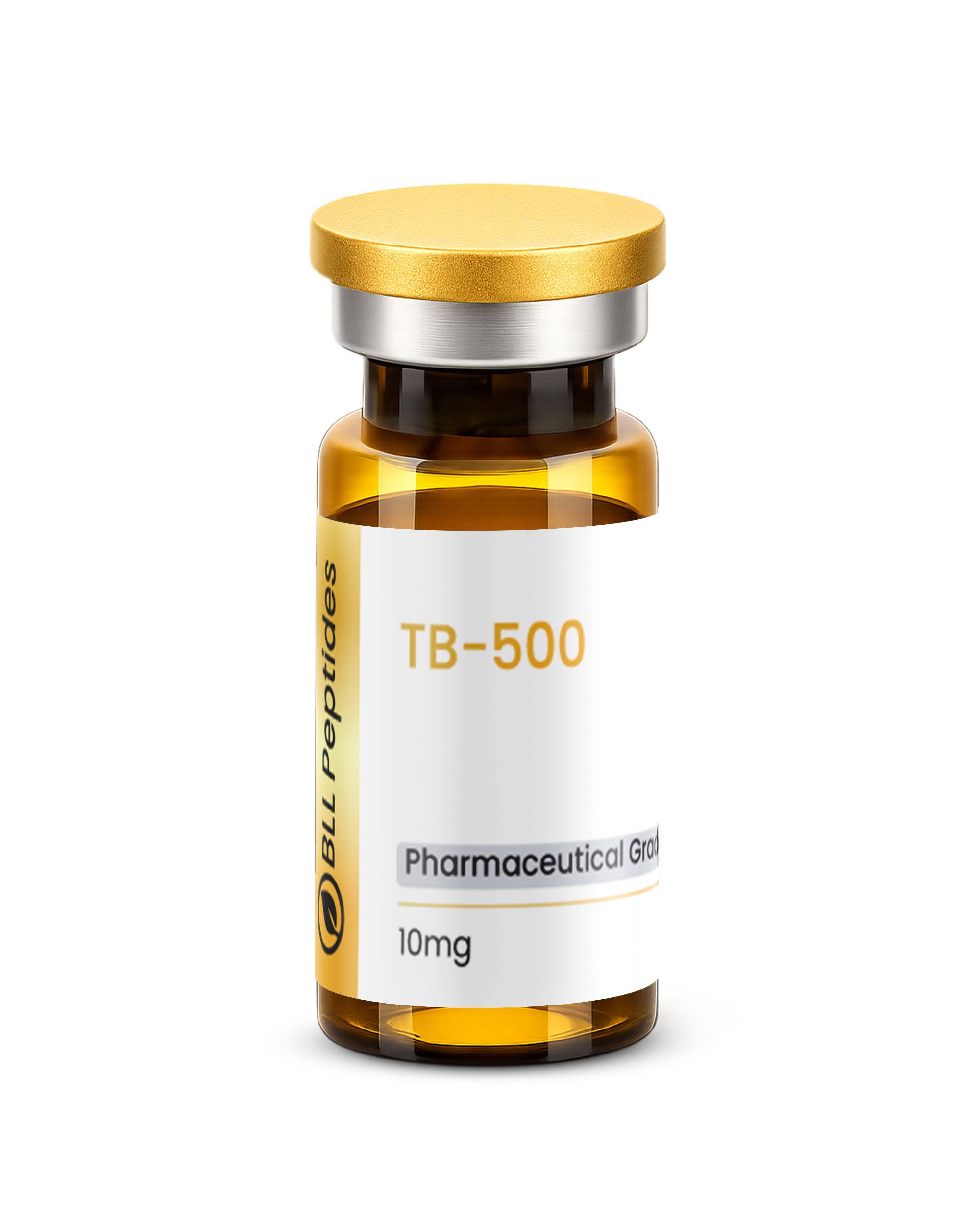
The patient had torn his ACL six months before we first spoke — and despite successful surgery, his recovery had stalled. The connective tissue wasn’t knitting the way it should. I’ve seen this pattern more times than I can count: the acute phase heals, but the deep remodeling that turns scar tissue into functional tissue lags behind. That’s the biology problem that TB-500 research is trying to address.
TB-500, the synthetic form of Thymosin Beta-4 (Tβ4), has accumulated a growing body of research suggesting it plays a critical role in the regulation of actin — the protein scaffold underlying cell movement, wound closure, and tissue repair. In the context of joint and connective tissue recovery, its mechanisms are particularly compelling for researchers studying tendons, ligaments, and cartilage restoration.
TB-500 and the Biology of Joint Repair
Connective tissue repair is notoriously slow. Tendons and ligaments have low cellularity and limited vascular supply — which means the chemical signals that recruit repair cells and organize new matrix are harder to maintain over time. Thymosin Beta-4 (the endogenous protein that TB-500 mimics) is one of the most abundant intracellular peptides in vertebrates, and its role in directing actin polymerization puts it at the center of cell migration and wound healing.
TB-500’s active domain — a nine-amino-acid sequence called LKKTETQ — is sufficient to replicate many of Tβ4’s repair-promoting effects, including angiogenesis stimulation, anti-inflammatory signaling, and stem cell recruitment.
In joints specifically, the repair cascade requires multiple overlapping processes: controlling acute inflammation, clearing damaged matrix, recruiting progenitor cells, and then organizing the synthesis of new collagen. Research suggests TB-500 may support several of these stages — not just one.
How TB-500 Influences Connective Tissue Research Models
In preclinical studies, Tβ4 has been shown to accelerate tendon healing by promoting tenocyte (tendon cell) migration and proliferation, stimulating the synthesis of type I and type III collagen, and reducing pro-inflammatory cytokine activity at injury sites. A study published in the Journal of Orthopaedic Research found that local application of Tβ4 significantly improved collagen fiber organization and tensile strength in rodent tendon repair models — key markers of functional recovery (PMID: 20225296).
What I find interesting from a surgical perspective is the collagen quality angle. It’s not just about how fast scar tissue forms — it’s about whether that tissue is organized correctly. Randomly oriented collagen fibers heal a wound but don’t restore function. TB-500 research suggests the peptide may influence the orientation and maturation of new collagen, which could be the difference between a tendon that holds under load and one that re-tears.
Research has also investigated TB-500 in cartilage regeneration models. Articular cartilage — the smooth tissue covering joint surfaces — has almost no inherent regenerative capacity. Studies examining Tβ4 in chondrocyte (cartilage cell) cultures have shown potential for stimulating matrix production and reducing inflammatory destruction, though this remains an early-stage area of investigation.
Key Research Findings on TB-500 and Recovery
Across preclinical studies, TB-500 has demonstrated several consistent findings in connective tissue research:
- Accelerated wound closure rates in skin, tendon, and corneal tissue models
- Stimulation of new blood vessel formation (angiogenesis), improving nutrient delivery to healing tissue
- Reduction in inflammatory markers including IL-1β and TNF-α
- In one cardiac research model, Tβ4 was found to reactivate cardiac progenitor cells — suggesting systemic regenerative properties beyond musculoskeletal tissue
The systemic nature of TB-500’s effects — rather than purely local action — is one reason researchers have classified it as a generalized tissue repair peptide rather than a joint-specific compound.
Interestingly, TB-500 research has found it to be effective even when administered systemically rather than locally — which differentiates it from many growth factors that require direct injection at the injury site. This systemic availability points to a mechanism that involves circulating signaling rather than purely local receptor activation.
For connective tissue researchers, TB-500 is available from BLL Peptides for laboratory and research use. A related compound worth exploring in parallel joint research is BPC-157, which has its own body of tendon and ligament healing research through the FAK-paxillin pathway.
Frequently Asked Questions About TB-500 and Joint Research
- What makes TB-500 relevant to joint and connective tissue research?
- TB-500 mimics Thymosin Beta-4, a peptide involved in actin regulation, cell migration, angiogenesis, and anti-inflammatory signaling — all processes critical to connective tissue repair. Research models have shown effects on tendon, ligament, and cartilage tissue.
- How does TB-500 differ from BPC-157 in repair research?
- Both are studied for tissue repair, but through different mechanisms. TB-500 works primarily through actin sequestration and stem cell recruitment, while BPC-157 acts through the FAK-paxillin pathway and nitric oxide signaling. They’re often studied as complementary research subjects.
- Is TB-500 research limited to musculoskeletal tissue?
- No. While joint and tendon applications are well-studied, Tβ4 research also covers cardiac tissue, corneal healing, neurological recovery, and skin wound models, reflecting its broad biological role.
- What collagen-related findings have emerged from TB-500 research?
- Studies have noted improved collagen fiber organization and increased tensile strength in tendon repair models — suggesting TB-500 influences not just the speed but the quality of connective tissue repair.
Dr. James Nguyen is a neurosurgeon and research advisor at BLL Peptides. His work focuses on peptide research, neurological recovery, and longevity science. All content is for educational and research purposes only.
This content is intended for research purposes only. BLL Peptides products are not intended for human consumption.