

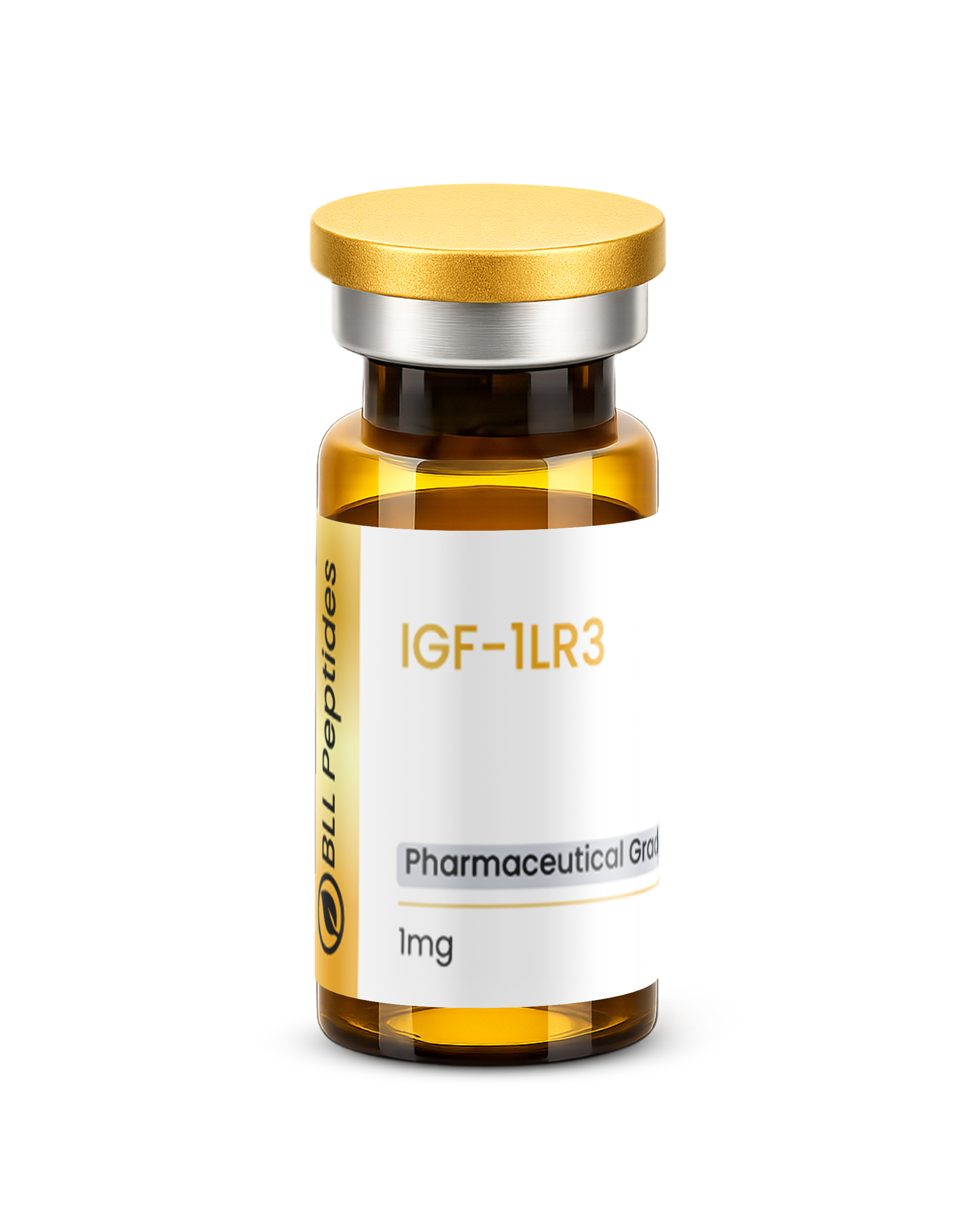
Every neurosurgeon eventually becomes interested in muscle. Not from vanity — from watching patients recover. The patients who do best after major neurological surgery or trauma are almost invariably the ones with the most muscle mass. Sarcopenia — the progressive loss of skeletal muscle with age — is now recognized as one of the strongest predictors of surgical outcomes, recovery speed, and long-term mortality. That’s what drew my attention to IGF-1 LR3: a research compound that sits at the precise intersection of muscle biology and the growth factor signaling that governs it.
IGF-1 LR3 (Long Arginine 3 IGF-1) is a synthetic analogue of human Insulin-like Growth Factor 1 (IGF-1) with a specific structural modification: an 83-amino-acid sequence that includes a 13-amino-acid N-terminal extension and an arginine-for-glutamic acid substitution at position 3. These changes reduce IGF-1 LR3’s binding affinity to IGF binding proteins (IGFBPs) by approximately 1,000-fold compared to native IGF-1, dramatically extending its active half-life from minutes to roughly 20-30 hours and amplifying its receptor-accessible bioavailability.
IGF-1 LR3 and Skeletal Muscle Biology
Skeletal muscle is the largest metabolically active tissue in the body and the primary reservoir of amino acids for systemic use. IGF-1 is the primary growth factor driving skeletal muscle hypertrophy (growth) and counteracting atrophy — it does this through a well-characterized signaling cascade involving the IGF-1 receptor → PI3K → Akt → mTOR pathway, which promotes protein synthesis while simultaneously inhibiting protein degradation through suppression of the FOXO family of atrophy-promoting transcription factors.
Native IGF-1 has a plasma half-life of approximately 10-12 minutes due to rapid IGFBP binding. IGF-1 LR3’s structural modification extends this active window dramatically — making it a valuable research tool for studying sustained IGF-1 receptor signaling rather than acute pulse effects.
The research applications of this extended bioavailability are significant. Many of IGF-1’s effects on muscle satellite cells (the stem cells responsible for muscle repair and growth) require sustained, rather than pulsatile, receptor activation. Satellite cell activation, proliferation, and differentiation — the three stages required for muscle fiber repair and hypertrophy — appear to be optimally driven by prolonged growth factor exposure. IGF-1 LR3 allows researchers to study these sustained effects in ways that aren’t possible with native IGF-1.
Key Research Findings on IGF-1 LR3 and Muscle Growth
In preclinical models, IGF-1 LR3 has consistently demonstrated more potent and sustained anabolic effects on muscle tissue than equivalent doses of native IGF-1. Studies in rodent models have shown significant increases in muscle fiber cross-sectional area, satellite cell activation, and muscle mass — with effects persisting considerably longer than those observed with native IGF-1 (PMID: 8388388).
Muscle atrophy research has been particularly active. In models of denervation atrophy, disuse atrophy, and cachexia (muscle wasting associated with chronic illness), IGF-1 LR3 has shown robust protective effects — reducing the rate of protein catabolism, preserving satellite cell populations, and maintaining muscle fiber integrity. This anti-atrophy capacity is of significant interest to researchers studying neuromuscular disease, aging, and post-surgical recovery.
The hyperplasia question is a distinctive aspect of IGF-1 LR3 research. While most anabolic interventions produce hypertrophy (enlargement of existing muscle fibers), some IGF-1 research suggests that sustained signaling may also promote hyperplasia — the generation of new muscle fibers from satellite cell differentiation. This would represent a fundamentally different mechanism from conventional resistance-exercise-driven hypertrophy and has attracted considerable research interest.
Research comparing local versus systemic administration of IGF-1 LR3 has found that local delivery to specific muscle groups produces hypertrophic effects in the targeted muscle without apparent changes in systemic IGF-1 levels — suggesting a paracrine signaling model rather than purely endocrine effects.
For muscle biology researchers, BPC-157 offers a complementary research perspective on muscle repair through different signaling pathways, while TB-500 provides data on actin-mediated cell migration and satellite cell recruitment. BLL Peptides carries IGF-1 LR3 for research use.
Frequently Asked Questions About IGF-1 LR3 and Muscle Research
- What makes IGF-1 LR3 different from regular IGF-1?
- IGF-1 LR3 has structural modifications that reduce binding to IGF binding proteins by ~1,000-fold, extending its active half-life from ~10 minutes to approximately 20-30 hours. This allows researchers to study sustained IGF-1 receptor signaling.
- What signaling pathway does IGF-1 LR3 activate in muscle tissue?
- IGF-1 LR3 activates the IGF-1 receptor → PI3K → Akt → mTOR pathway, promoting protein synthesis while suppressing FOXO-mediated protein degradation — the primary molecular mechanism of muscle hypertrophy and atrophy prevention.
- What is the difference between muscle hypertrophy and hyperplasia in research?
- Hypertrophy is the enlargement of existing muscle fibers. Hyperplasia is the generation of new muscle fibers from satellite cell differentiation. Some IGF-1 LR3 research suggests potential for both, though hyperplasia in adult human muscle remains a contested area.
- What anti-atrophy research has been done with IGF-1 LR3?
- Studies have examined IGF-1 LR3 in denervation atrophy, disuse atrophy, and cachexia models, finding robust protective effects including reduced protein catabolism, preserved satellite cell populations, and maintained muscle fiber integrity.
Dr. James Nguyen is a neurosurgeon and research advisor at BLL Peptides. His work focuses on peptide research, neurological recovery, and longevity science. All content is for educational and research purposes only.
This content is intended for research purposes only. BLL Peptides products are not intended for human consumption.