

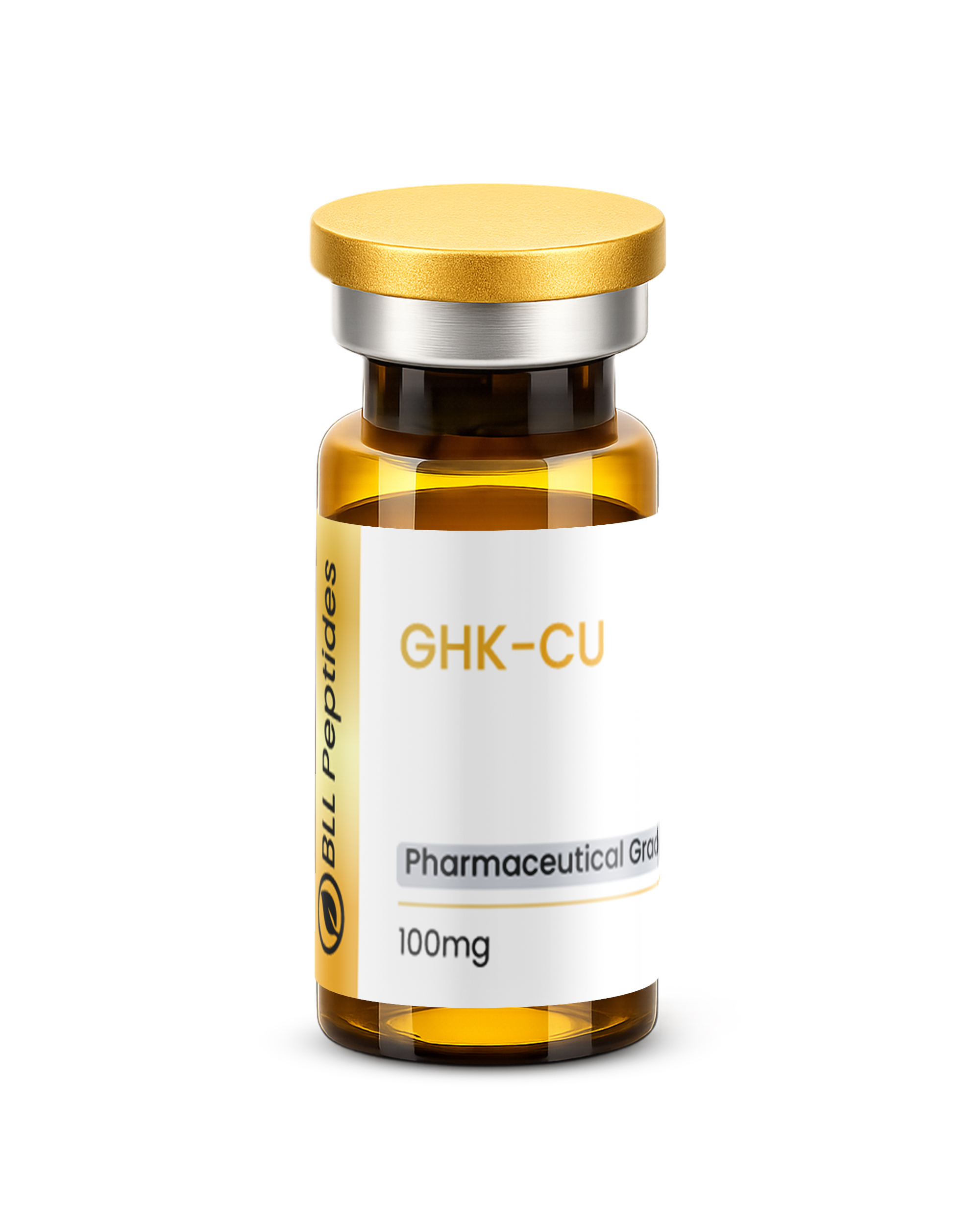
Skin is the largest organ in the body — and one of the most revealing windows into biological age. I don’t say that from a cosmetic standpoint. As a neurosurgeon, I’ve operated on patients from their 30s to their 90s, and the quality of the skin I’m working with — how it holds a suture, how it heals post-operatively — tells me a great deal about their underlying tissue health. The peptide GHK-Cu (copper tripeptide-1) sits in a fascinating scientific space: it’s one of the few compounds where the skin biology research and the systemic aging biology research have converged in genuinely surprising ways.
GHK-Cu is a naturally occurring tripeptide (glycine-histidine-lysine) complexed with copper (Cu²⁺). It was first isolated from human plasma albumin in the 1970s by Loren Pickart, who noted that aging human plasma seemed to lose the ability to stimulate certain liver cell functions — and traced that lost activity to this small copper-binding peptide. Since then, the GHK-Cu research literature has expanded to encompass wound healing, collagen synthesis, anti-inflammatory signaling, antioxidant defense, and remarkably, large-scale gene expression modulation.
GHK-Cu and Skin Biology: The Regeneration Mechanism
In skin tissue, GHK-Cu acts through multiple pathways simultaneously. At the most fundamental level, it stimulates fibroblasts — the cells responsible for producing collagen, elastin, and the extracellular matrix that gives skin its structural integrity. Research has demonstrated that GHK-Cu increases the synthesis of type I and type III collagen, glycosaminoglycans, and decorin (a proteoglycan critical for collagen organization).
The copper component plays an essential catalytic role. Cu²⁺ is a cofactor for lysyl oxidase, the enzyme responsible for crosslinking collagen and elastin fibers — a process essential for forming strong, organized connective tissue rather than the disorganized scar collagen that weakens healing wounds. By delivering copper in a bioavailable, cell-accessible form, GHK-Cu enhances this crosslinking process.
A landmark study found that GHK-Cu applied to aging skin significantly increased dermal fibroblast activity, collagen synthesis, and skin firmness measurements — with effects comparable to retinoic acid in some parameters, the gold standard topical aging intervention.
GHK-Cu also modulates matrix metalloproteinases (MMPs) — enzymes that break down the extracellular matrix. It inhibits excessive MMP activity (which would cause collagen destruction) while preserving the controlled, remodeling-appropriate MMP activity needed for tissue reorganization. This regulatory balance is critical to understanding why GHK-Cu supports organized repair rather than simply stimulating collagen production without quality control.
What the Research Shows on GHK-Cu’s Broader Biology
The aspect of GHK-Cu research that most surprised me when I first encountered it was the gene expression data. A comprehensive analysis by Pickart and colleagues found that GHK-Cu at physiological concentrations modulated the expression of over 4,000 human genes — up-regulating genes associated with tissue repair and protective responses while down-regulating genes associated with inflammation, tumor progression, and destructive collagenase activity (PMID: 25844318).
That’s a remarkable breadth of biological influence for a three-amino-acid peptide. The data suggests GHK-Cu isn’t simply a collagen stimulator — it’s acting as a broad regulatory signal that the body appears to use to initiate and coordinate tissue repair programs.
In skin specifically, human studies have documented reductions in fine lines and wrinkles, improvements in skin firmness and elasticity, and accelerated wound healing following injury — consistent with the fibroblast stimulation, MMP regulation, and collagen synthesis data from in vitro studies.
The concentration-dependent biology of GHK-Cu is worth noting: researchers have found that plasma GHK-Cu levels in young adults (approximately 200 ng/mL) correlate with strong tissue repair capacity, while aging adults show levels below 80 ng/mL — a more than 60% decline that tracks closely with wound healing impairment.
For researchers studying skin biology and tissue regeneration, GHK-Cu represents a well-characterized subject with an unusually deep research base. BLL Peptides supplies GHK-Cu for laboratory research. A complementary research compound is BPC-157, which also influences fibroblast activity and tissue repair through distinct nitric oxide and growth factor pathways. TB-500 offers another parallel lens on actin-mediated wound closure and cell migration.
Frequently Asked Questions About GHK-Cu and Skin Research
- What does GHK-Cu stand for and what makes it biologically active?
- GHK-Cu is glycine-histidine-lysine tripeptide complexed with copper (Cu²⁺). The copper is essential for its biological activity — both as a catalytic cofactor for connective tissue-forming enzymes and as a regulatory modulator of gene expression in repair pathways.
- How does GHK-Cu affect collagen synthesis?
- GHK-Cu stimulates fibroblasts to produce type I and type III collagen, increases glycosaminoglycan synthesis, and enhances lysyl oxidase activity — the enzyme that crosslinks collagen fibers into organized, functional connective tissue.
- What was found in the GHK-Cu gene expression research?
- Analysis found GHK-Cu modulated over 4,000 human genes at physiological concentrations — up-regulating repair and protective genes while down-regulating inflammatory and destructive pathways. This broad regulatory effect suggests GHK-Cu functions as a biological age-reset signal.
- How do GHK-Cu plasma levels change with age?
- GHK-Cu plasma levels decline from approximately 200 ng/mL in young adults to below 80 ng/mL in older individuals — a 60%+ decline that correlates with reduced tissue repair capacity and wound healing impairment.
Dr. James Nguyen is a neurosurgeon and research advisor at BLL Peptides. His work focuses on peptide research, neurological recovery, and longevity science. All content is for educational and research purposes only.
This content is intended for research purposes only. BLL Peptides products are not intended for human consumption.