

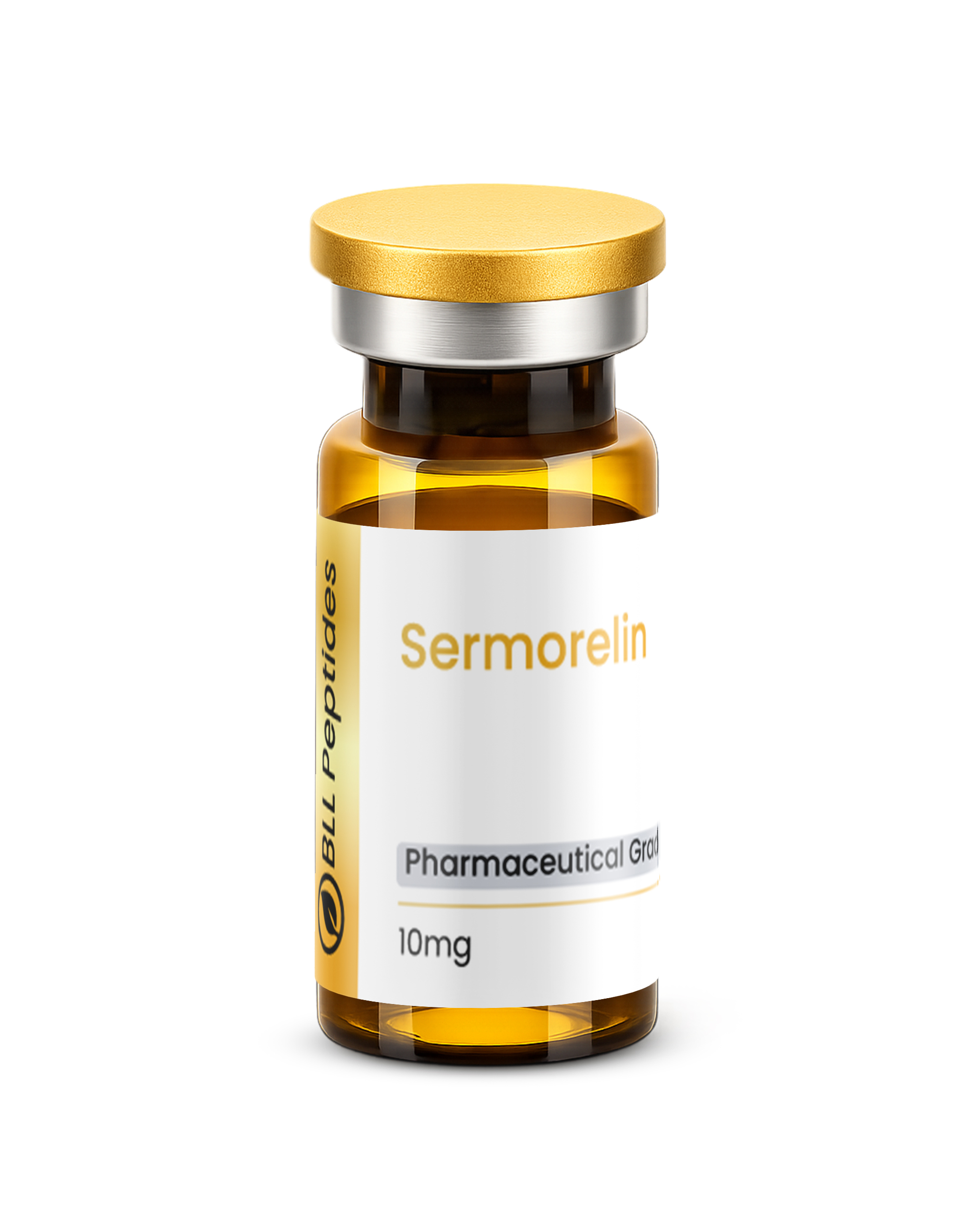
Growth hormone doesn’t just decline with age — it crashes. By the time most people reach their 40s, their pulsatile GH secretion has dropped by more than 50% compared to young adulthood. By their 60s, many are effectively in a state of functional growth hormone deficiency. As a neurosurgeon who works with patients recovering from serious illness and trauma, I’ve become increasingly interested in what this decline means for brain health specifically — and why Sermorelin research has become a serious topic in aging science.
Sermorelin is a synthetic analogue of the first 29 amino acids of human GHRH (growth hormone-releasing hormone) — the endogenous hypothalamic signal that triggers GH pulses from the pituitary. Unlike exogenous HGH (human growth hormone), which bypasses the body’s regulatory architecture entirely, Sermorelin works within the existing feedback system to stimulate the pituitary’s own GH production. That mechanistic difference has significant implications for how researchers interpret the safety and physiological relevance of its effects.
Sermorelin Research and the GH Decline Problem
The growth hormone axis — hypothalamic GHRH → pituitary somatotrophs → GH pulses → IGF-1 → tissue effects — is one of the most comprehensively studied endocrine systems in aging biology. GH and its downstream effector IGF-1 maintain lean body mass, support fat metabolism, drive tissue repair, influence immune function, and in the brain, support neuroprotection and cognitive function.
Somatopause — the term used to describe the age-related decline in GH secretion — is now recognized as a significant contributor to the body composition changes, reduced exercise capacity, impaired recovery, and cognitive changes seen with aging. Critically, research has established that the pituitary gland retains the capacity to produce GH in aging — it’s the hypothalamic GHRH signal that diminishes. This is why Sermorelin, which restores that hypothalamic stimulus, is studied as a potential approach to addressing somatopause.
Studies have shown that the aging pituitary remains responsive to GHRH stimulation — meaning that Sermorelin can potentially reactivate a GH secretory capacity that hasn’t disappeared, just gone quiet.
What the Sermorelin Research Literature Reveals
Human studies on Sermorelin have consistently demonstrated its ability to stimulate pulsatile GH release and raise IGF-1 levels. A placebo-controlled study by Vittone et al. in aging men found that six months of Sermorelin treatment significantly increased IGF-1 levels, improved lean body mass, and reduced body fat — with effects comparable to those seen with direct GH administration but through a physiologically regulated pathway (PMID: 9467543).
The neurological angle has generated particular interest. GH and IGF-1 receptors are expressed throughout the brain, including in hippocampal regions critical for memory consolidation and in prefrontal circuits involved in executive function. Animal studies have shown that GH replacement in GH-deficient models improves spatial memory, increases synaptic plasticity markers, and promotes neurogenesis in the hippocampus. Whether Sermorelin-mediated GH restoration produces equivalent effects is an active research question.
Sleep quality is another area where Sermorelin research has produced interesting data. The majority of daily GH secretion occurs during slow-wave sleep — and one of the consistent findings in aging is the disruption of both slow-wave sleep and nocturnal GH pulsatility. These two phenomena appear to be linked rather than independent, and some researchers have explored whether GHRH stimulation may influence sleep architecture as well as GH output.
Unlike synthetic HGH administration, Sermorelin preserves the body’s negative feedback loop — so GH levels rise within a physiologically bounded range rather than to supraphysiological levels, which has significant implications for the risk profile of GHRH-based research protocols.
For researchers exploring the GH axis, NAD+ provides an interesting parallel lens on cellular energetics and aging, while BPC-157 offers data on tissue repair mechanisms downstream of GH/IGF-1 signaling. BLL Peptides supplies Sermorelin for research use.
Frequently Asked Questions About Sermorelin and GH Decline Research
- How does Sermorelin differ from human growth hormone (HGH)?
- Sermorelin stimulates the pituitary to produce its own GH through the natural hypothalamic-pituitary axis. HGH bypasses this system by delivering exogenous growth hormone directly. Sermorelin preserves the feedback regulatory system; HGH does not.
- What is somatopause and how does Sermorelin research address it?
- Somatopause is the age-related decline in GH secretion, driven primarily by diminishing hypothalamic GHRH output rather than pituitary failure. Sermorelin addresses this by restoring the GHRH stimulus to a still-functional pituitary.
- What brain-related research has been done on Sermorelin?
- Research has explored GH/IGF-1 signaling in hippocampal neurogenesis, memory consolidation, synaptic plasticity, and sleep architecture. While most neurological studies used direct GH, Sermorelin as a GH-stimulating agent offers a more regulated experimental approach.
- Does Sermorelin affect sleep?
- Research suggests connections between GHRH signaling and slow-wave sleep architecture — the sleep stage where most GH secretion occurs. The relationship between Sermorelin, sleep quality, and nocturnal GH pulsatility is an active area of investigation.
Dr. James Nguyen is a neurosurgeon and research advisor at BLL Peptides. His work focuses on peptide research, neurological recovery, and longevity science. All content is for educational and research purposes only.
This content is intended for research purposes only. BLL Peptides products are not intended for human consumption.