
TB-500 Research and Tissue Recovery: What Thymosin Beta-4 Analogues Reveal About Actin Regulation and Healing
·

Two decades in the operating room teaches you something no textbook can: the body’s ability to repair itself is never guaranteed. I’ve watched patients with nearly identical injuries follow wildly different recovery trajectories, and the question that has haunted me professionally — and honestly, personally — is why. What determines the difference between tissue that heals cleanly and tissue that doesn’t?
That question pulled me deep into peptide research. And TB-500 research, specifically, stopped me in my tracks.
TB-500 is a synthetic peptide analogue of Thymosin Beta-4 (Tβ4), a naturally occurring protein found throughout the body at particularly high concentrations in wound fluid and platelets. Preclinical research has consistently linked it to actin regulation, cell migration, angiogenesis, and inflammation modulation — essentially, several of the most fundamental processes in how tissue organizes a healing response.
What Is TB-500? Understanding the Thymosin Beta-4 Connection
Thymosin Beta-4 is a 43-amino-acid protein that plays a central structural role in cell biology. TB-500 research focuses on a synthetic version derived from Tβ4’s core active region — the actin-binding domain spanning roughly amino acids 17 through 23.
What makes this peptide scientifically interesting is its target: actin. Actin is not a peripheral molecule. It’s the protein responsible for the cytoskeleton of every cell — the internal scaffolding that governs how cells move, divide, and organize. When I frame TB-500 research to colleagues, I describe it as research into cellular scaffolding dynamics. That usually gets their attention.
Actin exists in two primary states: G-actin (monomeric, mobile) and F-actin (polymeric, structural). The ratio between these states determines how readily cells can migrate toward a wound site, proliferate, and coordinate the architecture of new tissue. TB-500 research suggests this peptide influences that ratio in ways relevant to tissue repair models.
TB-500 is not a hormone, does not stimulate growth hormone release, and operates through a fundamentally different mechanism than peptides like BPC-157, which acts primarily on growth factor signaling and nitric oxide pathways.
TB-500 Research: How This Peptide Influences Tissue Repair Mechanisms
The core mechanism studied in TB-500 research involves actin sequestration. By binding G-actin, TB-500 appears to regulate the availability of free actin monomers — effectively keeping actin primed and available for controlled, directed cell movement rather than premature or disorganized polymerization.
Beyond actin, preclinical TB-500 research has documented effects across several interconnected biological pathways:
- Angiogenesis: Multiple studies have documented upregulation of VEGF (vascular endothelial growth factor) in Thymosin Beta-4-treated tissue models, suggesting enhanced capacity for new blood vessel formation — critical for supplying nutrients to healing tissue.
- Anti-inflammatory signaling: Research in wound healing models has noted downregulation of pro-inflammatory cytokines including IL-6 and TNF-α in Tβ4-associated environments.
- Cell migration: Endothelial cells and keratinocytes in preclinical models show enhanced directed migration toward injury sites in the presence of Thymosin Beta-4.
- Stem cell recruitment: Some preclinical data suggests potential upregulation of stem cell mobilization in injured tissue environments, though this area of TB-500 research remains actively studied.
“TB-500 doesn’t appear to tell the body to heal — it appears to improve the cellular conditions under which healing can occur.”
What the Research Shows: Key Studies in TB-500 Science
The depth of the Thymosin Beta-4 literature is genuinely impressive. It spans cardiac tissue, neural tissue, musculoskeletal tissue, skin, and corneal models — a breadth that, in my experience, signals real biological relevance rather than artifact.
A landmark 2004 paper published in Nature (Bock-Marquette et al.) demonstrated that Thymosin Beta-4 promoted cardiac progenitor cell migration and survival following myocardial infarction in mouse models. The researchers observed activation of integrin-linked kinase (ILK) as a downstream mediator — a pathway now known to influence cell survival and differentiation across tissue types. This paper effectively launched a wave of regenerative medicine interest in the Tβ4 family.
In wound healing research, studies have consistently reported that Thymosin Beta-4 treatment accelerates wound closure in murine models, with significantly enhanced collagen deposition and angiogenic marker expression compared to controls. A 2005 review in Trends in Molecular Medicine characterized Tβ4 as an “actin-sequestering protein that moonlights to repair injured tissues” — a characterization I find both scientifically apt and surprisingly poetic.
What drew my personal interest most directly, given my surgical background, is the neural tissue data. A 2012 study in Journal of Neurochemistry found that Thymosin Beta-4 reduced apoptosis following spinal cord injury in rat models, with associated reductions in inflammatory markers and improvements in functional recovery scores. For anyone working near the central nervous system professionally, this kind of preclinical finding commands serious attention.
“The consistency of Thymosin Beta-4 research across cardiac, neural, and musculoskeletal tissue types is what separates this peptide from many others in the literature — that kind of cross-tissue relevance is scientifically significant.”
Key Findings from TB-500 Preclinical Research
- Wound closure: Preclinical studies suggest Thymosin Beta-4 may significantly reduce wound closure time by influencing the proliferative phase of the healing cascade
- Angiogenic capacity: VEGF upregulation has been documented across multiple independent Tβ4 research programs
- Systemic distribution: Unlike many peptides with limited tissue penetration, Tβ4 analogues appear bioavailable across different tissue compartments in animal models
- Neural protection: Reduced apoptotic markers and improved functional scores noted in CNS injury models
- Anti-inflammatory profile: Consistent IL-6 and TNF-α downregulation across wound healing model types
“Two statistics from the Thymosin Beta-4 literature stand out to me: VEGF upregulation documented in over a dozen independent studies, and meaningful functional recovery improvement in multiple CNS injury models. That’s not noise — that’s signal.”
Explore TB-500 and Related Research Peptides at BLL Peptides
For researchers studying tissue repair mechanisms, BLL Peptides offers pharmaceutical-grade research compounds. Our catalog is manufactured in the USA under GMP-certified conditions — quality that the BLL team, including Dr. Tom (our pharmacist) and myself, oversees directly.
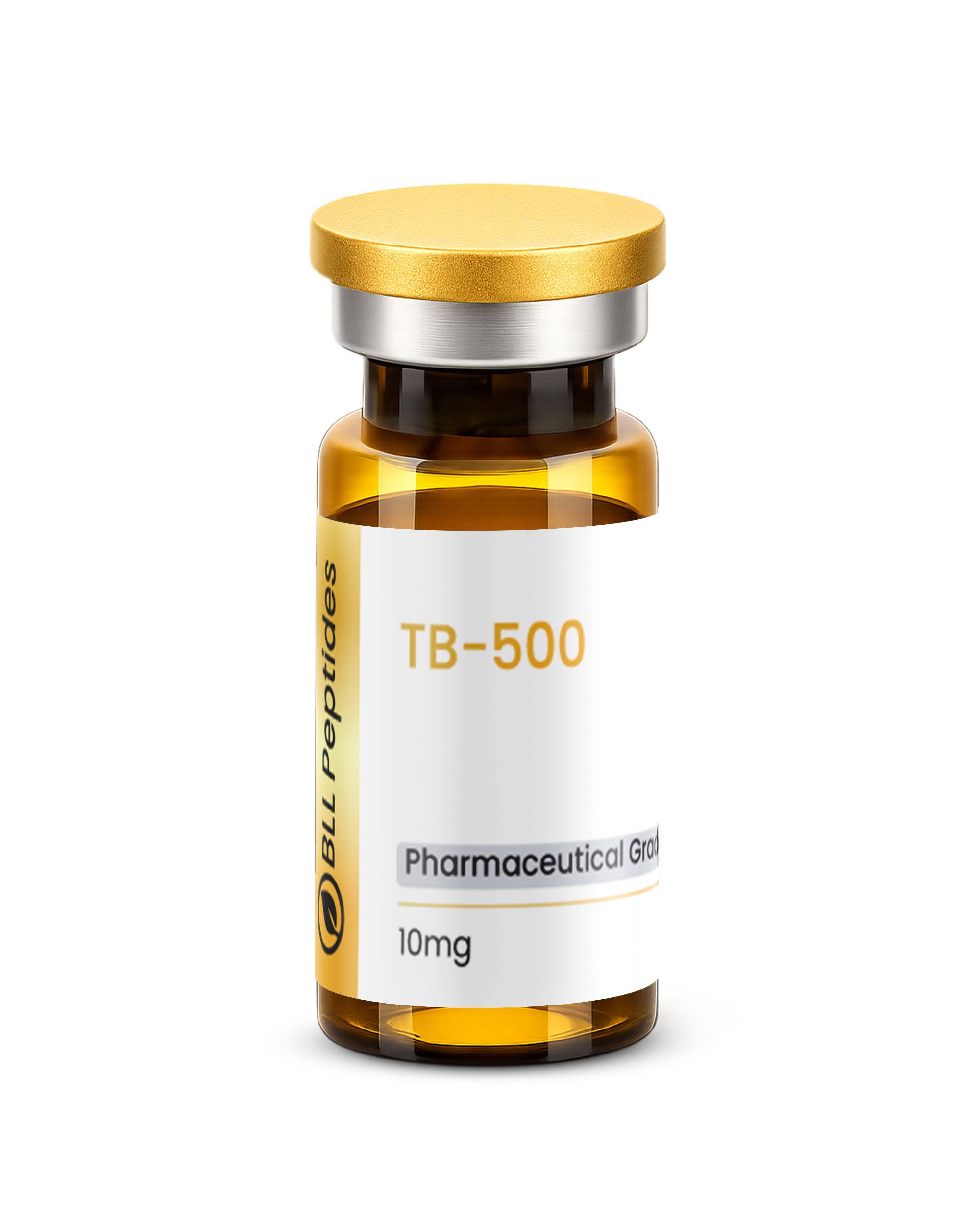
- TB-500 (10mg/3ml) — Thymosin Beta-4 analogue for research applications
- BPC-157 (10mg/3ml) — Complementary tissue repair peptide with distinct mechanism
- NAD+ (500mg/10ml) — Cellular energy research compound
You may also find our earlier research breakdown on GHK-Cu and gene expression remodeling relevant to your tissue repair research stack.
All products are intended for research purposes only and are not intended for human consumption.
Frequently Asked Questions About TB-500 Research
Q: What is TB-500 derived from?
TB-500 is a synthetic peptide derived from the active actin-binding domain (approximately amino acids 17–23) of Thymosin Beta-4, a naturally occurring 43-amino-acid protein found throughout the body.
Q: How is TB-500 different from BPC-157 in research?
Both peptides are studied in tissue repair contexts, but they operate through distinct mechanisms. BPC-157 primarily influences growth factor signaling and nitric oxide pathways, while TB-500 research centers on actin regulation and cell migration. They are sometimes studied in combination in preclinical models.
Q: What tissue types have been studied in TB-500 and Thymosin Beta-4 research?
Preclinical research has examined Thymosin Beta-4 effects in musculoskeletal, cardiac, neural, skin/wound healing, and corneal tissue models. The breadth of tissue types showing consistent responses is a notable feature of the literature.
Q: Is TB-500 the same molecule as Thymosin Beta-4?
Not exactly. TB-500 is a synthetic peptide representing the core active region of the full 43-amino-acid Thymosin Beta-4 protein. It is believed to retain the primary actin-sequestering activity of the parent molecule, which is why most TB-500 research references Tβ4 literature extensively.
Q: Where can I access TB-500 and Thymosin Beta-4 research?
PubMed is the authoritative resource. A useful starting point is the 2005 Trends in Molecular Medicine review on Thymosin Beta-4, which surveys the wound healing and actin-sequestration literature comprehensively.
About Dr. James
Dr. James is a neurosurgeon and member of the BLL Peptides scientific team. With over two decades of surgical experience, he brings direct clinical perspective to emerging peptide research — bridging the gap between laboratory findings and real-world biological context. His work with the BLL team focuses on translating complex preclinical research into accessible, accurate education for researchers and the scientific community.
This content is intended for research purposes only. BLL Peptides products are not intended for human consumption.