
Semax Research: BDNF Upregulation, Neuroprotection, and What the Studies Show
·

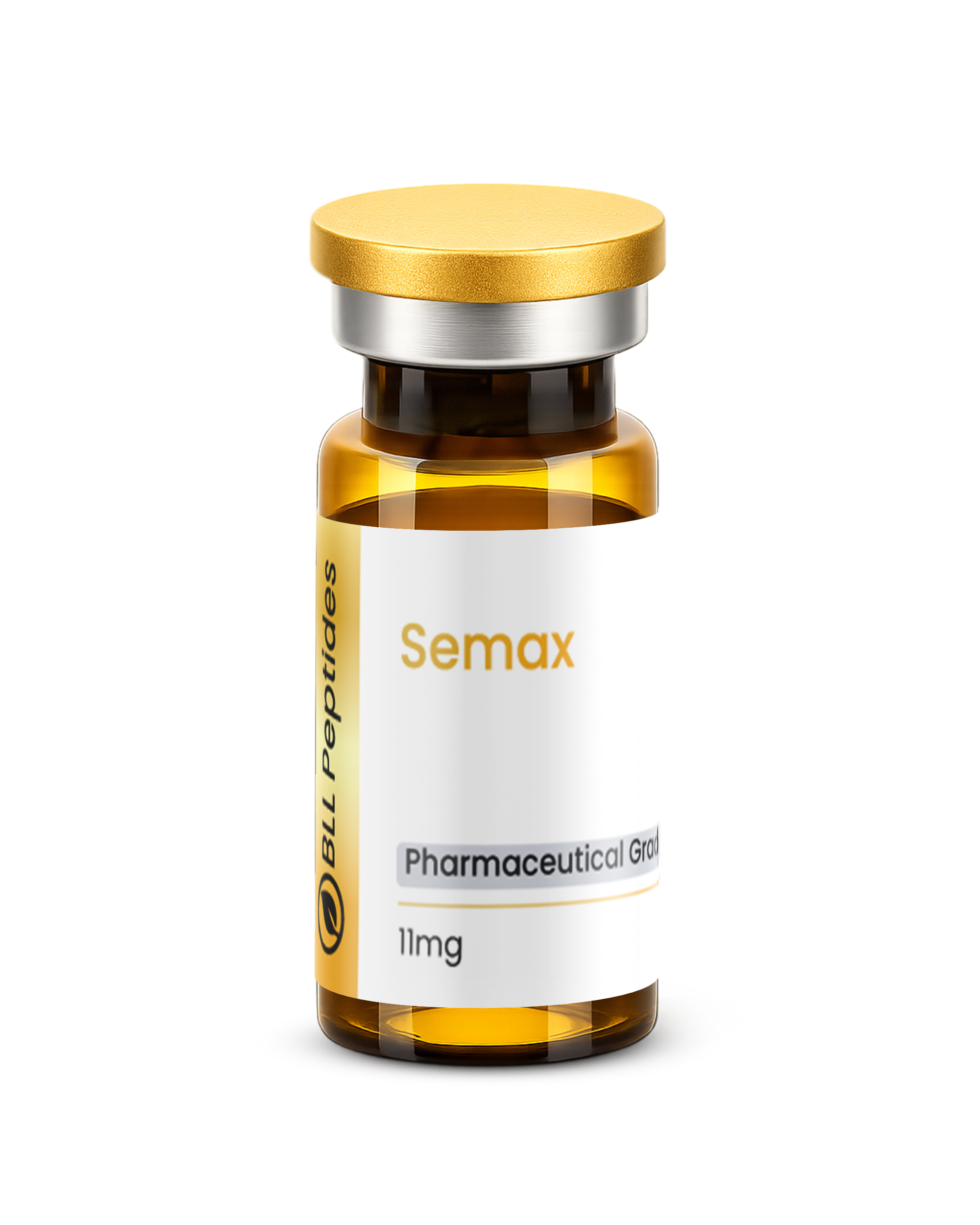
Most peptides work on muscle, fat, or connective tissue. Semax works on the brain — and specifically on one of the most important molecules in all of neuroscience: brain-derived neurotrophic factor (BDNF).
As someone who operates on the nervous system daily, I can tell you that BDNF is not a peripheral detail. It is central to neuroplasticity, neuron survival, and the brain’s capacity to adapt after injury. The fact that a synthetic peptide reliably upregulates it — even transiently — is exactly the kind of finding that keeps me reading the literature at midnight. Semax has been on my radar for years, and the research profile holds up.
This is a complete research breakdown of Semax: mechanisms, key studies, clinical data, and what the literature actually supports.
What Is Semax?
Semax is a synthetic heptapeptide derived from the N-terminal sequence of adrenocorticotropic hormone (ACTH). Specifically, it is based on the ACTH(4-10) fragment — Met-Glu-His-Phe-Pro-Gly-Pro — a region of the ACTH molecule that does not stimulate corticosteroid release but retains significant neurotropic activity.
It was developed in the 1980s by the Institute of Molecular Genetics of the Russian Academy of Sciences and has been used clinically in Russia and Eastern Europe primarily as a neuroprotective and nootropic agent. That gives it an unusually long clinical history compared to most research peptides — and a body of human-facing data that most compounds in this space simply do not have.
Key structural fact: The ACTH(4-10) fragment retains melanocortin receptor affinity but has been stripped of the pituitary-stimulating and cortisol-releasing properties of full ACTH. This specificity is central to its research profile.
How Semax Works: The BDNF and Neurotrophin Mechanism
Semax’s primary research-defined mechanism involves neurotrophin signaling — most prominently BDNF, but also nerve growth factor (NGF) and related pathways.
BDNF Upregulation
Multiple animal studies have documented that Semax administration produces significant increases in BDNF mRNA expression in the hippocampus, frontal cortex, and basal forebrain. This effect appears rapidly — measurable within hours in rodent models. In a landmark study by Dolotov et al. published in the Journal of Neurochemistry, Semax produced a 1.4-fold increase in BDNF mRNA in the rat hippocampus at low doses within hours of administration.
Why does this matter? BDNF is the primary growth factor supporting:
- Survival of existing neurons
- Synaptic plasticity and long-term potentiation (the cellular basis of learning and memory)
- Hippocampal neurogenesis
- Protection against neuronal apoptosis following ischemic or toxic insult
NGF and Melanocortin Receptor Activity
Beyond BDNF, Semax also appears to influence NGF expression — a neurotrophin supporting cholinergic neurons in the basal forebrain, critically involved in attention and memory. As an ACTH fragment analog, Semax retains affinity for melanocortin receptors (particularly MC4R), which are expressed throughout the brain and contribute to its behavioral and trophic effects through downstream signaling cascades.
The upstream distinction: Unlike synthetic stimulants that boost acute cognitive performance through neurotransmitter depletion, Semax’s proposed mechanism works upstream — through trophic factor expression that supports the structural biology of neuroplasticity itself.
Semax Research: What the Studies Show
Ischemic Stroke — The Most Compelling Human Data
As a neurosurgeon, this is the research area I find most immediately relevant. Semax has generated the most substantial human evidence base in acute ischemic stroke research.
Gusev et al. (2002) conducted a randomized controlled trial in acute ischemic stroke patients showing that Semax treatment was associated with significantly better neurological outcomes at 14 days compared to standard care controls. Mechanistic parallel studies showed Semax reduced the expression of pro-inflammatory genes and upregulated neurotrophic genes in the ischemic penumbra — the zone of at-risk but potentially salvageable tissue surrounding an infarct core.
That last point is particularly important from a neuroscience standpoint. The penumbra is exactly where trophic interventions have theoretical relevance — neurons there are metabolically stressed but not yet dead, and BDNF-pathway support has a plausible mechanism for preserving them.
Cognitive and Attention Research
- Animal models consistently show improved learning performance in memory tasks (Morris water maze, passive avoidance) following Semax administration
- Research indicates effects on both dopaminergic and serotonergic neurotransmission — systems central to attention, working memory, and executive function
- Early human data from Russian clinical use showed subjective improvements in attention and cognitive performance in healthy volunteers
Optic Nerve and Neuroprotective Models
One of Semax’s more specific applications has been in optic nerve damage research — glaucoma models and ischemic optic neuropathy. Russian clinical data suggests neuroprotective effects on retinal ganglion cells, which are CNS neurons that cannot regenerate after damage — making neuroprotective interventions the only viable research direction.
In rodent neurotoxin models, Semax pretreatment consistently reduced neuronal loss and improved behavioral outcomes — findings mechanistically consistent with BDNF-mediated neuroprotection documented in the hippocampal studies.
Key Research Findings
“Semax produced a 1.4-fold increase in BDNF mRNA expression in the rat hippocampus — one of the most reproducible neurotrophin-upregulating findings in the research peptide literature.”
“In a controlled clinical trial, Semax in acute ischemic stroke was associated with significantly improved neurological outcomes at 14 days — representing rare human-level evidence for a research peptide compound.”
“Semax’s mechanism is upstream: it works through trophic factor expression that supports the structural biology of neuroplasticity, not through direct neurotransmitter manipulation.”
Key statistics from the literature:
- 1.4× BDNF mRNA increase in hippocampus (Dolotov et al., Journal of Neurochemistry)
- BDNF expression changes measurable within 2–4 hours of administration in rodent models
- Human stroke trial with 14-day neurological outcome improvement vs. standard care (Gusev et al., 2002)
For the primary BDNF research, see: Dolotov et al., Journal of Neurochemistry — Semax and BDNF in the rat brain (PubMed)
Semax and Related Research Compounds at BLL Peptides
For researchers studying neuroprotection, BDNF modulation, and cognitive neuroscience, Semax is one of the more compelling compounds in the peptide research space — particularly given its relatively robust clinical data and well-defined mechanistic rationale via neurotrophin pathways.
BLL Peptides carries pharmaceutical-grade research compounds with third-party COA on every batch. Relevant compounds for neuroprotection and neurometabolic research:
Pharmaceutical grade. Third-party COA on every batch. → bllpeptides.com
Related Research Articles
- BPC-157 vs TB-500: What the Research Shows and How They Differ
- Tesamorelin Research: Growth Hormone Release, Mechanisms, and What the Studies Show
Frequently Asked Questions: Semax Research
Q: What is Semax?
Semax is a synthetic heptapeptide derived from the ACTH(4–10) fragment — a sequence of adrenocorticotropic hormone that retains neurotropic activity without producing cortisol release. Developed in Russia and studied for neuroprotective, stroke recovery, and cognitive applications, it is notable for reliably upregulating BDNF and NGF in preclinical models.
Q: What does Semax do to BDNF?
Multiple rodent studies show Semax produces significant, rapid increases in BDNF mRNA expression — particularly in the hippocampus and frontal cortex. The Dolotov et al. study documented a 1.4-fold increase measurable within hours of administration. BDNF upregulation is considered Semax’s primary mechanistic signature and the basis of its proposed neuroprotective and cognitive research effects.
Q: Is there human research data on Semax?
Yes — Semax has more human evidence than most research peptides. The Gusev et al. (2002) randomized trial in acute ischemic stroke patients showed improved neurological outcomes at 14 days. Additional human data exists for optic nerve conditions from Russian clinical use. These studies are generally older and smaller than modern clinical trial standards, but represent genuine controlled human data.
Q: How does Semax differ from other nootropic research peptides?
Semax’s key distinction is its direct effect on neurotrophin expression — BDNF and NGF upregulation — which operates upstream of most other nootropic compounds. Rather than modulating neurotransmitter levels acutely, Semax works through trophic factor pathways that support neuronal health and synaptic plasticity at a structural level.
Q: How does Semax relate to Selank?
Semax and Selank are both Russian-developed CNS research peptides but structurally and mechanistically distinct. Selank is based on tuftsin and primarily studied for anxiolytic and immunomodulatory effects. Semax is based on ACTH and primarily studied for neuroprotective and cognitive effects via neurotrophin pathways. Some researchers study them in parallel, but they address different biological questions.
About the Author
Dr. James Nguyen is a board-certified neurosurgeon trained at Yale University with over 20 years of clinical and research experience. His practice focuses on complex spine and cranial procedures, and his research interests include neuroprotective mechanisms, tissue regeneration, and the emerging science of peptide-based compounds in preclinical models. Dr. Nguyen serves as Medical Advisor to BLL Peptides, where he oversees scientific integrity and authors the research blog. All content is written for research and educational purposes only and does not constitute medical advice.
Disclaimer: This content is intended for research purposes only. BLL Peptides products are not intended for human consumption.