NAD+ and Mitochondrial Energy Research: How This Coenzyme Powers Cellular Function
·

Energy is the currency of biology. Every cellular process — from protein synthesis to axonal signaling — requires it. And at the center of how cells actually generate that energy sits a molecule that most people have heard of but few have fully appreciated: NAD+.
Nicotinamide adenine dinucleotide (NAD+) isn’t a hormone or a growth factor. It’s a coenzyme — a small molecule that enzymes need to function. But its role in mitochondrial energy production is so fundamental that understanding NAD+ biology is essentially understanding how cells stay alive. That’s a topic I return to repeatedly, both in research and in thinking about what drives the clinical deterioration I see in aging patients.
What Is NAD+ and Why Does It Matter for Energy?
NAD+ (the oxidized form) and NADH (the reduced form) cycle back and forth, accepting and donating electrons in the metabolic reactions that power the cell. This redox cycling is the foundation of cellular energy metabolism.
NAD+ participates in over 500 enzymatic reactions — but its most critical role in energy production occurs in the mitochondria, specifically in the electron transport chain (ETC). Without sufficient NAD+, the ETC cannot function efficiently, ATP production drops, and cells lose the energy needed to maintain normal function.
The problem is that NAD+ levels decline with age — systematically and measurably. Research has documented 40-60% reductions in NAD+ levels between young adulthood and old age in multiple tissues including skeletal muscle, brain, liver, and skin. This decline isn’t trivial; it’s increasingly understood as a central driver of the mitochondrial dysfunction that underlies aging and age-related disease.
For context on how other compounds support mitochondrial health through different mechanisms, our analysis of SS-31 research explores a mitochondria-targeted peptide that protects cardiolipin and ETC supercomplex integrity.
NAD+ in the Mitochondrial Energy Cascade
Let’s trace how NAD+ actually powers ATP synthesis — the process that generates the cellular energy currency used for virtually everything:
Glycolysis (cytoplasm): Glucose is broken down to pyruvate, generating 2 NADH molecules per glucose. These carry electrons to the mitochondria.
Krebs Cycle (mitochondrial matrix): Pyruvate (and fatty acids via beta-oxidation) are further oxidized, generating 3 NADH and 1 FADH2 per turn of the cycle. This is where the bulk of electrons destined for ATP synthesis are captured.
Electron Transport Chain (inner mitochondrial membrane): NADH donates its electrons to Complex I of the ETC. As electrons flow through Complexes I → III → IV, protons are pumped across the inner membrane, creating the proton gradient that drives ATP synthase. Each NADH molecule donated to Complex I enables the synthesis of approximately 2.5 ATP molecules.
NAD+ regeneration: After donating electrons, NADH becomes NAD+ again — ready to accept more electrons. This cycling is continuous during active metabolism. The speed and efficiency of this cycle determines how fast cells can generate energy.
When NAD+ levels fall — as they do with age, cellular stress, or mitochondrial damage — this electron cycling slows. The ETC becomes less efficient, proton gradient generation decreases, and ATP output drops. The cell enters a state of energetic insufficiency that impairs every process requiring energy: protein folding, DNA repair, signal transduction, contractile function.
What the Research Shows
The research literature on NAD+ and mitochondrial function has expanded dramatically over the past decade, driven partly by the discovery of NAD+ as a substrate for sirtuins (SIRT1-7) — protein deacetylases that regulate mitochondrial biogenesis, DNA repair, and stress responses.
A landmark study published in Cell by David Sinclair’s group at Harvard demonstrated that NAD+ supplementation via precursor (NMN) restored mitochondrial function in aged mice to levels resembling much younger animals. Crucially, the effects were observed in skeletal muscle, where age-related NAD+ decline was most pronounced. Two-year-old mice treated with NMN showed mitochondrial respiration rates comparable to six-month-old controls — a striking demonstration of functional restoration.
Research on direct NAD+ supplementation (as opposed to precursors) has explored the bioavailability question. A 2022 trial published in Nature Aging found that intravenous NAD+ produced rapid, dose-dependent increases in blood NAD+ and its metabolites, with cellular uptake confirmed in immune cells. Muscle bioenergetics improved measurably at higher doses.
In neurological research — my area of closest attention — NAD+ depletion is implicated in the pathophysiology of multiple neurodegenerative conditions. The brain is an exceptionally high energy consumer (~20% of total body energy use at ~2% of body mass), making neurons particularly vulnerable to NAD+-dependent energy failure. Studies in models of Alzheimer’s and Parkinson’s disease have found that maintaining NAD+ levels attenuates neuronal loss and preserves cognitive function.
MOTS-c — a mitochondria-derived peptide that regulates metabolic homeostasis — works through a complementary pathway. See our MOTS-c research analysis for how mitochondrial signaling peptides interface with NAD+ metabolism.
Key Research Findings
- 40-60% reduction in tissue NAD+ levels between young adulthood and old age
- NAD+ participates in over 500 enzymatic reactions, with ETC function as a primary role
- Each NADH molecule enables synthesis of ~2.5 ATP molecules via Complex I
- NAD+ restoration via NMN reversed mitochondrial aging markers in aged mice
- IV NAD+ produces measurable cellular uptake and bioenergetics improvement in human trials
- Brain neurons (high energy consumers) are particularly vulnerable to NAD+ decline
- Sirtuin activation by NAD+ connects energy metabolism to DNA repair and longevity pathways
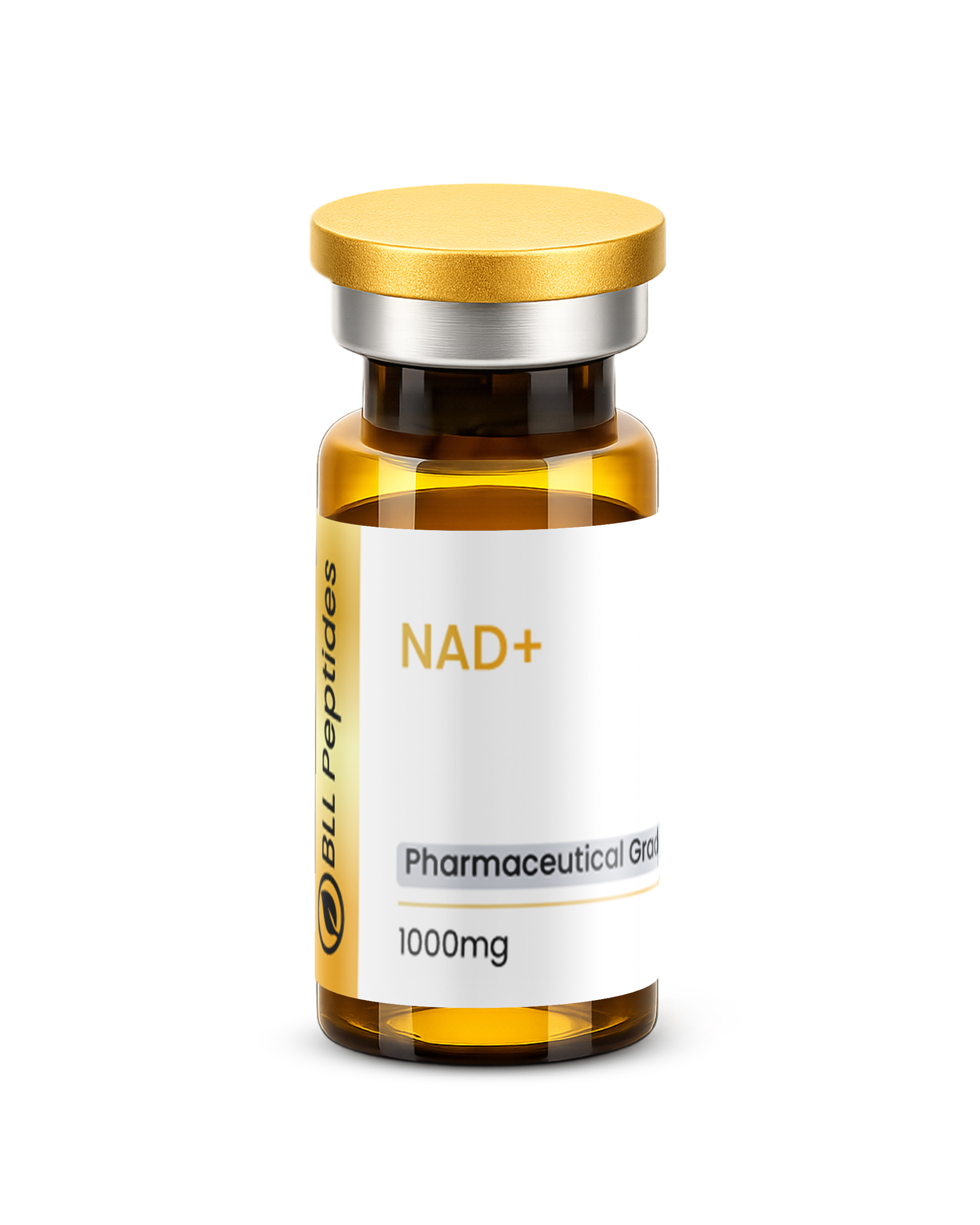
BLL Peptides offers NAD+ research compound for laboratory research applications.
Frequently Asked Questions About NAD+ Energy Research
Q: What is the difference between NAD+ and NADH?
A: NAD+ is the oxidized form — it accepts electrons and becomes NADH (the reduced form). NADH donates its electrons to the electron transport chain, regenerating NAD+. This cycling is continuous in metabolically active cells.
Q: Why do NAD+ levels decline with age?
A: Multiple mechanisms contribute: increased NAD+ consumption by PARP enzymes (activated by DNA damage), reduced biosynthesis, and decreased activity of the NAD+ salvage pathway. CD38, a NAD+-consuming enzyme expressed on immune cells, also increases with age and is a major driver of age-related NAD+ decline.
Q: What are sirtuins and how do they relate to NAD+?
A: Sirtuins (SIRT1-7) are NAD+-dependent deacetylase enzymes that regulate mitochondrial biogenesis (SIRT1, SIRT3), DNA repair (SIRT1, SIRT6), and metabolic homeostasis. They consume NAD+ in their catalytic cycle, which is why NAD+ availability directly regulates sirtuin activity.
Q: What is the difference between NAD+ and NMN/NR supplementation in research?
A: NMN (nicotinamide mononucleotide) and NR (nicotinamide riboside) are NAD+ precursors that are converted to NAD+ intracellularly. Direct NAD+ supplementation bypasses this conversion step. Research is ongoing to determine which approach most efficiently elevates tissue NAD+ levels in different experimental contexts.
Q: How does NAD+ biology connect to neurodegeneration research?
A: Neurons have extremely high energy demands and limited metabolic flexibility. NAD+ depletion impairs both energy production and DNA repair in neural tissue. Research in models of Alzheimer’s, Parkinson’s, and ALS has found that maintaining NAD+ levels attenuates neuronal loss — making it an active target in neurodegeneration research.
Related Research
If you found this research overview helpful, explore our related guides:
About the Author: Dr. James is a board-certified neurosurgeon with over 15 years of clinical experience. His interest in cellular bioenergetics stems from the central role of mitochondrial function in neurological health and disease. He contributes research analysis and scientific commentary to BLL Peptides.
This content is intended for research purposes only. BLL Peptides products are not intended for human consumption.