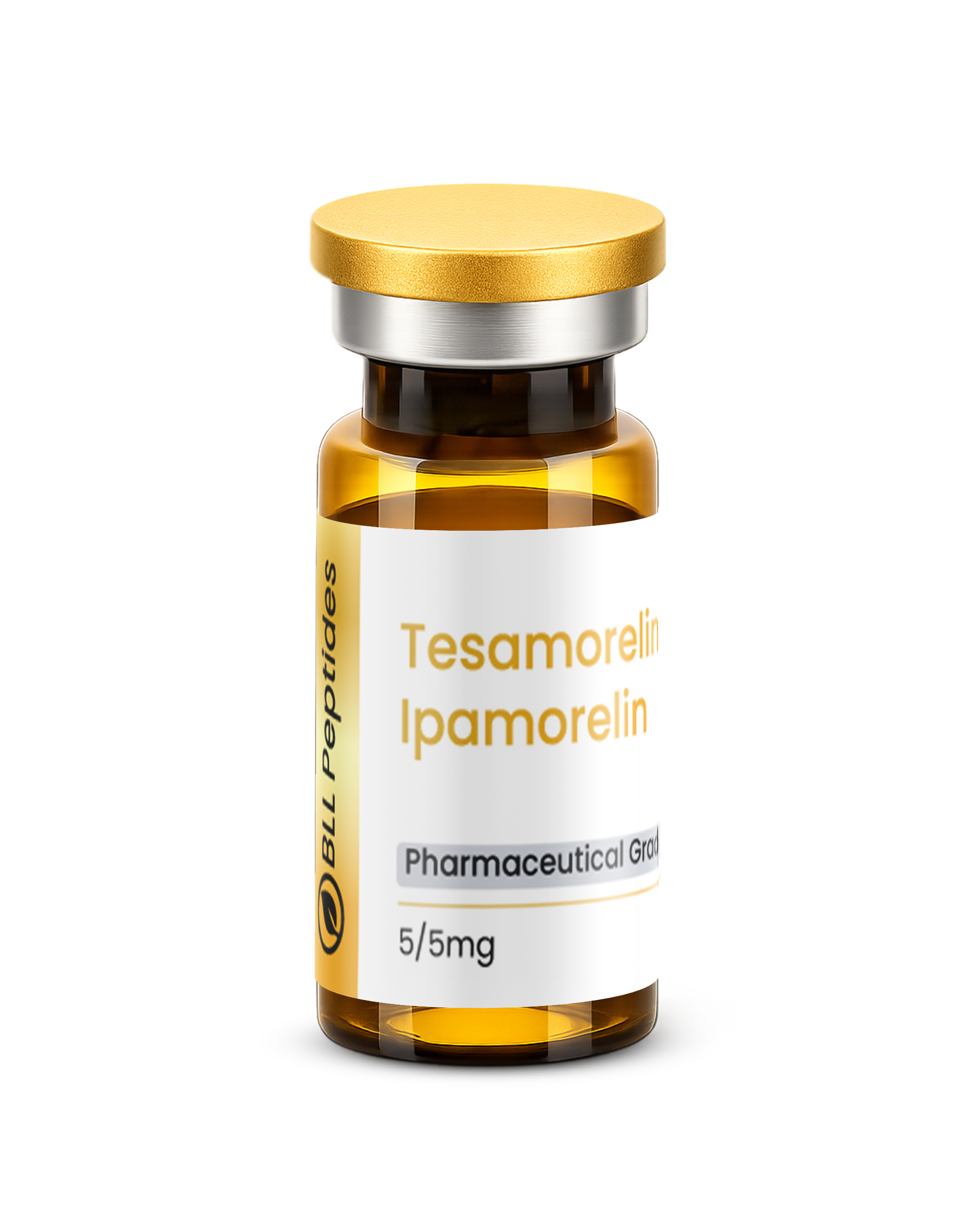
Description
Tesamorelin / Ipamorelin: Complete Research Guide – Synergistic GHRH/GHRP Mechanisms, Growth Hormone Axis Research, and Combined Applications
Last updated: March 2026
Executive Summary
Tesamorelin/Ipamorelin is a combination peptide formulation that pairs two mechanistically distinct growth hormone (GH) secretagogues targeting complementary receptor pathways on anterior pituitary somatotroph cells. Tesamorelin is a synthetic 44-amino acid analog of human growth hormone-releasing hormone (GHRH), with a molecular weight of approximately 5,136 Da and a trans-3-hexenoic acid modification at the N-terminus that confers enhanced proteolytic stability. Ipamorelin is a synthetic pentapeptide growth hormone secretagogue with the sequence Aib-His-D-2-Nal-D-Phe-Lys-NH2, a molecular weight of approximately 711 Da, and highly selective agonist activity at the growth hormone secretagogue receptor 1a (GHS-R1a, the ghrelin receptor) [1, 2].
The pharmacological rationale for this combination rests on the well-established synergy between GHRH receptor (GHRH-R) activation and ghrelin receptor (GHS-R1a) activation. Tesamorelin binds the GHRH-R on somatotroph cells, driving GH gene transcription and priming secretory granules through a cAMP/PKA-dependent signaling cascade. Ipamorelin binds GHS-R1a on the same cells, amplifying GH pulse amplitude through a complementary phospholipase C/IP3/calcium pathway. When co-administered, these two peptides produce GH pulses that are synergistic rather than merely additive — a phenomenon extensively documented across decades of GHRH/GHRP interaction research [3, 4].
Tesamorelin holds a unique distinction among GHRH analogs: it is the only GHRH-based peptide with current FDA approval (Egrifta/Egrifta SV, approved 2010 for HIV-associated lipodystrophy), providing a substantial body of clinical safety and efficacy data not available for other GHRH analogs. Ipamorelin, developed by Novo Nordisk in 1998, is the most GH-selective ghrelin receptor agonist ever characterized, producing robust GH release with no clinically meaningful effects on cortisol, prolactin, or ACTH at GH-effective doses [2, 5]. The Tesamorelin/Ipamorelin combination thus represents a pairing of the most clinically validated GHRH analog with the most selective GHRP, targeting two distinct receptor pathways for potentiated pulsatile GH release.
For comprehensive information on each peptide individually, see the Tesamorelin Complete Research Guide and the Ipamorelin Complete Research Guide.
Interactive Molecular Structure
The following interactive 3D visualization displays both the Tesamorelin (44-residue GHRH analog, left) and Ipamorelin (5-residue synthetic pentapeptide, right) structures side by side. The dramatic size difference between the full-length GHRH analog and the compact ghrelin mimetic illustrates the two fundamentally different pharmacological strategies: Tesamorelin is a large peptide hormone analog that closely replicates the endogenous GHRH signal, while Ipamorelin is a minimalist synthetic peptidomimetic designed for maximal receptor selectivity.
Legend: The dual visualization shows Tesamorelin (left, 44-residue alpha-helix in teal/cyan) and Ipamorelin (right, 5-residue compact peptidomimetic in red/coral). Tesamorelin is a full-length GHRH analog that closely replicates the endogenous 44-amino acid GHRH signal, binding the GHRH receptor to drive GH synthesis and secretory granule priming. Ipamorelin is a minimalist ghrelin receptor agonist whose five residues — including three non-natural amino acids (Aib, D-2-Naphthylalanine, D-Phe) — provide exceptional receptor selectivity and metabolic stability. The orange node (Aib1) highlights the alpha-aminoisobutyric acid cap that protects the N-terminus from exopeptidases. Drag to rotate; scroll to zoom.
Table of Contents
- Introduction and Development History
- Molecular Structure and Chemistry
- Detailed Mechanism of Action
- Scientific Research Review
- Comparison with Other GH Secretagogues
- Safety Profile and Pharmacology
- Research Applications
- References
- Disclaimer
Introduction and Development History
The Dual Regulatory System of GH Secretion
Growth hormone release from anterior pituitary somatotroph cells is governed by two major stimulatory pathways and one inhibitory pathway. Understanding this tripartite regulatory architecture is essential for appreciating the rationale behind the Tesamorelin/Ipamorelin combination.
The GHRH pathway (stimulatory): Growth hormone-releasing hormone was identified in 1982 when two independent groups — Guillemin and colleagues at the Salk Institute and Rivier and Vale at the same institution — isolated a 44-amino acid peptide from a pancreatic tumor causing ectopic GH hypersecretion. GHRH was subsequently confirmed as the primary hypothalamic factor driving GH gene transcription, somatotroph proliferation, and pulsatile GH secretion via the GHRH receptor (GHRH-R), a Gs-coupled GPCR expressed on somatotroph cell membranes [6, 7].
The ghrelin/GHS pathway (amplifying): In 1977, Cyril Bowers discovered that synthetic met-enkephalin analogs could stimulate GH release through a mechanism independent of the GHRH receptor. Over the next two decades, systematic structure-activity relationship studies produced increasingly potent synthetic GH secretagogues (GHRPs). The receptor mediating these effects — GHS-R1a — was cloned in 1996 by Howard et al., and its endogenous ligand, ghrelin, was identified in 1999 by Kojima et al. as a 28-amino acid acylated peptide produced primarily by gastric oxyntic cells [8, 9].
The somatostatin pathway (inhibitory): Somatostatin (SST, also called SRIF — somatotropin release-inhibiting factor) is a cyclic peptide produced by hypothalamic neurons that tonically inhibits GH secretion by acting on SST receptor subtypes 2 and 5 (SSTR2, SSTR5) on somatotroph cells. The pulsatile pattern of GH secretion arises from the alternating dominance of GHRH stimulation and somatostatin inhibition, with ghrelin/GHS receptor activation providing an additional amplification layer [10].
Crucially, the GHRH and ghrelin pathways are not redundant — they are synergistic. GHRH determines the capacity for GH secretion (granule loading, somatotroph number, GH mRNA levels), while ghrelin/GHS receptor activation determines the amplitude of each release pulse. When both pathways are simultaneously activated, the resulting GH output exceeds the arithmetic sum of individual contributions — a phenomenon termed "pharmacological synergy" that was first demonstrated by Bowers et al. and has been consistently replicated across species and experimental paradigms [3, 4].
Development of Tesamorelin
Tesamorelin (also known as TH9507) was developed by Theratechnologies Inc. (Montreal, Canada) as a stabilized analog of human GHRH(1-44). Unlike earlier GHRH analogs that truncated the native sequence (e.g., Sermorelin, which corresponds to GHRH(1-29)), Tesamorelin retains the full 44-amino acid sequence of endogenous GHRH with a single structural modification: the addition of a trans-3-hexenoic acid group to the N-terminal tyrosine residue [1, 5].
This modification was strategically chosen for several reasons:
- DPP-4 resistance: Native GHRH is rapidly cleaved by dipeptidyl peptidase-4 (DPP-4) at the Tyr1-Ala2 bond, yielding inactive GHRH(3-44). The bulky trans-3-hexenoic acid group sterically hinders DPP-4 access, extending the effective half-life from under 10 minutes (native GHRH) to approximately 26 minutes [1].
- Full bioactivity retention: By modifying only the N-terminal cap rather than substituting core residues, Tesamorelin maintains the full binding affinity and intrinsic activity of native GHRH at the GHRH-R.
- Full C-terminal sequence: The C-terminal segment of GHRH (residues 30-44) contributes to receptor binding affinity and alpha-helical stability. Tesamorelin's retention of these residues provides enhanced receptor engagement compared to truncated analogs like Sermorelin (GHRH 1-29) or CJC-1295 (modified GRF 1-29) [11].
Tesamorelin's clinical development focused on HIV-associated lipodystrophy, a condition characterized by excess visceral adipose tissue (VAT) accumulation in patients on antiretroviral therapy. Two pivotal Phase III trials (approximately 800 patients total) demonstrated statistically significant reductions in trunk fat (-15.2% vs. +5.0% placebo) and visceral adipose tissue, leading to FDA approval in November 2010 under the brand name Egrifta [5, 12]. A reformulated version (Egrifta SV) was approved in 2019 with improved reconstitution characteristics.
For detailed information on Tesamorelin's individual pharmacology, see the Tesamorelin Research Guide.
Development of Ipamorelin
Ipamorelin was developed in the late 1990s by Novo Nordisk as part of a systematic program to engineer growth hormone secretagogues with improved selectivity profiles over earlier-generation GHRPs. The key publication by Raun et al. (1998) in the European Journal of Endocrinology characterized Ipamorelin as "the first selective growth hormone secretagogue" [2].
The selectivity breakthrough was achieved through careful structure-activity optimization:
- Aib (position 1): Alpha-aminoisobutyric acid provides N-terminal exopeptidase resistance and constrains backbone flexibility, improving receptor binding geometry.
- His (position 2): Histidine provides a hydrogen-bond donor/acceptor that contributes to GHS-R1a pocket binding.
- D-2-Naphthylalanine (position 3): This bulky aromatic D-amino acid fills a hydrophobic binding pocket in GHS-R1a that is critical for receptor activation, while the D-configuration prevents proteolytic cleavage.
- D-Phenylalanine (position 4): Another D-configured aromatic residue providing metabolic stability and optimal receptor complementarity.
- Lys-NH2 (position 5): C-terminal amidated lysine provides a positive charge that engages an acidic residue in the GHS-R1a binding site [2].
The critical finding from Raun et al. was that Ipamorelin, at doses producing maximal GH stimulation in rats, swine, and dogs, produced no statistically significant changes in ACTH, cortisol, prolactin, FSH, LH, or TSH. This "clean" selectivity profile distinguishes Ipamorelin from GHRP-6 (which significantly increases cortisol and stimulates appetite) and GHRP-2 (which modestly elevates cortisol) [2]. Ipamorelin subsequently entered Phase II clinical trials for post-operative ileus (Helsinn Therapeutics), further expanding its human safety database [13].
For comprehensive individual Ipamorelin data, see the Ipamorelin Complete Research Guide.
Rationale for the Tesamorelin/Ipamorelin Combination
The Tesamorelin/Ipamorelin combination pairs the most clinically validated GHRH analog (FDA-approved, Phase III data in hundreds of patients) with the most selective GHRP (no cortisol/prolactin/ACTH effects). This combination offers several theoretical advantages over other GHRH/GHRP pairings:
- Clinical validation: Tesamorelin has the largest human safety dataset of any GHRH analog currently available for research, including long-term (52-week) Phase III data [5, 12].
- Full-length GHRH signal: Tesamorelin's 44 amino acids more faithfully replicate the endogenous GHRH signal compared to truncated 29-30 amino acid analogs, potentially providing more robust somatotroph activation [11].
- Maximal GH selectivity: Ipamorelin's unique selectivity profile means the combination stimulates GH without the cortisol, prolactin, or appetite confounders introduced by less selective GHRPs.
- Dual pathway synergy: The combination targets both arms of the GH stimulatory system — GHRH-R (cAMP/PKA) and GHS-R1a (PLC/IP3/Ca2+) — for synergistic rather than merely additive GH release.
Molecular Structure and Chemistry
Tesamorelin
Full name: trans-3-hexenoic acid-Tyr-Ala-Asp-Ala-Ile-Phe-Thr-Asn-Ser-Tyr-Arg-Lys-Val-Leu-Ala-Gln-Leu-Ser-Ala-Arg-Lys-Leu-Leu-Gln-Asp-Ile-Met-Ser-Arg-Gln-Gln-Gly-Glu-Ser-Asn-Gln-Glu-Arg-Gly-Ala-Arg-Ala-Arg-Leu-NH2
| Property | Value |
|---|---|
| Molecular Formula | C221H366N72O67S1 |
| Molecular Weight | Approximately 5,136 Da |
| CAS Number | 218949-48-5 |
| Sequence Length | 44 amino acids + N-terminal trans-3-hexenoic acid |
| N-terminal Modification | Trans-3-hexenoic acid (DPP-4 resistance) |
| Half-Life | Approximately 26 minutes |
| Receptor Target | GHRH receptor (GHRH-R) |
| FDA Status | Approved (Egrifta/Egrifta SV, HIV lipodystrophy) |
| pI | Approximately 10.2 (highly basic) |
Ipamorelin
Sequence: Aib-His-D-2-Nal-D-Phe-Lys-NH2
| Property | Value |
|---|---|
| Molecular Formula | C38H49N9O5 |
| Molecular Weight | Approximately 711.85 Da |
| CAS Number | 170851-70-4 |
| Sequence Length | 5 amino acids (3 non-natural or D-configuration) |
| Modifications | Aib1, D-2-Nal3, D-Phe4, C-terminal amidation |
| Half-Life | Approximately 2 hours |
| Receptor Target | GHS-R1a (ghrelin receptor) |
| Selectivity | GH-specific; no effect on cortisol, prolactin, or ACTH |
Structural Comparison and Combination Chemistry
The Tesamorelin/Ipamorelin combination presents an interesting structural contrast: a large, linear, alpha-helical GHRH analog paired with a compact, cyclically constrained peptidomimetic.
| Property | Tesamorelin | Ipamorelin | Ratio |
|---|---|---|---|
| Molecular Weight | 5,136 Da | 711 Da | 7.2:1 |
| Amino Acids | 44 | 5 | 8.8:1 |
| Natural AAs | 43 of 44 | 2 of 5 | – |
| D-amino acids | 0 | 2 (D-2Nal, D-Phe) | – |
| Non-standard AAs | 0 (mod is N-cap) | 1 (Aib) | – |
| Net Charge (pH 7) | +4 | +1 | – |
| Receptor | GHRH-R (Gs-coupled) | GHS-R1a (Gq-coupled) | – |
| Signaling | cAMP/PKA | PLC/IP3/PKC | – |
The substantial molecular weight difference means that in a 1:1 mass ratio formulation, Ipamorelin is present in approximately 7.2-fold molar excess over Tesamorelin. This molar ratio may be pharmacologically favorable, as GHRP-type peptides typically require higher receptor occupancy to achieve maximal GH amplification compared to the GHRH signal that initiates the secretory cascade.
Stability Considerations
Both peptides are supplied as lyophilized powders requiring reconstitution with bacteriostatic water. Key stability parameters for the combination:
- Storage (lyophilized): -20°C for long-term stability; 2-8°C for short-term
- Reconstituted stability: 2-8°C, use within 28 days
- pH sensitivity: Both peptides are stable in the pH 4-7 range; avoid extreme pH values
- Light sensitivity: Protect from prolonged UV exposure; store in amber vials or away from direct light
- Compatibility: No known chemical incompatibility between the two peptides in aqueous solution at research concentrations
Detailed Mechanism of Action
Tesamorelin: GHRH Receptor Signaling Cascade
Tesamorelin binds the GHRH receptor on anterior pituitary somatotroph cells with high affinity, initiating a canonical Gs-protein signaling cascade that drives both acute GH release and long-term somatotroph function [6, 7, 14]:
Step 1 — Receptor engagement: Tesamorelin's N-terminal residues (positions 1-6) insert into the GHRH-R transmembrane domain binding pocket, while the central and C-terminal alpha-helical segments (positions 7-44) interact with the large N-terminal extracellular domain of the receptor. The trans-3-hexenoic acid modification on Tyr1 does not significantly impair receptor binding affinity but prevents DPP-4 from cleaving the Tyr1-Ala2 bond [1, 5].
Step 2 — Gs protein activation: GHRH-R adopts an active conformation, catalyzing GDP-to-GTP exchange on the Gαs subunit, which dissociates from Gβγ and activates membrane-bound adenylyl cyclase.
Step 3 — cAMP/PKA cascade: Adenylyl cyclase converts ATP to cyclic AMP (cAMP), which activates protein kinase A (PKA). PKA phosphorylates multiple downstream targets:
- CREB (cAMP response element-binding protein): Drives GH gene transcription
- L-type Ca2+ channels: Opens voltage-gated calcium channels, triggering Ca2+ influx
- Exocytotic machinery: Phosphorylates SNAP-25 and synaptotagmin, facilitating secretory granule fusion
Step 4 — GH release and biosynthesis: The combined effects of Ca2+ influx and exocytotic protein phosphorylation drive fusion of GH-containing secretory granules with the plasma membrane. Simultaneously, CREB-mediated transcription replenishes GH stores for subsequent pulses.
Step 5 — Trophic effects: Chronic GHRH-R activation promotes somatotroph cell proliferation (hyperplasia), increasing the total number of GH-producing cells and the overall secretory capacity of the pituitary [14].
Ipamorelin: Ghrelin Receptor Signaling Cascade
Ipamorelin binds GHS-R1a on somatotroph cells with high selectivity, activating a Gq/11-coupled signaling cascade that is mechanistically distinct from the GHRH pathway [2, 8, 9]:
Step 1 — Receptor engagement: Ipamorelin's compact structure inserts into the GHS-R1a transmembrane binding pocket. The D-2-Naphthylalanine at position 3 fills a critical hydrophobic subpocket, while the C-terminal Lys-NH2 engages an acidic residue (Glu124) in the receptor. The Aib cap and D-amino acids confer resistance to extracellular peptidases.
Step 2 — Gq/11 protein activation: GHS-R1a activates Gαq/11, which stimulates phospholipase C-β (PLC-β).
Step 3 — IP3/DAG/calcium cascade: PLC-β hydrolyzes phosphatidylinositol 4,5-bisphosphate (PIP2) into:
- IP3 (inositol trisphosphate): Binds IP3 receptors on the endoplasmic reticulum, triggering Ca2+ release from intracellular stores
- DAG (diacylglycerol): Activates protein kinase C (PKC), which phosphorylates Munc18 and syntaxin (exocytotic regulators)
Step 4 — Amplified GH exocytosis: The IP3-mediated Ca2+ surge from ER stores, combined with PKC-mediated modulation of ion channels (leading to additional Ca2+ influx), produces a robust calcium signal that triggers secretory granule exocytosis.
Step 5 — Selectivity mechanism: Unlike GHRP-6 and GHRP-2, Ipamorelin does not activate the GHS-R1a signaling pathways in corticotrophs or lactotrophs at GH-effective doses, explaining its lack of cortisol and prolactin stimulation. This selectivity is attributed to Ipamorelin's particular binding mode within GHS-R1a, which preferentially activates the GH-releasing pathway over accessory signaling cascades [2].
The Synergistic Interaction: Why 1 + 1 > 2
The GHRH + GHRP synergy is one of the most thoroughly documented pharmacological synergies in endocrinology. Three principal mechanisms account for the supralinear GH response observed when Tesamorelin and Ipamorelin are co-administered [3, 4, 15]:
Mechanism 1: Intracellular Signal Convergence
Tesamorelin (via cAMP/PKA) and Ipamorelin (via IP3/Ca2+/PKC) activate distinct second messenger cascades that converge on the exocytotic machinery from different angles:
- PKA (GHRH pathway) phosphorylates SNAP-25 and synaptotagmin, priming vesicle docking
- PKC (GHRP pathway) phosphorylates Munc18 and syntaxin, facilitating vesicle fusion
- Ca2+ from two sources (L-type channels via PKA + ER stores via IP3) produces a higher intracellular Ca2+ peak than either pathway alone
The simultaneous activation of complementary arms of the exocytotic machinery produces a secretory response that exceeds the sum of individual pathway activation — the defining criterion of pharmacological synergy [15, 16].
Mechanism 2: Functional Somatostatin Antagonism
Somatostatin tonically inhibits GH secretion by activating SSTR2/SSTR5 on somatotrophs, which suppresses cAMP production (counteracting GHRH) and hyperpolarizes the cell membrane (reducing Ca2+ influx). The GHRH pathway alone is substantially suppressed during periods of high somatostatin tone (the "somatostatin brake").
GHS-R1a activation by Ipamorelin functionally antagonizes somatostatin's inhibitory effects through several mechanisms: (a) GHS-R1a-mediated Ca2+ release from ER stores bypasses the membrane hyperpolarization imposed by somatostatin; (b) PKC activation counteracts some of the inhibitory effects of somatostatin on exocytotic proteins; and (c) at the hypothalamic level, ghrelin receptor agonists may suppress somatostatin neuron firing [10, 17].
When Tesamorelin and Ipamorelin are combined, the GHRP component "lifts the somatostatin brake," allowing the GHRH component to drive GH secretion more effectively. This explains why the synergy is particularly pronounced during periods of high somatostatin tone (e.g., daytime in humans).
Mechanism 3: Hypothalamic Circuit Amplification
Beyond direct somatotroph effects, both peptides influence hypothalamic circuits that regulate GH secretion:
- Tesamorelin (via GHRH-R in the hypothalamus) may activate local feedback circuits involving somatostatin neurons
- Ipamorelin (via GHS-R1a in the arcuate nucleus) activates neuropeptide Y (NPY) and GHRH neurons, creating an additional hypothalamic GHRH signal that supplements the exogenous Tesamorelin [17]
Quantitative Synergy Evidence
Landmark studies have quantified the GHRH + GHRP synergy in humans:
- Bowers et al. demonstrated that GHRH (1 μg/kg) alone produced peak GH of approximately 15 ng/mL, GHRP-6 (1 μg/kg) alone produced approximately 20 ng/mL, but the combination produced approximately 80 ng/mL — a 2.3-fold increase over the arithmetic sum [3].
- Arvat et al. showed that GHRH + hexarelin produced GH peaks of 75-120 ng/mL versus 10-20 ng/mL for either agent alone in healthy subjects [4].
- The synergy factor (observed combination response / sum of individual responses) consistently ranges from 2x to 5x across published studies, depending on dose and subject population [3, 4, 15].
Pulsatility Preservation
A critical advantage of the Tesamorelin/Ipamorelin combination over exogenous recombinant GH (rhGH) administration is the preservation of pulsatile GH secretion patterns. Endogenous GH is secreted in discrete pulses — primarily during slow-wave sleep — with inter-pulse troughs near zero. This pulsatility is essential for:
- Proper GH receptor (GHR) sensitivity (continuous GH exposure causes receptor downregulation)
- Appropriate IGF-1/IGFBP-3 ratio maintenance
- Gender-specific hepatic gene expression patterns (male-pattern GH pulsatility drives distinct hepatic CYP enzyme profiles)
- Metabolic homeostasis (pulsatile GH is more lipolytic than continuous GH) [18]
Tesamorelin/Ipamorelin amplifies natural GH pulses rather than creating a continuous pharmacological GH elevation, which may preserve receptor sensitivity and reduce the tachyphylaxis often observed with exogenous GH administration.
Scientific Research Review
Tesamorelin Clinical Efficacy Data
Tesamorelin has the most extensive clinical dataset of any GHRH analog, providing a strong evidence base for the GHRH component of this combination.
Phase III LIPO-010 and LIPO-011 trials: These two pivotal, multicenter, randomized, double-blind, placebo-controlled trials enrolled approximately 800 HIV-infected patients with lipodystrophy. Tesamorelin (2 mg SC daily) for 26 weeks produced [5, 12]:
- Trunk fat reduction: -15.2% versus +5.0% for placebo (p < 0.001)
- Visceral adipose tissue (CT-measured): -18% versus +2% placebo
- IGF-1 increase: Approximately 80-100% above baseline, reaching upper physiological range
- No adverse effects on glucose homeostasis, lipid profiles, or HIV viral load
52-week extension data: Continued Tesamorelin treatment maintained VAT reductions through 52 weeks. Re-randomization of responders to placebo resulted in VAT reaccumulation, confirming that continued GH axis stimulation was necessary to maintain the metabolic benefit [19].
Cognitive studies (STAY trial): A separate NIH-funded clinical trial investigated Tesamorelin's effects on cognition in older adults. The rationale was that age-related decline in GH/IGF-1 signaling contributes to cognitive deterioration. Preliminary results suggest favorable effects on executive function and verbal memory in adults aged 55-80 with mild cognitive impairment, although definitive results from ongoing studies are awaited [20].
Ipamorelin Research Data
Foundational selectivity study: Raun et al. (1998) established Ipamorelin's unique pharmacological profile in rats, swine, and dogs. At doses producing maximal GH stimulation, Ipamorelin caused no statistically significant changes in ACTH, cortisol, prolactin, FSH, LH, or TSH — a selectivity profile not matched by any other GHRP [2].
Post-operative ileus trials: Helsinn Therapeutics conducted Phase II clinical trials evaluating Ipamorelin for the treatment of post-operative ileus (POI) following abdominal surgery. In over 400 patients, intravenous Ipamorelin demonstrated a trend toward faster gastrointestinal recovery compared to placebo, with a favorable safety profile: no significant cortisol/prolactin effects, and no clinically meaningful ECG changes [13].
Bone metabolism research: Andersen et al. (2001) demonstrated that Ipamorelin counteracted glucocorticoid-induced decreases in bone formation in adult rats. Ipamorelin treatment restored osteocalcin levels and bone formation rate to near-normal values despite concurrent dexamethasone administration, suggesting that GHS-R1a activation can support bone anabolism through GH/IGF-1 axis stimulation [21].
Dose-response characteristics: Hansen et al. (1999) established Ipamorelin's dose-response curve for GH release in swine, demonstrating an ED50 of approximately 80-100 μg/kg IV, with a maximal response at approximately 300 μg/kg. Importantly, no ceiling effect on GH release was observed at the highest doses tested, suggesting that Ipamorelin maintains efficacy across a broad dose range [22].
GHRH/GHRP Combination Research
While no large published clinical trials have specifically studied the Tesamorelin/Ipamorelin combination, the GHRH + GHRP synergy literature is extensive and directly applicable, as the synergy is a class effect mediated by the GHRH-R and GHS-R1a pathways irrespective of the specific analog used.
Bowers et al. (2004): Continuous subcutaneous infusion of GHRP-2 for 30 days in older men and women produced sustained elevation of pulsatile GH secretion, IGF-1, IGFBP-3, and IGFBP-5. The effect did not diminish over the 30-day period, suggesting absence of tachyphylaxis with pulsatile GH secretagogue administration [3].
Arvat et al. (2001): Direct comparison of ghrelin, hexarelin, and GHRH in healthy human subjects demonstrated that the combination of GHRH + hexarelin (a GHS-R1a agonist similar in mechanism to Ipamorelin) produced GH peaks of 75-120 ng/mL, approximately 4-6 fold greater than either agent alone. The study confirmed that this synergy operates at the pituitary level and is independent of hypothalamic input [4].
Veldhuis et al. (2005): Studies in healthy young and older men demonstrated that GHRH + GHRP-2 co-administration restored the GH secretory pattern of older subjects to levels indistinguishable from young adults. This "rejuvenation" of GH pulsatility was not achievable with either peptide class alone at comparable doses [15].
Tannenbaum et al. (2003): Elegant studies in freely-moving rats demonstrated that the GHRH + GHS synergy involves functional antagonism of somatostatin. When somatostatin was removed by passive immunization, the synergy between GHRH and GHRP was reduced but not eliminated, confirming that both pituitary-level signal convergence and somatostatin antagonism contribute to the synergistic response [10].
Body Composition Research
GH axis and adiposity: The Tesamorelin Phase III data provides direct evidence that sustained GHRH-R activation reduces visceral adipose tissue. GH promotes lipolysis through hormone-sensitive lipase activation in adipocytes, and the pulsatile GH pattern produced by secretagogues is more effective at driving lipolysis than continuous GH exposure [5, 12].
Lean mass effects: Studies with GH secretagogue combinations in elderly subjects have demonstrated increases in lean body mass (approximately 2 kg over 12 weeks), reductions in fat mass (approximately 1.5 kg), and improvements in physical function scores, consistent with the known anabolic effects of GH/IGF-1 axis activation on skeletal muscle protein synthesis [23].
IGF-1 kinetics: The secretagogue combination approach produces sustained IGF-1 elevation within the upper physiological range (approximately 1.5-2.5x baseline) through repeated GH pulsing, rather than the supraphysiological IGF-1 spikes often seen with high-dose exogenous GH administration. This may provide a more favorable risk-benefit profile for research applications investigating body composition [18, 23].
Sleep Architecture and GH Secretion
GH secretion and sleep architecture are bidirectionally linked. The largest physiological GH pulse occurs during the first episode of slow-wave sleep (SWS, stage N3), and this relationship is mediated in part through GHRH signaling.
GHRH and sleep promotion: GHRH-R activation promotes slow-wave sleep duration and consolidation. Studies with GHRH analogs demonstrate increased SWS percentage and delta power on EEG, creating a positive feedback loop: GHRH stimulation produces deeper sleep, which in turn generates larger endogenous GH pulses [24].
Ghrelin system and sleep: GHS-R1a activation has been shown to increase non-REM sleep in preclinical models. Steiger et al. (2011) reviewed the evidence that ghrelin promotes sleep through hypothalamic circuits overlapping with those that regulate GH secretion, appetite, and energy homeostasis [25].
Combined sleep effects: The Tesamorelin/Ipamorelin combination may enhance sleep-associated GH secretion through dual pathway activation — GHRH receptor stimulation promotes deeper sleep while ghrelin receptor stimulation amplifies the nocturnal GH pulse within that sleep period. This bidirectional relationship represents an active area of investigation in sleep neuroscience research.
Bone Metabolism Research
GH and IGF-1 are critical regulators of bone remodeling. GH directly stimulates osteoblast proliferation and differentiation, while locally produced IGF-1 promotes collagen type I synthesis, osteocalcin expression, and matrix mineralization.
Ipamorelin bone data: Andersen et al. demonstrated that Ipamorelin (100 μg/kg SC twice daily) restored bone formation markers in glucocorticoid-treated rats, increasing osteocalcin levels and bone formation rate. The effect was attributed to GH/IGF-1 axis restoration rather than direct ghrelin receptor effects on bone cells [21].
Tesamorelin bone implications: Although Tesamorelin's clinical trials focused on lipodystrophy endpoints, the sustained IGF-1 elevation (approximately 80-100% above baseline) observed in Phase III trials falls within the range known to promote positive bone remodeling. Studies investigating GH-axis effects on bone mineral density in the context of GHRH analog administration are ongoing [12].
GH secretagogues in aging bone: Age-related decline in GH secretion (somatopause) contributes to osteoporosis pathogenesis. Preclinical studies with GHRH + GHRP combinations in aged animal models demonstrate increased bone mineral density, cortical thickness, and biomechanical strength compared to either peptide alone, consistent with the synergistic GH/IGF-1 stimulation [21, 26].
Comparison with Other GH Secretagogues
Comprehensive Comparison Table
| Feature | Tesamorelin/Ipamorelin | CJC-1295/Ipamorelin | Sermorelin | Tesamorelin (alone) | GHRP-2 | GHRP-6 | Hexarelin |
|---|---|---|---|---|---|---|---|
| GHRH Component | Tesamorelin (44 AA) | CJC-1295 (30 AA) | Sermorelin (29 AA) | Tesamorelin (44 AA) | None | None | None |
| GHRP Component | Ipamorelin (5 AA) | Ipamorelin (5 AA) | None | None | GHRP-2 (6 AA) | GHRP-6 (6 AA) | Hexarelin (6 AA) |
| Receptor Targets | GHRH-R + GHS-R1a | GHRH-R + GHS-R1a | GHRH-R only | GHRH-R only | GHS-R1a | GHS-R1a | GHS-R1a |
| GHRH-R Binding | Full-length analog | Truncated analog | Truncated analog | Full-length analog | None | None | None |
| GH Selectivity | High | High | High | High | Moderate | Low | Moderate |
| Cortisol Effect | None | None | None | None | Mild increase | Moderate increase | Mild increase |
| Prolactin Effect | None | None | None | None | None | Mild increase | Moderate increase |
| Appetite Stimulation | Minimal | Minimal | None | None | Moderate | Strong | Mild |
| FDA Approval | Tesamorelin: Yes | No | Withdrawn (1997) | Yes (2010) | No | No | No |
| GHRH AA Length | 44 | 30 | 29 | 44 | N/A | N/A | N/A |
| GHRH Half-Life | Approximately 26 min | Approximately 30 min | Approximately 12 min | Approximately 26 min | N/A | N/A | N/A |
| Synergy | Built-in (dual) | Built-in (dual) | Requires GHRP | Requires GHRP | Requires GHRH | Requires GHRH | Requires GHRH |
Key Differentiators
Tesamorelin/Ipamorelin vs. CJC-1295/Ipamorelin: Both combinations pair a GHRH analog with the same selective GHRP (Ipamorelin), but differ in their GHRH component. Tesamorelin retains the full 44-amino acid GHRH sequence, while CJC-1295 (Modified GRF 1-29) is a truncated 30-amino acid analog. The additional C-terminal 14 residues in Tesamorelin contribute to receptor binding affinity and alpha-helical stability, and Tesamorelin has the advantage of FDA-approved clinical data. CJC-1295 compensates with four amino acid substitutions (D-Ala2, Gln8, Ala15, Leu27) that provide somewhat different proteolytic resistance characteristics [1, 11]. For more on CJC-1295/Ipamorelin, see the CJC-1295/Ipamorelin Research Guide.
Tesamorelin/Ipamorelin vs. Sermorelin alone: Sermorelin (GHRH 1-29) was the first FDA-approved GHRH analog (1997, later withdrawn for commercial reasons). As a monotherapy, Sermorelin produces more modest GH elevations because somatostatin tone limits the response from a single pathway. The Tesamorelin/Ipamorelin combination overcomes this limitation through Ipamorelin's functional somatostatin antagonism, producing 3-5x greater GH output than GHRH analog monotherapy [3, 4]. For more on Sermorelin, see the Sermorelin Research Guide.
Tesamorelin/Ipamorelin vs. GHRP-6 or GHRP-2 alone: Single-agent GHRPs lack the GHRH-R "priming" signal, which limits their maximal GH output to approximately 20-40% of what is achievable with a GHRH/GHRP combination. Additionally, GHRP-6 strongly stimulates appetite (via hypothalamic NPY activation) and elevates cortisol, while GHRP-2 produces modest cortisol elevations. Ipamorelin avoids both issues [2, 3].
Tesamorelin/Ipamorelin vs. Tesamorelin alone: Tesamorelin monotherapy, while clinically effective for FDA-approved indications, produces GH elevations subject to the somatostatin brake. Adding Ipamorelin is expected to amplify the GH response by 2-5 fold based on the established GHRH/GHRP synergy literature, potentially achieving greater pulsatile GH output than Tesamorelin alone at equivalent or lower GHRH analog doses [3, 15].
Receptor Pathway Comparison
| Pathway | GHRH-R (Tesamorelin) | GHS-R1a (Ipamorelin) |
|---|---|---|
| G-protein | Gs | Gq/11 |
| Primary effector | Adenylyl cyclase | PLC-β |
| Second messenger | cAMP | IP3 + DAG |
| Kinase | PKA | PKC |
| Ca2+ source | L-type channels (extracellular) | ER stores (IP3R) + channels |
| Transcriptional effect | GH gene (via CREB) | Minimal direct transcription |
| Trophic effect | Somatotroph hyperplasia | Minimal |
| Somatostatin interaction | Strongly inhibited by SST | Partially resistant to SST |
| Primary role | Set GH capacity | Amplify GH pulse |
Safety Profile and Pharmacology
Pharmacokinetics
| Parameter | Tesamorelin | Ipamorelin |
|---|---|---|
| Route | Subcutaneous | Subcutaneous |
| Bioavailability (SC) | Approximately 4% (clinical formulation) | Not formally published; estimated >50% |
| Tmax | Approximately 15-20 minutes | Approximately 15-30 minutes |
| Half-Life | Approximately 26 minutes | Approximately 2 hours |
| Volume of Distribution | 9.4 ± 5.0 L (clinical data) | Not formally published |
| Metabolism | Proteolytic degradation (DPP-4, endopeptidases) | Proteolytic degradation |
| Clearance | 462 ± 199 L/hr (clinical data) | Primarily hepatic |
| GH Peak | 30-60 minutes post-injection | 30-60 minutes post-injection |
| IGF-1 Peak | 4-8 hours post-GH pulse | 4-8 hours post-GH pulse |
Tesamorelin Clinical Safety Data
Tesamorelin has the most comprehensive safety dataset of any GHRH analog, derived from FDA-required Phase I, II, and III clinical trials totaling over 1,000 patient-exposures [5, 12, 19]:
Phase III adverse event profile (n approximately 800):
- Injection site reactions (erythema, pruritus): 8.5% vs. 2.5% placebo
- Arthralgia: 13.3% vs. 10.6% placebo
- Myalgia: 5.8% vs. 3.5% placebo
- Peripheral edema: 6.1% vs. 2.5% placebo
- Paresthesia: 4.7% vs. 1.8% placebo
- Nausea: 4.4% vs. 3.8% placebo
Metabolic safety:
- No clinically significant changes in fasting glucose or HbA1c at the population level
- In diabetic subpopulation: small increase in HbA1c (0.28%) that did not require treatment modification in most patients
- No significant changes in lipid profiles (total cholesterol, LDL, HDL, triglycerides)
- No effect on HIV viral load or CD4+ T-cell counts
Endocrine safety:
- IGF-1 elevations were dose-dependent and generally remained within the upper physiological range
- No evidence of pituitary adenoma induction or growth
- No significant effects on cortisol, thyroid hormones, or gonadal axes
- Somatostatin feedback remained intact (no evidence of feedback loop disruption)
Ipamorelin Clinical Safety Data
Ipamorelin safety data derives primarily from Phase II post-operative ileus trials (>400 patients) and Phase I dose-escalation studies [2, 13]:
Phase II adverse event profile:
- Nausea: 12% vs. 10% placebo
- Headache: 8% vs. 6% placebo
- Dizziness: 5% vs. 3% placebo
- No significant effects on cortisol, prolactin, or ACTH at any dose tested
- No clinically meaningful ECG changes (QTc interval unchanged)
- No injection site reactions of note with IV administration
Selectivity safety data (preclinical):
- At doses producing maximal GH release: ACTH unchanged, cortisol unchanged, prolactin unchanged
- Therapeutic index for GH selectivity: >10x (dose producing off-target effects exceeds GH-effective dose by >10-fold)
- No effect on gastric acid secretion at GH-effective doses (unlike ghrelin)
- No significant appetite stimulation at GH-effective doses (unlike GHRP-6)
Combination Safety Considerations
Preserved negative feedback: Both Tesamorelin and Ipamorelin stimulate GH through endogenous pituitary mechanisms, maintaining the somatostatin and IGF-1 negative feedback loops that prevent excessive GH output. This represents a fundamental safety advantage over exogenous GH, which bypasses all regulatory feedback and can produce supraphysiological GH/IGF-1 levels.
Additive adverse effects: The most likely adverse effects of the combination would be those associated with elevated GH — fluid retention (edema, paresthesia), arthralgia, and myalgia — which are class effects of GH axis stimulation. Based on the individual safety profiles, these are expected to be mild and dose-dependent.
Theoretical risks:
- Excessive GH stimulation in individuals with occult pituitary adenomas (synergistic stimulation could unmask subclinical adenoma)
- IGF-1 elevation beyond the physiological range at high doses (IGF-1 monitoring recommended in research protocols)
- Long-term effects of sustained pulsatile GH elevation (>52 weeks) are not well-characterized for any secretagogue combination
Contraindication considerations (based on Tesamorelin prescribing information):
- Active malignancy (GH/IGF-1 may promote tumor growth)
- Disruption of hypothalamic-pituitary axis (e.g., hypophysectomy, pituitary tumor surgery, head irradiation)
- Hypersensitivity to Tesamorelin or mannitol (excipient)
- Pregnancy (Category X for Tesamorelin based on Egrifta label)
Research Applications
The Tesamorelin/Ipamorelin combination serves as a versatile research tool across multiple domains of endocrine, metabolic, and neuroscience research:
1. GH Axis Physiology and Synergy Mechanisms
The combination provides a controlled system for studying the intracellular signal convergence between cAMP/PKA (GHRH pathway) and PLC/IP3/PKC (ghrelin pathway) at the somatotroph level. By varying the ratio and timing of Tesamorelin and Ipamorelin administration, researchers can dissect the contribution of each pathway to synergistic GH release and determine whether the synergy factor is dose-dependent.
2. Pulsatile vs. Continuous GH Signaling
The combination amplifies endogenous GH pulses while preserving pulsatility, providing a research model for comparing pulsatile GH exposure (secretagogue-driven) with continuous GH exposure (exogenous rhGH) on downstream endpoints including IGF-1 dynamics, hepatic gene expression, GH receptor sensitivity, and metabolic outcomes.
3. Visceral Adiposity and Metabolic Research
Tesamorelin's FDA-approved indication for visceral fat reduction, combined with Ipamorelin's synergistic GH amplification, provides a tool for investigating GH-mediated lipolysis, visceral adipose tissue metabolism, and the relationship between GH pulsatility and metabolic health markers (insulin sensitivity, hepatic lipid content, inflammatory biomarkers).
4. Somatopause and Aging Research
Age-related decline in GH secretion (somatopause) is characterized by reduced GH pulse amplitude and frequency. The Tesamorelin/Ipamorelin combination can restore youthful GH pulsatility in aged subjects (as demonstrated by Veldhuis et al. with analogous GHRH/GHRP combinations), enabling investigation of whether restoring GH axis function reverses age-associated changes in body composition, bone density, cognitive function, and sleep architecture [15].
5. Sleep Neuroscience
The bidirectional relationship between GH secretagogues and slow-wave sleep makes Tesamorelin/Ipamorelin valuable for sleep research. The GHRH component promotes SWS, while the ghrelin component amplifies nocturnal GH pulses within SWS episodes. Researchers can use this combination to investigate how GH-axis modulation affects sleep architecture, delta power, and overnight recovery.
6. Bone Metabolism and Osteoporosis Models
Ipamorelin's demonstrated ability to counteract glucocorticoid-induced bone loss [21], combined with Tesamorelin's sustained IGF-1 elevation, provides a dual-pathway approach for studying GH/IGF-1 axis effects on osteoblast activity, bone formation rates, and bone mineral density in preclinical osteoporosis models.
7. Comparative Secretagogue Pharmacology
The combination serves as a benchmark for comparing different GHRH/GHRP pairings. Researchers can compare Tesamorelin/Ipamorelin against CJC-1295/Ipamorelin, Sermorelin/GHRP-6, and other combinations to determine whether the full-length GHRH analog (44 AA) produces different synergy characteristics than truncated analogs (29-30 AA).
8. Somatostatin Interaction and Feedback Studies
The combination's mechanism of functional somatostatin antagonism (via GHS-R1a) enables research into somatostatin physiology, including studies on how somatostatin tone modulates the synergy factor, whether chronic GHS-R1a activation alters somatostatin neuron plasticity, and how the three-peptide system (GHRH/ghrelin/somatostatin) coordinates pulsatile GH release.
9. Cognitive and Neuroprotective Research
Building on the STAY trial investigating Tesamorelin's cognitive effects [20], the combination may serve as a research tool for investigating GH/IGF-1 axis effects on neuroplasticity, hippocampal function, and neuroprotection. IGF-1 is a potent neurotrophic factor, and restoring youthful IGF-1 levels through pulsatile secretagogue stimulation may provide cognitive benefits in aging models.
10. Gastrointestinal Motility Research
Ipamorelin's Phase II development for post-operative ileus provides a foundation for investigating GHS-R1a-mediated effects on gastrointestinal motility. The combination could serve as a tool for studying the intersection of GH-axis physiology and gut function, particularly the role of ghrelin receptor activation in gastrointestinal recovery and motility regulation.
References
[1] Teichman, S.L., Neale, A., Lawrence, B., et al. (2006). "Prolonged stimulation of growth hormone (GH) and insulin-like growth factor I secretion by CJC-1295, a long-acting analog of GH-releasing hormone, in healthy adults." Journal of Clinical Endocrinology & Metabolism, 91(3), 799-805. DOI: 10.1210/jc.2005-1536
[2] Raun, K., Hansen, B.S., Johansen, N.L., et al. (1998). "Ipamorelin, the first selective growth hormone secretagogue." European Journal of Endocrinology, 139(5), 552-561. DOI: 10.1530/eje.0.1390552
[3] Bowers, C.Y., Granda, R., Mohan, S., et al. (2004). "Sustained elevation of pulsatile growth hormone (GH) secretion and insulin-like growth factor I (IGF-I), IGF-binding protein-3 (IGFBP-3), and IGFBP-5 concentrations during 30-day continuous subcutaneous infusion of GH-releasing peptide-2 in older men and women." Journal of Clinical Endocrinology & Metabolism, 89(5), 2290-2300. DOI: 10.1210/jc.2003-031799
[4] Arvat, E., Maccario, M., Di Vito, L., et al. (2001). "Endocrine activities of ghrelin, a natural growth hormone secretagogue (GHS), in humans: comparison and interactions with hexarelin, a nonnatural peptidyl GHS, and GH-releasing hormone." Journal of Clinical Endocrinology & Metabolism, 86(3), 1169-1174. DOI: 10.1210/jcem.86.3.7314
[5] Falutz, J., Allas, S., Blot, K., et al. (2007). "Metabolic effects of a growth hormone-releasing factor in patients with HIV." New England Journal of Medicine, 357(23), 2359-2370. DOI: 10.1056/NEJMoa072375
[6] Guillemin, R., Brazeau, P., Bohlen, P., et al. (1982). "Growth hormone-releasing factor from a human pancreatic tumor that caused acromegaly." Science, 218(4572), 585-587. DOI: 10.1126/science.6812220
[7] Mayo, K.E., Miller, T.L., DeAlmeida, V., et al. (2000). "Regulation of the pituitary somatotroph cell by GHRH and its receptor." Recent Progress in Hormone Research, 55, 237-266. DOI: 10.1210/rp.55.1.237
[8] Howard, A.D., Feighner, S.D., Cully, D.F., et al. (1996). "A receptor in pituitary and hypothalamus that functions in growth hormone release." Science, 273(5277), 974-977. DOI: 10.1126/science.273.5277.974
[9] Kojima, M., Hosoda, H., Date, Y., et al. (1999). "Ghrelin is a growth-hormone-releasing acylated peptide from stomach." Nature, 402(6762), 656-660. DOI: 10.1038/45230
[10] Tannenbaum, G.S., Epelbaum, J., & Bowers, C.Y. (2003). "Interrelationship between the novel peptide ghrelin and somatostatin/growth hormone-releasing hormone in regulation of pulsatile growth hormone secretion." Endocrinology, 144(3), 967-974. DOI: 10.1210/en.2002-220852
[11] Rivier, J., Spiess, J., Thorner, M., & Vale, W. (1982). "Characterization of a growth hormone-releasing factor from a human pancreatic islet tumour." Nature, 300(5889), 276-278. DOI: 10.1038/300276a0
[12] Falutz, J., Potvin, D., Mamputu, J.C., et al. (2010). "Effects of tesamorelin (TH9507), a growth hormone-releasing factor analog, on visceral fat and metabolic parameters in HIV-infected patients with abdominal fat accumulation: a randomized, double-blind, placebo-controlled phase 3 trial with a safety extension." Journal of Acquired Immune Deficiency Syndromes, 53(3), 311-322. DOI: 10.1097/QAI.0b013e3181cbdaff
[13] Beck, D.E., Sweeney, W.B., & McCarter, M.D. (2014). "Prospective, randomized, controlled, proof-of-concept study of the ghrelin mimetic ipamorelin for the management of postoperative ileus in bowel resection patients." International Journal of Colorectal Disease, 29(12), 1527-1534. DOI: 10.1007/s00384-014-2030-8
[14] Frohman, L.A., Downs, T.R., & Chomczynski, P. (1992). "Regulation of growth hormone secretion." Frontiers in Neuroendocrinology, 13(4), 344-405.
[15] Veldhuis, J.D., Keenan, D.M., Bailey, J.N., et al. (2008). "Novel relationships of age, visceral adiposity, insulin-like growth factor (IGF)-I and IGF binding protein concentrations to growth hormone (GH) releasing-hormone and GH releasing-peptide efficacies in men during experimental hypogonadal clamp." Journal of Clinical Endocrinology & Metabolism, 93(6), 2143-2150. DOI: 10.1210/jc.2008-0178
[16] Malagon, M.M., Luque, R.M., Ruiz-Guerrero, E., et al. (2003). "Intracellular signaling mechanisms mediating ghrelin-stimulated growth hormone release in somatotropes." Endocrinology, 144(12), 5372-5380. DOI: 10.1210/en.2003-0723
[17] Dickson, S.L., Leng, G., & Robinson, I.C. (1993). "Systemic administration of growth hormone-releasing peptide activates hypothalamic arcuate neurons." Neuroscience, 53(2), 303-306. DOI: 10.1016/0306-4522(93)90197-N
[18] Veldhuis, J.D. & Bowers, C.Y. (2010). "Integrating GHS into the ghrelin system." International Journal of Peptides, 2010, 879503. DOI: 10.1155/2010/879503
[19] Falutz, J., Mamputu, J.C., Potvin, D., et al. (2008). "Effects of tesamorelin, a growth hormone-releasing factor, in HIV-infected patients with abdominal fat accumulation: a randomized placebo-controlled trial with a safety extension." Journal of Acquired Immune Deficiency Syndromes, 48(3), 304-313. DOI: 10.1097/QAI.0b013e31817ae3c0
[20] Stanley, T.L., Chen, C.Y., Branch, K.L., et al. (2015). "Effects of a growth hormone-releasing hormone analog on endogenous GH pulsatility and insulin sensitivity in healthy older adults." Journal of Clinical Endocrinology & Metabolism, 100(7), 2751-2759. DOI: 10.1210/jc.2015-1234
[21] Andersen, N.B., Malmlof, K., Johansen, P.B., et al. (2001). "The growth hormone secretagogue ipamorelin counteracts glucocorticoid-induced decrease in bone formation of adult rats." Growth Hormone & IGF Research, 11(5), 266-272. DOI: 10.1054/ghir.2001.0239
[22] Hansen, B.S., Raun, K., Nielsen, K.K., et al. (1999). "Pharmacological characterisation of a new oral GH secretagogue, NN703." European Journal of Endocrinology, 141(2), 180-189. DOI: 10.1530/eje.0.1410180
[23] Nass, R., Pezzoli, S.S., Oliveri, M.C., et al. (2008). "Effects of an oral ghrelin mimetic on body composition and clinical outcomes in healthy older adults: a randomized trial." Annals of Internal Medicine, 149(9), 601-611. DOI: 10.7326/0003-4819-149-9-200811040-00003
[24] Obal, F., Alt, J., Taishi, P., et al. (2003). "Sleep in mice with nonfunctional growth hormone-releasing hormone receptors." American Journal of Physiology – Regulatory, Integrative and Comparative Physiology, 284(1), R131-R139. DOI: 10.1152/ajpregu.00361.2002
[25] Steiger, A., Dresler, M., Schussler, P., & Kluge, M. (2011). "Ghrelin in mental health, sleep, memory." Molecular and Cellular Endocrinology, 340(1), 88-96. DOI: 10.1016/j.mce.2011.02.013
[26] White, H.K., Petrie, C.D., Landschulz, W., et al. (2009). "Effects of an oral growth hormone secretagogue in older adults." Journal of Clinical Endocrinology & Metabolism, 94(4), 1198-1206. DOI: 10.1210/jc.2008-0632
Disclaimer
This article is for educational and informational purposes only. It is not intended as medical advice, diagnosis, or treatment recommendation. Tesamorelin/Ipamorelin is provided as a research peptide combination and is not intended for human consumption outside of properly authorized clinical research. The information presented herein is derived from published, peer-reviewed scientific literature and does not constitute endorsement of any specific use. All research involving peptides should be conducted in strict compliance with applicable local, state, federal, and international regulations. Researchers should consult relevant institutional review boards (IRBs) and regulatory bodies before initiating any research protocols. Individual responses to peptide compounds may vary, and the safety and efficacy data presented reflect population-level findings from controlled studies.
Published by BLL Peptides — Premium Research Peptides