
Semax Peptide Research: A Neurosurgeon’s Investigation into BDNF, Neuroprotection, and Cognitive Resilience
·

Two years ago, I sat across from a patient in post-op — a 54-year-old engineer, technically a textbook success after a meningioma resection — and he told me something that stayed with me: “My hands work fine. But I feel like I’m thinking through fog.” His imaging was clean. His motor scores were perfect. But something upstream had shifted. That conversation sent me back into the literature on neurotrophin signaling and post-surgical cognitive function, and that’s exactly where I first encountered Semax peptide research in depth.
What I found was more compelling than I expected — a compound with deep roots in serious neuroscience, a clear mechanistic rationale, and a growing body of preclinical data that any researcher interested in neuroprotection should know.
What Is Semax? The Direct Answer
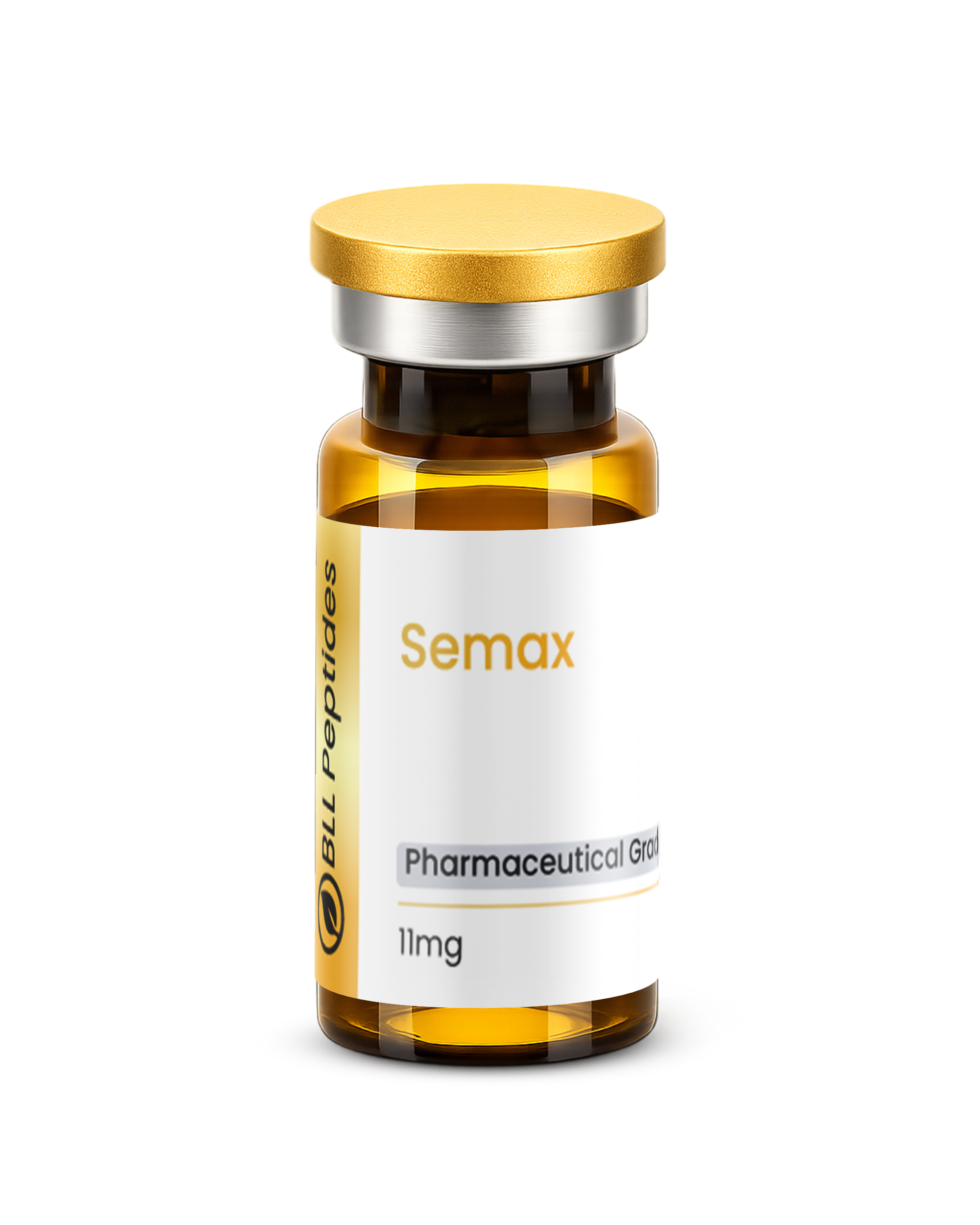
Semax (Met-Glu-His-Phe-Pro-Gly-Pro) is a synthetic heptapeptide analog of ACTH(4-7) — a fragment of adrenocorticotropic hormone — extended at the C-terminus with a Pro-Gly-Pro tripeptide to dramatically improve metabolic stability and CNS bioavailability. It was developed at the Institute of Molecular Genetics of the Russian Academy of Sciences and has held clinical approval in Russia for stroke recovery, TBI rehabilitation, and cognitive impairment since the 1990s.
Unlike purely synthetic research peptides built from scratch, Semax is derived from a naturally occurring hormonal fragment. ACTH(4-7) carries intrinsic biological activity — including melanocortin receptor interaction and neurotrophin signaling influence. The Pro-Gly-Pro extension prevents rapid enzymatic cleavage, converting a short-lived fragment into a stable research compound with measurable CNS penetration. What distinguished Semax in my literature review wasn’t just its origins — it was the breadth of mechanisms converging on neural function, and the quality of the BDNF data specifically.
How Semax Works: BDNF Upregulation, Melanocortin Receptors, and Monoamine Modulation
As a neurosurgeon, I think in systems. And Semax operates across several interconnected systems simultaneously. Three primary mechanisms emerge from the research literature:
BDNF and TrkB receptor upregulation: This is the mechanism I find most significant. Multiple animal studies have demonstrated that Semax dramatically upregulates both BDNF expression and the high-affinity BDNF receptor TrkB in specific brain regions — including the hippocampus and basal forebrain. One frequently cited study found BDNF mRNA elevated by up to 80-fold in hippocampal tissue following Semax administration in rodent models. BDNF is the primary neurotrophin governing synaptic plasticity, long-term potentiation, and neuronal survival. That magnitude of upregulation from a small peptide is not something you encounter routinely in the literature.
Melanocortin receptor interaction: Semax retains the ACTH(4-7) core, which has documented affinity for melanocortin receptor subtypes MC3-R and MC4-R. These receptors are expressed throughout the central nervous system and are implicated in cognitive function, neuroprotection, and modulation of inflammatory cascades in neural tissue. Melanocortin receptor signaling also intersects with dopaminergic pathways — relevant to the motivational and attentional effects observed in Semax behavioral research.
Monoamine system modulation: Semax has been shown to influence dopamine, serotonin, and enkephalin dynamics in preclinical models. Dopamine turnover in prefrontal and striatal regions — critical for attention, working memory, and executive function — appears enhanced in Semax-treated animals. Serotonin receptor sensitivity changes have also been reported, adding an anxiolytic-adjacent dimension to its behavioral research profile.
Together, these mechanisms make Semax one of the more mechanistically differentiated neuroprotective compounds in the research literature — simultaneously driving trophic factor expression, modulating receptor-level inflammation, and tuning the monoamine dynamics that govern cognition and recovery.
What Semax Peptide Research Actually Shows
The evidence base for Semax spans four primary research domains:
Neuroprotection in Ischemia Models
This is where Semax has the most substantive preclinical data. In rodent models of focal cerebral ischemia, Semax administration significantly reduced infarct volume and improved neurological deficit scores versus untreated controls. The proposed mechanisms include reduction of oxidative stress markers, suppression of pro-inflammatory cytokines (including IL-1β and TNF-α) in ischemic tissue, and enhancement of neurotrophic factor signaling in the peri-infarct zone. As a neurosurgeon who has managed stroke patients through recovery, those findings carry real weight. Early PubMed-indexed research on Semax’s neuroprotective effects in ischemia models established the foundation that subsequent work has continued to build on.
Cognitive Function in Animal Models
In learning and memory paradigms — including the Morris water maze, radial arm maze, and passive avoidance tests — Semax-treated animals consistently outperform controls on acquisition and retention tasks. Notably, these effects are most pronounced in models where cognitive performance is challenged: animals subjected to hypoxia, early-life stress, or cholinergic lesions show the largest Semax response. This suggests the compound may be particularly relevant in models of cognitive vulnerability rather than simply enhancing baseline performance in healthy subjects.
Optic Nerve and Visual System Research
An area I didn’t expect to find — but one that makes clear mechanistic sense — is Semax research in optic nerve pathology. Pilot clinical research in Russia explored Semax in patients with optic nerve disease, with findings suggesting measurable improvements in visual acuity and electrophysiological parameters. Given the optic nerve’s anatomical status as central nervous system tissue, this intersects directly with my own clinical interests in neural tissue recovery and trophic support.
Neuroinflammation and Immune Modulation
Because of its ACTH-derived core, Semax also demonstrates immunomodulatory activity — specifically, modulation of genes involved in innate immune response within neural tissue. This positions Semax at the intersection of neuroinflammation and neuroprotection research, an area of rapidly growing interest as the field develops a clearer picture of how inflammatory cascades in the CNS contribute to both acute injury and chronic neurodegeneration.
Key Research Findings
- Semax upregulates hippocampal BDNF mRNA by up to 80-fold in rodent models — an unusually large neurotrophin response for a peptide compound
- Significantly reduces infarct volume in focal cerebral ischemia models, with accompanying improvement in neurological deficit scores
- Enhances dopamine turnover in prefrontal and striatal regions, with measurable effects on attention and working memory in behavioral paradigms
- Suppresses pro-inflammatory cytokines IL-1β and TNF-α in ischemic neural tissue, suggesting a neuro-anti-inflammatory mechanism alongside direct neuroprotection
- Holds Russian regulatory approval for stroke rehabilitation, TBI recovery, and cognitive impairment — a human research context rare among peptides in this category
- Demonstrates greatest cognitive effect in challenged models: hypoxia, cholinergic deficit, and chronic stress paradigms show the largest performance gains
The 80-fold BDNF upregulation documented in hippocampal tissue — from a single small peptide — is the kind of finding that stops you mid-literature review and sends you back to confirm the methodology. It did for me.
Semax and Complementary Research Compounds at BLL Peptides
Researchers exploring neuroprotective and neurotrophin-modulating compounds frequently examine Semax alongside other mechanistically distinct peptides. BPC-157 covers the angiogenesis and tissue repair angle — particularly relevant for researchers interested in the vascular component of neural recovery post-injury. NAD+ offers a complementary lens on mitochondrial biogenesis and sirtuin pathway activation, which intersect with the neuroenergetic demands of recovery from ischemia and oxidative challenge. For researchers examining melanocortin receptor biology specifically — directly relevant to understanding Semax’s receptor-level mechanisms — our PT-141 research compound page covers the MC receptor system in depth.
This content is intended for research purposes only. BLL Peptides products are not intended for human consumption.
Frequently Asked Questions About Semax
What is Semax derived from?
Semax is a synthetic heptapeptide derived from ACTH(4-7) — a biologically active fragment of adrenocorticotropic hormone. The natural ACTH(4-7) fragment has very short plasma stability; Semax extends it with a Pro-Gly-Pro C-terminal sequence to dramatically increase metabolic resistance and enable meaningful CNS bioavailability in research models.
Why does Semax upregulate BDNF so dramatically?
The precise mechanism is still being characterized. The leading hypothesis involves activation of transcription factors downstream of melanocortin receptor signaling (particularly MC3-R and MC4-R), which converge on BDNF gene promoter regions. The Pro-Gly-Pro extension may also contribute through independent neurotrophin-stimulating activity — similar Pro-Gly-Pro-containing compounds have shown BDNF-inducing properties in other research contexts.
Is Semax the same as Selank?
No — though both are synthetic peptides developed at the Institute of Molecular Genetics of the Russian Academy of Sciences, they have distinct structures and primary research profiles. Semax is ACTH-derived and studied primarily for neuroprotection and cognitive function. Selank is tuftsin-derived and studied primarily as an anxiolytic compound. Both upregulate BDNF, but through distinct receptor-level mechanisms.
What clinical conditions has Semax been studied in?
Semax has been studied in clinical research contexts in Russia for stroke recovery, traumatic brain injury rehabilitation, optic nerve disease, and cognitive impairment. It holds Russian regulatory approval for these applications — a level of clinical investigation that is relatively uncommon for peptides in this research category and provides a meaningful human data context alongside the extensive animal model literature.
What research areas benefit most from Semax’s BDNF upregulation?
Research domains where BDNF signaling is a primary variable — including neuroplasticity, memory consolidation, post-ischemic recovery, and models of cognitive aging — are most directly served by Semax’s trophic factor profile. BDNF’s role in synaptic long-term potentiation makes Semax particularly relevant for researchers investigating the molecular basis of learning and memory under both normal and pathological conditions.
About the Author
Dr. James is a board-certified neurosurgeon and member of the BLL Peptides research advisory team. With decades of surgical experience and a focused interest in neural recovery, neuroprotection, and the emerging science of signaling peptides, Dr. James regularly reviews preclinical literature and translates complex findings for clinicians and researchers working at the frontier of neuroscience.
This content is intended for research purposes only. BLL Peptides products are not intended for human consumption.