

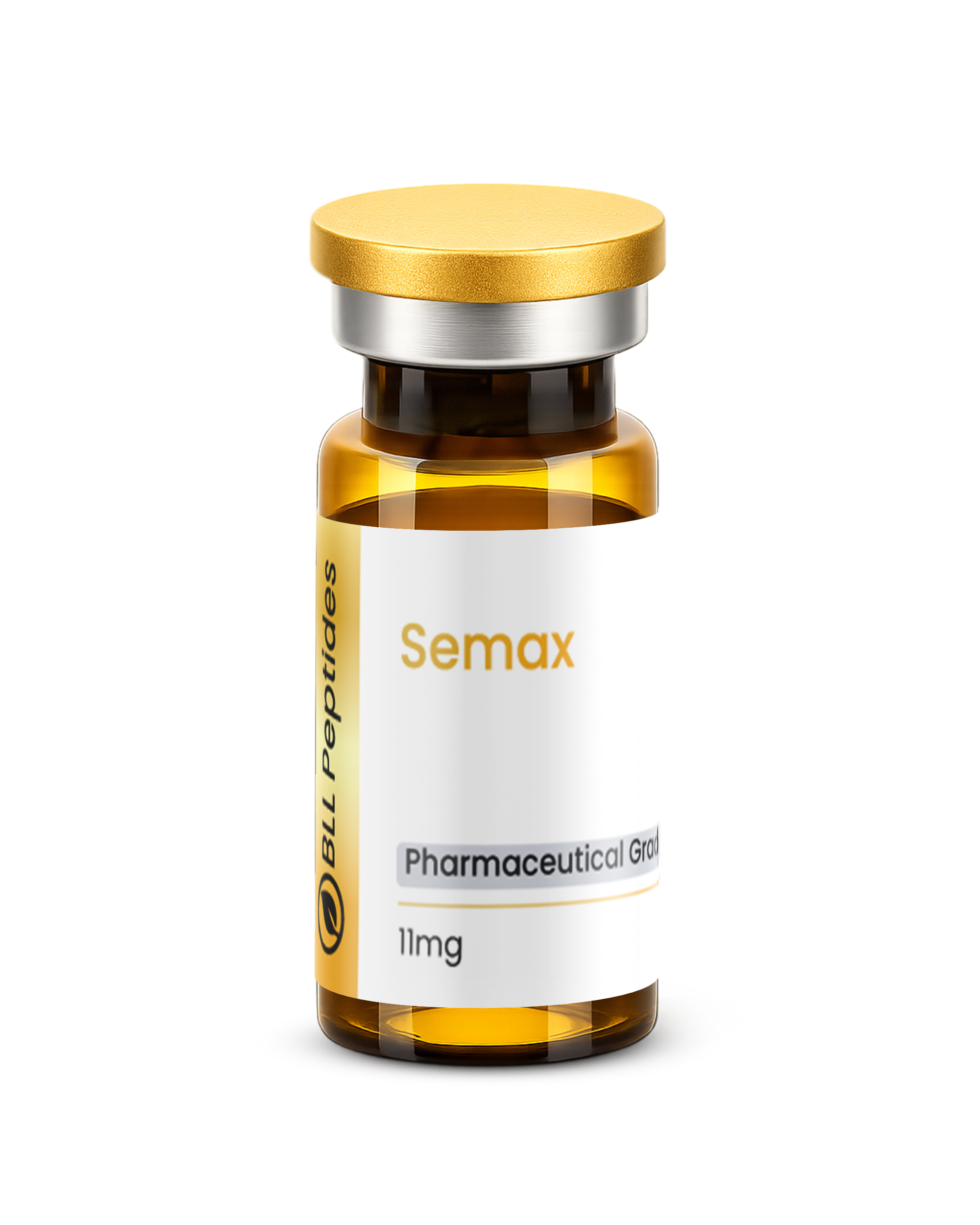
After two decades operating on the human brain, I’ll admit something that still surprises me: I learned more about neuropeptide signaling from a handful of Russian research papers than from anything in my formal training. That’s not a criticism — it’s a measure of how fast this field is moving. And right now, Semax peptide research is moving faster than almost anything else I follow.
Semax peptide research focuses on a synthetic heptapeptide analogue of ACTH(4–10) — the sequence Met-Glu-His-Phe-Pro-Gly-Pro (MEHFPGP), modified with a stabilizing Pro-Gly-Pro C-terminal extension. Originally developed in Soviet-era Russia at the Institute of Molecular Genetics, Semax has since accumulated a substantive body of peer-reviewed literature exploring its potential roles in neuroprotection, cognitive modulation, and neuroplasticity. What makes it genuinely compelling from a neuroscience perspective is how it appears to intersect with brain-derived neurotrophic factor (BDNF) signaling — one of the most clinically important proteins in all of neurobiology.
What Is Semax?
Semax is a synthetic peptide derived from adrenocorticotropic hormone (ACTH), specifically the fragment known as ACTH(4–10). Researchers enhanced the original fragment by adding a C-terminal Pro-Gly-Pro sequence, which dramatically increases metabolic stability compared to the native peptide. This modification allows Semax to resist enzymatic breakdown far more effectively than ACTH itself — a critical factor for any compound intended for sustained research applications.
Importantly, Semax does not bind to classical ACTH receptors, nor does it trigger adrenal responses. Its mechanism is distinct — and, if the literature is to be believed, considerably more sophisticated. Rather than working through the standard HPA axis, Semax appears to act primarily through neurotrophic factor regulation and modulation of central monoamine systems.
How Semax Works: What the Research Suggests
The mechanistic picture researchers have been assembling is genuinely unusual. Semax appears to significantly upregulate BDNF expression in ischemic brain tissue models — by as much as 140% compared to controls in some studies. For context: BDNF is the single most important neurotrophin in the adult brain. It supports neuron survival, promotes synaptic plasticity, and is a central driver of learning and memory consolidation. Finding a small synthetic peptide that reliably upregulates BDNF without the off-target effects of broader neurotrophic interventions is exactly the kind of thing that gets neuroscientists excited.
A landmark 2009 study published in Molecular Biology and indexed on PubMed (PMID: 19086254) found that Semax modulated expression of over 80 genes in rat brain tissue following ischemia — spanning immune response pathways, synaptic transmission, and neuroplasticity networks simultaneously. Finding a single compound that touches all three of those categories at once is, to put it plainly, scientifically unusual.
Additional pathways under active investigation include:
- Serotonergic modulation: Research suggests Semax may influence serotonin receptor sensitivity in limbic structures, with potential implications for mood and stress response research
- Dopaminergic activity: Animal studies have observed changes in dopamine turnover in the striatum following Semax exposure
- NGF co-regulation: Some studies report upregulation of nerve growth factor (NGF) alongside BDNF, suggesting a broader neurotrophic effect rather than a single-target mechanism
- NF-κB pathway modulation: Semax appears to interact with neuroinflammatory signaling cascades, a finding of increasing relevance to neuroimmunology research
What Semax Peptide Research Has Found So Far
The bulk of published Semax research comes from Russia, where the peptide has been studied extensively since the 1980s. This sometimes draws skepticism in Western circles — but dismissing the data outright would be a scientific error. The methodology is sound, and several key findings have been independently replicated.
The convergence of BDNF upregulation, dopaminergic modulation, and anti-inflammatory activity in a single small peptide is scientifically unusual — and scientifically significant.
Key findings across the literature include:
- Cerebral ischemia models: Multiple animal studies report neuroprotective effects — reduced infarct volume and improved behavioral recovery outcomes — in experimental stroke models
- Cognitive performance studies: Rodent studies have documented improvements in memory consolidation tasks and maze performance in animals with experimentally induced cognitive deficits
- Gene expression profiling: Genomic analyses have associated Semax with altered expression of 80+ genes in ischemic tissue — a finding that has opened new lines of inquiry into neuropeptide-genome interaction
- BDNF persistence: Research has documented that Semax’s effects on BDNF expression persist beyond the peptide’s active half-life, suggesting it may trigger durable downstream gene expression changes rather than simply acting as a transient receptor ligand
- Optic nerve research: A smaller body of literature from Russian clinical contexts has explored Semax in optic neuropathy settings, though this work remains early-stage by Western standards
Related Peptide Research at BLL Peptides
Researchers studying neuroprotective and neurotrophic peptide mechanisms often explore compounds in parallel. BLL Peptides offers several research-grade peptides relevant to adjacent areas of study:
- BPC-157 — a pentadecapeptide studied extensively in CNS and peripheral nervous system research contexts, with a large published literature on tissue signaling
- NAD+ — a coenzyme central to mitochondrial energy metabolism, increasingly studied alongside neurotrophic factors in neuronal health research
All BLL Peptides products are manufactured in the USA under GMP-certified conditions and are supplied strictly for research purposes. Explore the full catalog at bllpeptides.com.
Frequently Asked Questions About Semax Peptide Research
What is Semax and why is it drawing scientific attention?
Semax is a synthetic heptapeptide analogue of ACTH(4–10), engineered for metabolic stability with a C-terminal Pro-Gly-Pro extension. It’s drawing scientific attention primarily because of its apparent ability to upregulate BDNF, modulate central monoamine systems, and show neuroprotective effects in animal ischemia models — all without the hormonal side effects associated with ACTH itself.
How does Semax differ from ACTH?
Although structurally derived from ACTH, Semax does not bind classical ACTH receptors and does not stimulate adrenal cortisol production. Its biological activity operates through distinct mechanisms — primarily neurotrophic factor regulation (BDNF, NGF) and modulation of gene expression in nervous tissue — rather than through the HPA axis.
What is the connection between Semax and BDNF?
BDNF (brain-derived neurotrophic factor) is a protein essential to neuron survival, synaptic plasticity, and memory formation. Multiple studies have found that Semax upregulates BDNF expression in ischemic brain tissue models — in some cases by approximately 140% compared to controls — making BDNF modulation one of the central research questions in the Semax literature.
Is Semax approved for clinical use?
In Russia, Semax has been used in pharmaceutical contexts for decades. It is not approved by the FDA for clinical use in the United States. In Western research settings, it is studied as a research peptide only and is not intended for human use outside of formally approved clinical trials.
Where can researchers access peer-reviewed Semax studies?
PubMed is the best starting point. Searching “Semax neuroprotection,” “Semax BDNF,” or “ACTH 4-10 analogue brain” will surface the key literature. Much of the foundational work comes from teams at the Institute of Molecular Genetics in Moscow, though Western groups have begun contributing replications and extensions in recent years.
About the Author
Dr. James is a board-certified neurosurgeon with over two decades of clinical and surgical experience. Outside the operating room, he maintains an active interest in the emerging science of neuropeptides and their potential implications for brain health research. He serves as a scientific advisor to Better Life Lab and BLL Peptides, contributing research summaries and evidence reviews to help researchers stay current with developments in peptide biology. His writing represents scientific inquiry, not medical advice.
This content is intended for research purposes only. BLL Peptides products are not intended for human consumption.